
When the Court Came to Campus
November 09, 2026
November 09, 2026
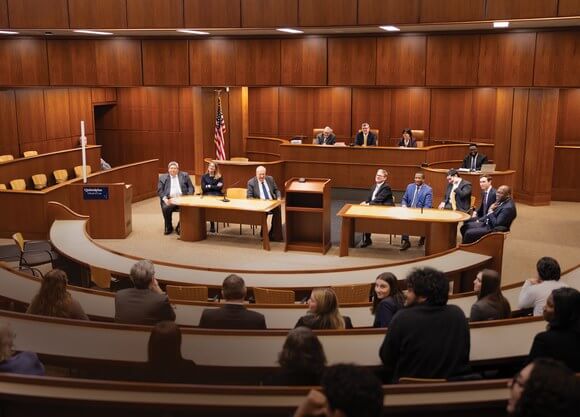
A hush settled over the Brooke A. Goff Courtroom as three federal appellate judges took the bench. Conversations ceased. Students sat a little straighter. Attorneys gathered their notes. Then, with the strike of a gavel, a Quinnipiac classroom became one of the nation's most important courtrooms.
For the first time in School of Law history, the U.S. Court of Appeals for the Second Circuit — one of 13 federal appellate courts, just below the U.S. Supreme Court — held a live session on campus, giving students a firsthand look at the questioning, advocacy and legal reasoning that define appellate practice.
The visit was historic.
The opportunity it offered students was not.
Just months earlier, Quinnipiac welcomed the Connecticut Appellate Court to campus for oral arguments, giving students the rare chance to observe both state and federal appellate courts in action during the same academic year.
Together, the visits underscored a defining feature of a Quinnipiac legal education: students don't just study the law. They experience it. It's an approach rooted in the school’s philosophy of educating the whole lawyer by developing both the mind and the heart through rigorous legal training, practical experience and a commitment to professionalism and service.
"Hosting the court aligns squarely with our commitment to educating the whole lawyer by preparing students for practice from day one," said School of Law Dean Brian Gallini. "Seeing federal judges engage with advocates offers students a level of insight that simply cannot be replicated in a classroom. It demystifies the process and makes the work feel more accessible and tangible."
For Quinnipiac Law students, opportunities to learn from judges, practicing attorneys and real clients aren't enhancements to their education; they're central to how Quinnipiac prepares future lawyers.
"Moments like the Second Circuit's visit are powerful not just because of their visibility, but because of what they represent," Gallini said. "They reflect a law school committed to connecting students with the real work of the profession by bringing the bench, the bar and the classroom into closer alignment."
The Second Circuit's appearance was part of the court's On Circuit outreach program, which brings federal appellate proceedings to communities across Connecticut, New York and Vermont. During the session, U.S. Circuit Judges José A. Cabranes, William J. Nardini and Maria Araújo Kahn heard oral arguments in three federal appeals spanning corporate liability, criminal procedure and constitutional rights. Because the cases remained under consideration, students instead focused on watching the judges question attorneys, test legal arguments and evaluate complex legal issues.
Gallini said Quinnipiac's philosophy of educating the whole lawyer prepares students to be both practice-ready and purpose-ready graduates by developing professional judgment, communication skills, ethics and a commitment to service. Beginning in the first year, Bridge to Practice, Quinnipiac Law's signature program, guides students from foundational coursework through hands-on legal experience, bar preparation and the transition into practice.
This comprehensive approach has earned Quinnipiac Law national recognition for experiential learning while helping attract one of the strongest incoming classes in the law school's history, marked by the highest median undergraduate GPA on record and a 37% increase in applications.
For Shianne Taylor, JD '26, former president of the Student Bar Association, watching the Second Circuit transformed years of classroom instruction into something tangible.
"We read opinions all the time," Taylor said. "But seeing the passion of the advocates and how judges pushed both sides respectfully helped me understand the process in a completely different way."
After the arguments, students, alumni and members of the Quinnipiac community joined the judges and attorneys for a question-and-answer session, while a smaller group of students met with the judges and their clerks over lunch to discuss career paths and judicial clerkships.
"The lunch was a meaningful opportunity for our students to connect with leaders in the profession in an informal way," said Millie VandenBroek, associate dean of career development. "Events like the Second Circuit visit bring the law to life, right on campus."
VandenBroek said conversations with judges and clerks often inspire students to pursue judicial clerkships, experiences she describes as among the most valuable ways for new attorneys to begin their careers.
For Liam Drobny, MBA '26, JD '26, the day's lessons extended well beyond the oral arguments.
After the proceedings, Drobny was part of the group invited to join the judges for lunch, where he was struck by how approachable they were.
"Effective appellate advocacy requires a deep understanding of the law, the ability to think critically in the moment, and the confidence to turn an argument into a conversation with the court," Drobny said. "Experiences like this reflect Quinnipiac's commitment to connecting students with the profession. They balance what we learn in the classroom with real-world experience."
The event's appeal extended beyond current students. When Brett Aiello '08, JD '11, heard the Second Circuit was coming to Quinnipiac, the former Connecticut state prosecutor returned to campus, eager to experience the court session firsthand. Aiello believes experiences like these help students make the transition from studying law to practicing it.
"I've argued cases in our state appellate courts, but I'd never had the opportunity to watch a federal appellate argument," Aiello said. "Having high-level advocacy brought directly to students is an invaluable experience. Opportunities like this help bridge theory and practice and can inspire students to pursue appellate work themselves."
For Gallini, the Second Circuit's visit reflected the kind of legal education Quinnipiac strives to deliver every day.
"There is a strong sense of momentum here grounded in student success, experiential opportunity and a commitment to preparing graduates who are ready to contribute from day one," Gallini said. "Just as importantly, we're educating lawyers equipped with the knowledge, judgment and integrity to lead, while continuing to build a community grounded in access, professionalism and service."

Megan (Martucci) Parlanti ’18, MBA ’19, hasn’t just found her calling at work. She’s made it the purpose that drives her career.
Read More
Projects Day and Illuminate showcase student innovation across disciplines
Read More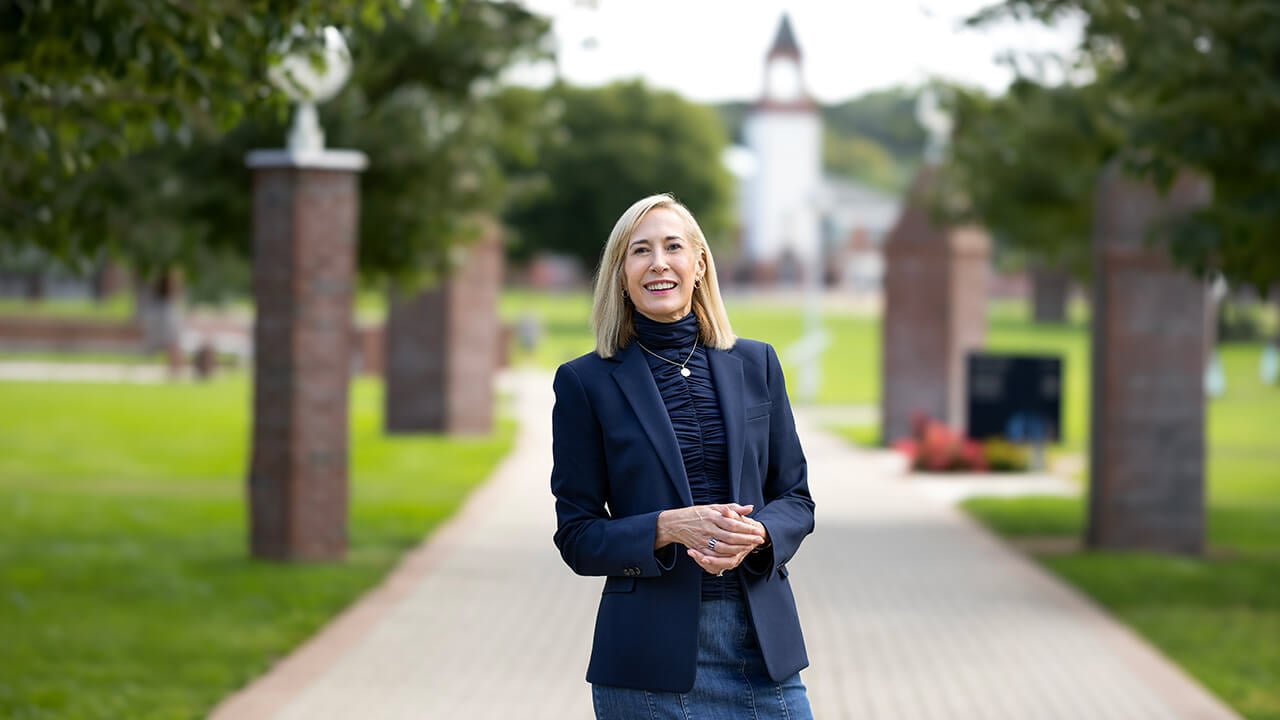
One of my favorite times of the year takes place when our new students arrive on campus.
Read More
As editor of Quinnipiac Magazine, one of my favorite jobs is compiling our story list. The ideas sprout from every corner of our community — the musings of my colleagues, the conversations with faculty and staff, and, of course, the email submissions of our alumni.
Read More
The world of communication is changing. At Quinnipiac, students are preparing to put their skills to work wherever their careers take them.
Read More












Quinnipiac Today is your source for what's happening throughout #BobcatNation. Sign up for our weekly email newsletter to be among the first to know about news, events and members of our Bobcat family who are making a positive difference in our world.
Sign Up Now