Curiosity and listening are the antidote to today’s partisan politics, author says
February 28, 2023
February 28, 2023
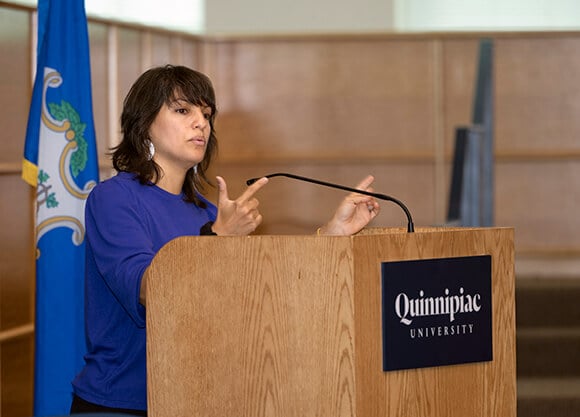
A journalist, entrepreneur and author of “I Never Thought of It That Way,” Guzmán spent two days at Quinnipiac last semester sharing her ideas for building new bridges and healing old wounds in America.
On the night of her visit, every seat was taken in the Mount Carmel Auditorium. It was one part tent revival, one part master class in civility and humility. The next day, she followed up with a provocative and illuminating workshop for faculty and staff.
“Politics today feels like it's exclusively about stopping the other side,” Guzmán said, calling out a country’s partisan warts. “But actually, politics is supposed to be about how we create societies that support all of us, in all of our differences.
“The American experiment, as imperfect as it has been, has also been amazing. We’ve made it this far,” Guzmán said proudly. “But to be able to continue to do this, we need to engage in the process. We need to visit — and revisit — how living in this world feels. Where do our norms and ideas and actions hit or miss the mark?”
The answers are reserved for the relentlessly curious, Guzmán said, the people willing to listen and ask the questions that inspire dialogue, not shut it down.
It’s not about keeping score or shouting at those who don’t think like you. It’s about dismissing the labels, stereotypes and generalizations that foster contempt rather than connection.
“The archvillain of curiosity is certainty,” Guzmán said flatly.
Politics and partisanship aren’t tone deaf in Guzmán’s world. As she mentioned several times during her talk: “People can’t hear unless they’re heard.”
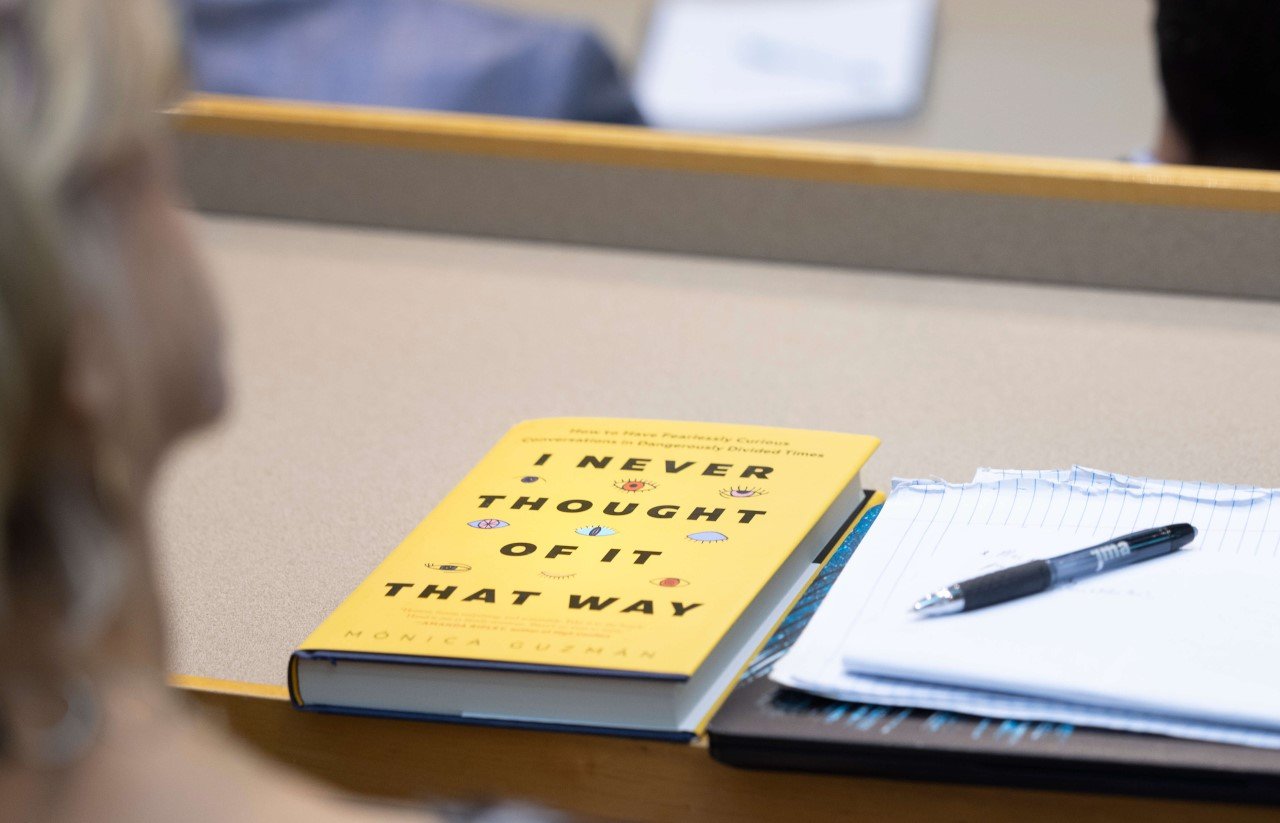
The cover of Guzmán’s book also hints at the understanding inside. Above the title is the payoff of 238 pages: “How to Have Fearlessly Curious Conversations in Dangerously Divided Times.”
Given the opportunity, Guzmán said, the worst of human nature is empowered when partisan politics becomes corrosive and manipulative.
“It all comes down to whoever is underrepresented in your life will be overrepresented in your imagination,” Guzmán said. “And if we can’t as a democracy — a messy, promising, dangerous democracy — keep some bridges, we can’t check what’s in our imagination and what’s actually true. ... Get curious about each other with each other before it’s too late. For that to happen, we need to build some bridges.”
One person and one plank at a time.
While planks clearly build bridges, they also build party platforms. During the 2016 presidential campaign, Republican nominee Donald Trump ran on a plank to build a 30-foot high wall along the U.S.-Mexico border.
Guzmán’s parents, proud Mexican immigrants and U.S. citizens, were steadfast and unwavering in their support of the GOP standard-bearer. They voted for Trump in 2016 and again in 2020.
But the political dissension in Guzmán’s family started long before that. She remembers the day everything changed in painstaking detail.
“There was a day in the year 2000. I was in high school. We had just become American citizens, my family and I,” she said. “And I plopped my backpack down in the office at my house, and I looked up and I saw a Bush-Cheney sign over my mother’s desk. And my eyes just went wide.”
Suddenly, everything — and nothing — made sense. The fiery debates at the dining room table raged on. So did the intense political theater in the car. At one point, a good friend offered her this advice: “You know what I think? I think you have one job here. You either change your parents — or you forget them.”
Neither option was acceptable to Guzmán. Her family’s love was unconditional, non-negotiable and off-limits.
It would’ve been easy to grab the nearest social flamethrower and torch the relationship with her parents. Instead, Guzmán learned to separate the views from the person. More importantly, she learned to listen and be curious.
But old habits die hard, especially when people and politics are demonized in America.
“One of the most pernicious ways we do this I found, particularly in these divided times, is when we assume that someone who opposes what we support must hate what we love,” Guzmán said.
Suddenly and intentionally at the podium, Guzmán’s applied the pronoun “they” to her teachable examples of this toxic partisanship.
“They wanted to defund the police when crime is up. They wanted to make it easier to buy guns when school shootings are on the rise," Guzmán said. “They must hate the need to be safe.
“They want to force me to carry a pregnancy I don't want. They want to inject a vaccine into my body that I don't trust,” she added. “They must hate my need to breathe.”
So what’s left, Guzmán asked rhetorically.
“Rather than ask what people think about guns, abortion and the latest campus controversy, ask what concerns they have,” Guzmán said.
“And when they tell you those concerns, the follow-up question is, ‘Do you have any more?’ Then share your own concerns. Putting it all on the table gathers the knowledge that reveals the gas that gets your curiosity engine going before your judgment blinks.”
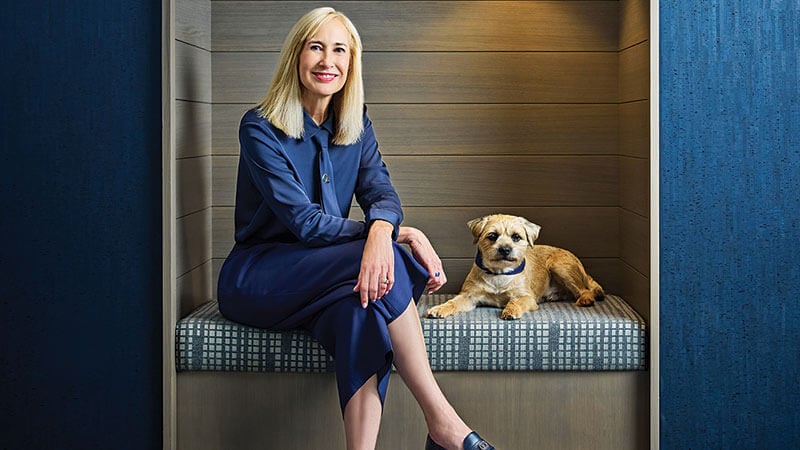
In my first few months at Quinnipiac, what’s captured both my attention and my heart is the sense of pride across our community.
Read More
The gasps of joy never happen after one visit. It might take weeks. Months. Maybe longer.
Read More
Elena Giacomini MBA ’25, MS ’26, returned to the Quinnipiac women’s volleyball team for another graduate season after a stellar debut in which she excelled on the court and in the classroom while bringing the Bobcats to the brink of the NCAA Tournament.
Read More
Last spring, as he contemplated a basketball future outside of Hamden, Amarri Monroe ’26 was steered by more than his heart.
Read More
As a kid growing up in Ramsey, New Jersey, Russell Anderson ’04 loved tinkering with technology. After his dad bought him some old video equipment at a garage sale, Anderson became the neighborhood kid running around with a huge Betacam camera perched on his shoulder.
Read MoreGet the latest news and events sent right to your email by subscribing to Quinnipiac Today
Subscribe