
Bright Ideas, Real Impact
November 09, 2026
November 09, 2026

When Superstorm Sandy struck in 2012, Kaitlyn McVeigh ’26 saw firsthand the impact extreme weather can have on communities. Years later, McVeigh is using data science to explore how technology can help predict what comes next.
A data science major with minors in law in society and Irish studies, McVeigh applied machine learning techniques to nearly two decades of New York City weather data. By comparing predictive models and analyzing several factors, including temperature, humidity and wind patterns, she examined how AI can identify environmental trends and improve forecasting accuracy.
As artificial intelligence reshapes industries and redefines the skills graduates need to succeed, Quinnipiac students aren’t simply learning how to use these new tools. They’re learning how to leverage them to ask better questions.
McVeigh was among hundreds of students who shared their research this spring at Projects Day and Illuminate to showcase how curiosity, creativity and innovation can lead to solutions with real-world impact.
“It’s incredible to see so many students presenting their work and passions, and to be able to focus on what we’re interested in and share that with each other,” McVeigh said. “In our classes, we were able to explore topics we’re passionate about and use data science to bring those ideas to life. It has really enhanced my education here.”
At Projects Day, students demonstrated that mindset through AI-powered applications, engineering solutions and technology designed to address real-world challenges.
“Over the past decade, the School of Computing & Engineering has grown tremendously, preparing our students to succeed and lead in an ever-evolving technological world,” School of Computing & Engineering Dean Taskin Kocak said. “These projects are a powerful reflection of that progress and the bright future ahead.”
That spirit of innovation extended throughout The SITE during Illuminate, where more than 600 students showcased research, scholarship and creative work — from scientific discoveries and business ideas to digital art, game design and live music.
“This is a very important part of what we do here at Quinnipiac — involving students in hands-on, high-impact experiences, whether it’s research in the sciences, business or humanities, or creating games, including some that are award-winning,” said Illuminate 2026 event organizer Pat Boily, professor of biology and associate dean for administration and finance.
From AI-powered tools designed to reduce food waste and improve accessibility to future scientific discoveries and support for deaf and hard-of-hearing patients, students demonstrated that innovation begins with a question. At Projects Day and Illuminate, Quinnipiac students set out to answer them.
“When creative research is presented alongside scientific and academic research, connections between ideas and disciplines begin to emerge that might otherwise go unnoticed,” said Nicole James, visiting assistant professor of digital visual arts. “It really highlights the complexity of student talent, passion and academic curiosity at Quinnipiac.”
Developed by Reeya Patel ’26, MS ’27; Megan Mohr ’26, MS ’27 and Adelina Chocho ’26, MS ’27.
Every year, millions of households throw away food simply because people lose track of what they already have. A team of Quinnipiac students saw an opportunity to use artificial intelligence to change that.
The students developed ScrapDish, an AI-powered mobile application designed to reduce household food waste by helping people track ingredients, monitor expiration dates and create personalized recipes based on what food they already have available.
The app uses advanced technologies such as object detection, optical character recognition to capture expiration dates from packaged food, speech-to-text capabilities and a conversational assistant to make sustainable choices easier — showing how technology can turn everyday challenges into opportunities for change.
Developed by Eric May ’26, MS ’27; Shawn Acheampong ’26, MS ’27; Morgan Montz ’26, MS ’27; Evan Vastakis ’26, MS ’27; Kiernan Boyle ’26, Nicholas Farrell ’26, Alexander Michel ’26, Zachary O’Connell ’26 and Cade Wetter ’26.
For millions of people in the Deaf community, communication barriers can limit access, connection and understanding. An interdisciplinary team of Quinnipiac students explored how technology could help close that gap.
The team’s spoken English-to-American Sign Language (ASL) translation robot was designed with a focus on creating more inclusive spaces for the Deaf and hard of hearing community. The robot captures spoken English, converts it to text and transforms the text into ASL gloss tokens, which are written in ALL CAPS to show they represent a sign rather than an English word.
For example, POSS-1 CAT NAME fs-QUINNIPIAC in gloss represents, “My cat’s name is Quinnipiac.” In this example, POSS-1 means “my” in the first person and fs-QUINNIPIAC means finger spell Quinnipiac.
For Nicole Wijendra ’26, discovery began with a simple question: What does this do?
That question centered on SE_1780, a little-understood protein from Staphylococcus epidermidis, a common skin bacterium that can sometimes cause infections.
A biochemistry major with a microbiology/immunology minor, Wijendra combined computational analysis with laboratory testing to predict and validate the protein’s function, discovering that it likely helps break down certain types of fats. By helping define mystery proteins in the Protein Data Bank — proteins whose function is currently unknown — her research could one day support the discovery of new antibiotic targets.
After graduating in May, Wijendra joined the research and development team at EnviroLogix, building directly on the skills she developed in Quinnipiac’s labs.
When Rachel Jasiczek, MS ’26, learned her daughter was diagnosed with a SYNGAP1-related disorder, she began searching for answers. SYNGAP1-related disorders are rare genetic conditions that affect brain development and can cause challenges with learning, communication and daily living skills.
That journey brought her back to the classroom with a bigger question: How can educators help children learn when traditional approaches don’t meet their needs?
Jasiczek, a graduate student in the special education master’s program, focused her research on improving reading outcomes for students with SYNGAP1-related disorders.
Her work explored how structured, evidence-based literacy instruction, paired with stronger collaboration between educators and families, can improve reading skills and create more consistent learning experiences between the classroom and home.

Want to learn what Quinnipiac is all about? We invite you to join us at an Open House, where our students, faculty and staff will introduce you to life as a Bobcat through a variety of sessions and tours.

Megan (Martucci) Parlanti ’18, MBA ’19, hasn’t just found her calling at work. She’s made it the purpose that drives her career.
Read More
One of my favorite times of the year takes place when our new students arrive on campus.
Read More
As editor of Quinnipiac Magazine, one of my favorite jobs is compiling our story list. The ideas sprout from every corner of our community — the musings of my colleagues, the conversations with faculty and staff, and, of course, the email submissions of our alumni.
Read More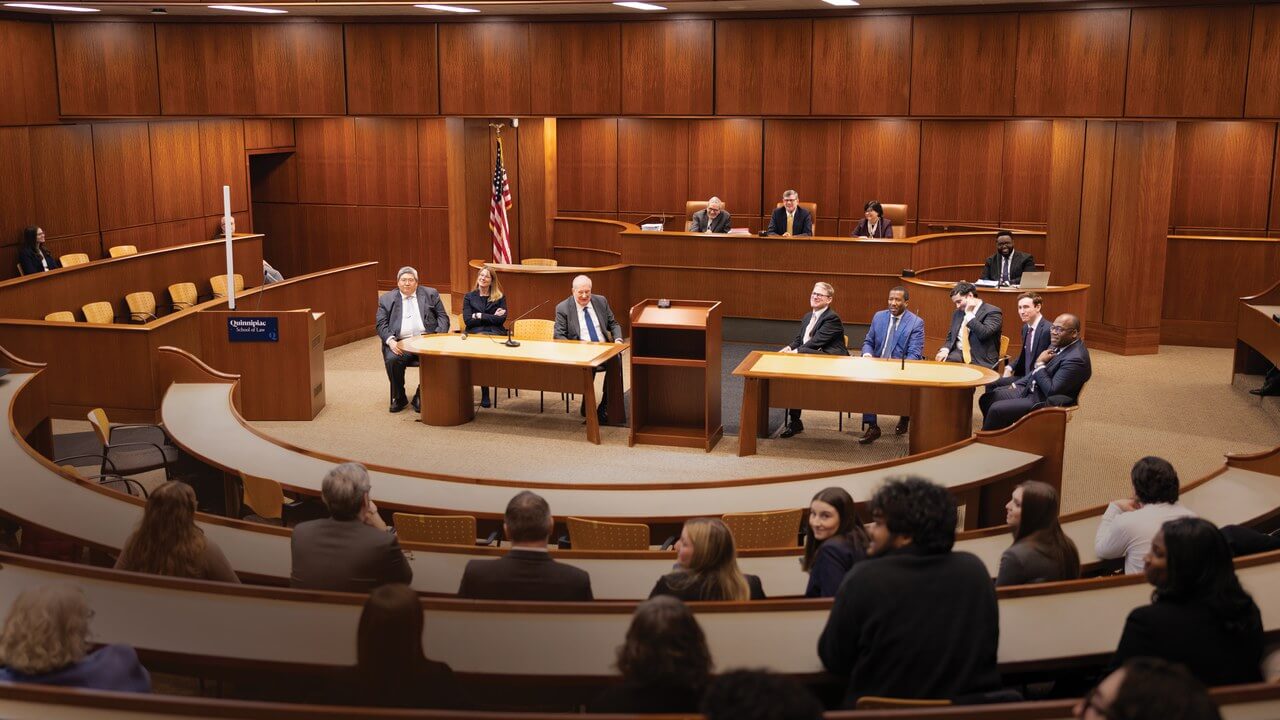
A historic visit from the U.S. Court of Appeals for the Second Circuit offered a powerful example of Quinnipiac Law's nationally recognized approach to experiential legal education.
Read More
Moments after the final burst of the goal horn, Rand Pecknold emerged from all the hugs on the Quinnipiac bench, brushed a tear from his cheek and felt his feet slide beneath him as he stepped onto the ice at Amalie Arena.
Read More




Quinnipiac Today is your source for what's happening throughout #BobcatNation. Sign up for our weekly email newsletter to be among the first to know about news, events and members of our Bobcat family who are making a positive difference in our world.
Sign Up Now