



Transformative BSN program redesign gains national attention for innovative paradigm shift in nursing education
February 03, 2026
February 03, 2026

The innovative curriculum redesign reinforces Quinnipiac’s position as a national leader in preparing practice-ready nurses equipped to meet the demands of an increasingly complex healthcare environment.
With the goal of producing nurses who are confident, adaptable and fully prepared for practice from day one, the sweeping overhaul reexamined both what is taught and how instruction is delivered. Development of the innovative curriculum redesign involved deconstructing the long-standing lecture-exam paradigm and organizing the curriculum around intentional skill building.
Students entering Quinnipiac School of Nursing’s 15-month accelerated BSN program in January 2026 are the first class to experience the redesigned curriculum before it rolls out for implementation across the school’s BSN programs.
“I am excited to see the transformation in our student engagement and outcome and the shift from passive learning to active professional growth,” said Tyler Traister, assistant professor of nursing and BSN program director, “By prioritizing the durable, transferable skills that define nursing practice, we ensure our students are prepared not just to pass the NCLEX, but to thrive as effective leaders throughout their nursing career.”
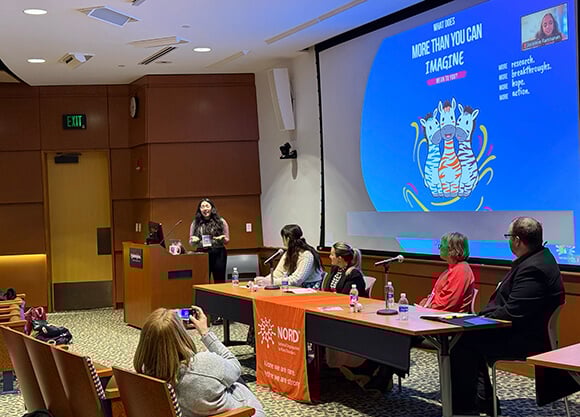
At the AACN conference, Traister and Lisa Rebeschi, senior associate dean, together with Christine Looser, senior director of strategic partnerships at The Minerva Project, jointly delivered their presentation, “A Curriculum Transformation of Baccalaureate Nursing Education to Prepare Practice-Ready Graduates.”
A highlight of the revised BSN program is its new Skills Taxonomy framework. By consistently connecting learning experiences to related skills hashtags, the program’s new architecture is built around four intentional course types — essentials, applied, inquiry and clinical. Each hashtag relates to skills practicing nurses and graduates of the program need to have, said Rebeschi.
“Our skills taxonomy gives a purpose for everything we do in the curriculum. As students are achieving these durable, transferable skills, they’re making the connection of that assignment to what we’re trying to accomplish in the program – why that assignment is important, how it ties into their learning outcomes. This makes everything very explicit as well as very trackable for us to look at across the curriculum,” said Rebeschi.
The innovative new BSN program structure also moves away from traditional, content-heavy lecture models and instead creates an evidence-based learning environment in which competency development is at the forefront. As a whole, the redesign emphasizes durable, transferable skills, strong critical thinking, and an adaptive mindset — all essential for success in rapidly evolving care settings.
While developing the new curriculum, Quinnipiac School of Nursing became the first nursing school to collaborate with global education company The Minerva Project to incorporate its science-based learning approach, including developing the skills taxonomy.
“We’re very grateful for that opportunity to work with The Minerva Project,” Rebeschi said. “As we were developing the skills taxonomy that was instrumental to us with Christine and her colleagues at The Minerva Project, they were learning about our nursing education and our standards and the essentials that our curriculum has to be based on; and how to incorporate that into a skills taxonomy.”
Statewide, Quinnipiac’s redesigned BSN program also captured the attention and interest of the Connecticut State Board of Nursing Examiners when it was successfully presented for curriculum approval.
“It’s something folks have not seen before. They’re really intrigued by the potential of not just the approach of the curriculum — the content and how we’ve structured this with the skills taxonomy — but also but how we’re teaching,” said Rebeschi.
The innovative curriculum transforms the traditional model of lectures followed by tests to involve less testing but more frequent formative assessments. In this way, students receive critical feedback on competencies and skills as they’re learning.
“That is a drastic change from traditional nursing curricula that has been laden with tests,” Rebeschi said. “Students will still have tests in our curriculum; but to the extent that testing is currently used as a main assessment to determine if students are practice ready, we’ll be looking at their knowledge, skills and competencies in a formative way across the courses and across the program.”
At the AACN conference, the Quinnipiac presenters explained the goal for the BSN program redesign wasn’t merely to update content but to fundamentally transform the learning experience.
“It was really the first time we got to speak about our new curriculum more broadly with colleagues from across the country. There was excitement in the room,” Rebeschi said.



























Quinnipiac Today is your source for what's happening throughout #BobcatNation. Sign up for our weekly email newsletter to be among the first to know about news, events and members of our Bobcat family who are making a positive difference in our world.
Sign Up Now