



Campus conversation with Mohegan Tribe Chief Lynn Malerba inspires Quinnipiac community
November 24, 2025
November 24, 2025

The first female chief in the Mohegan Tribe’s modern history, Malerba is also the first Native American to serve as the Treasurer of the United States (2022-2024). Malerba, who began her professional career as a registered nurse, also served as Director of Cardiology and Pulmonary Services at Lawrence and Memorial Hospital in New London, Connecticut.
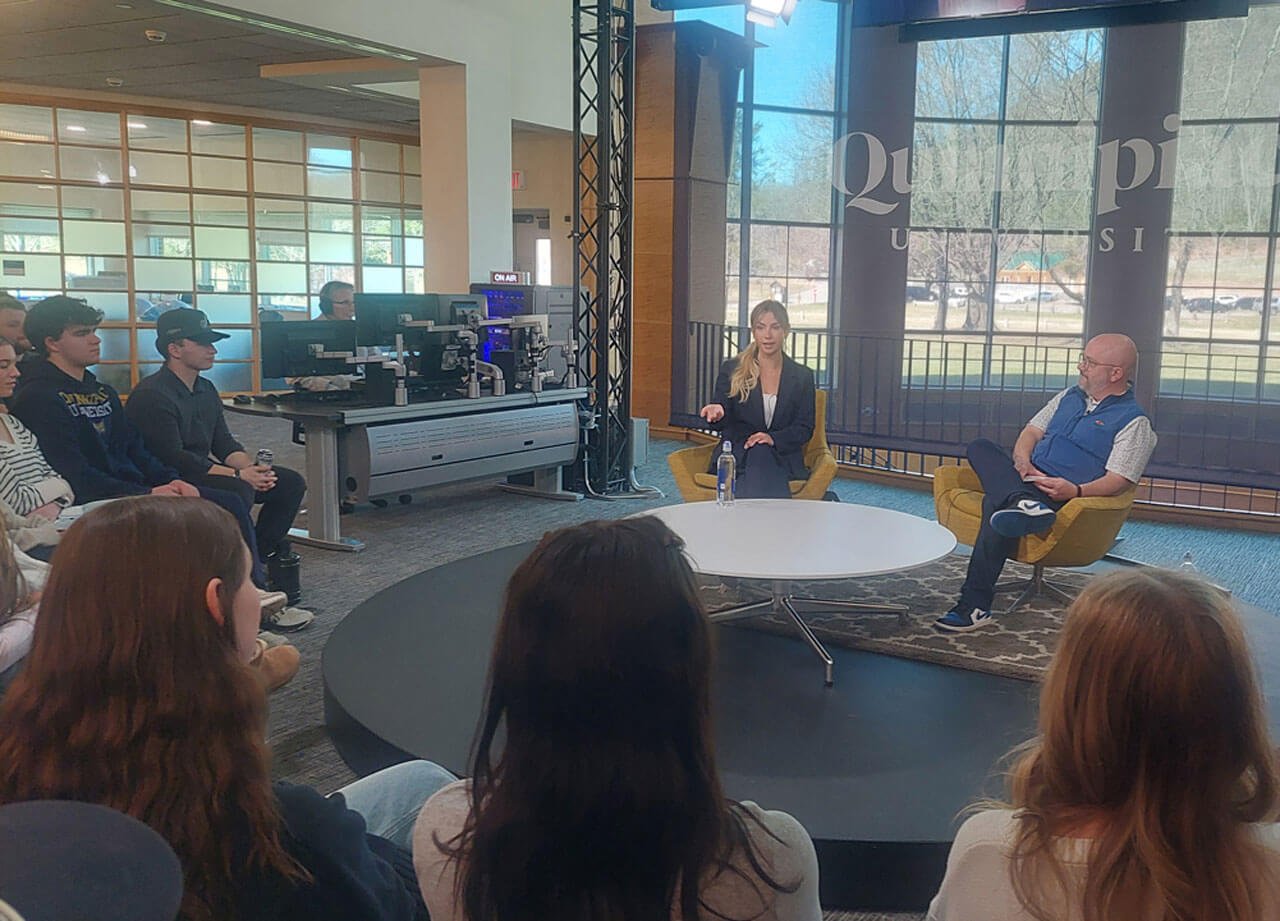
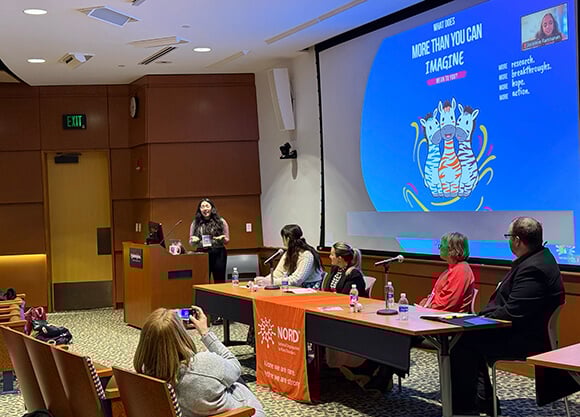
Malerba’s talk at The SITE on the South Quad of the Mount Carmel Campus gathered a full house during Common Hour on November 18 and was livestreamed to Bobcats watching at the North Haven Campus. School of Nursing Dean Larry Slater said it was an honor to have Malerba’s talk kick off the school’s Leadership Conversations Series for the academic year.
“We are very excited to have Chief Malerba here to launch our Leadership Conversations for the School of Nursing, a regular event that we hope to see going forward, which is excellently facilitated by our new Common Hour,” said Slater.
Each Tuesday and Thursday from 12:30 p.m. to 1:45 p.m., Common Hour is dedicated time for Quinnipiac students, faculty and staff to experience community engagement, cross-disciplinary collaboration, and impactful student-centered programs.
Erica Mumm, clinical associate professor of nursing, introduced Malerba to the audience.
“November is recognized as Native American Heritage Month, and here at Quinnipiac University and within the School of Nursing we believe in celebrating with and learning through all people. To honor that commitment, the School of Nursing has invited Chief Lynn Malerba to speak with you all today,” said Mumm.
Malerba, who proudly bears the name Chief Mutáwi Mutáhash (Many Hearts), opened with a welcome in the Mohegan language and shared that her tribal name was selected by the Tribe’s medicine woman.
“She said I will call you Chief Many Hearts because as a cardiology nurse, you held many hearts in your hands, and now as the chief you hold our hearts in your hands. It’s a name that I carry forward very proudly,” Malerba said.
Prior to becoming chief, Malerba served as Chairwoman of the Tribal Council and served in Tribal Government as Executive Director of Health and Human Services. Malerba was named the first female chief and the 18th chief of the Mohegan Tribe on August 15, 2010.
Malerba said leaders are not created in a vacuum independent of others; rather, they are embraced by others around them who allow them to lead. She spoke of lineage and leadership, including the strength and leadership modeled by her mother, Loretta Roberge, a Tribal Council member who achieved Federal Recognition for the Tribe and held the position of Tribal Nonner (an elder female of respect). Malerba was also greatly inspired by her great-grandfather Chief Matagha (Burrill Fielding).
“The definition of lineage can be described not only as blood lineage but also following in the footsteps of people that you admire, who have encouraged you and mentored you along the way. It may also be succeeding on the path of people who have led the way in their particular fields or led the way for enduring social change. And as nurses, I think we can all relate to social change and social justice – that’s what we’re all about,” Malerba said. “In that regard, I’m probably the luckiest woman on earth because I have been the recipient of all of the good works and encouragement of people who have been extremely influential in their roles as leaders, as relatives, and as professional mentors.”
As chief, Malerba has engaged in federal policy for the good of all of native nations. She formerly served as the United South and Eastern Tribes Board of Directors Secretary; Chairwoman of the Tribal Self-Governance Advisory Committee of the Federal Indian Health Service; and as a member of the Justice Department’s Tribal Nations Leadership Council; the Tribal Advisory Committee for the National Institute of Health; the Treasury Tribal Advisory Committee; and the Federal Reserve Bank of Minneapolis Center for Indian Country Development Leadership Council.
“What I found was when you’re offered a seat at the table it is important to ensure that you are very clear about what it is you are trying to accomplish via policy and guidance, and how you imagine that progress; but also how you will keep the United States faithful to their trust and treaty obligations,” said Malerba.
Recognized Native American tribes are political governments which have a political relationship with the United States.
“It is a government-to-government relationship. We have tribal citizens, not tribal members, and that is exactly how we engage with the federal government and they do have that trust and treaty obligation to engage with us,” said Malerba.
The U.S. government’s trust responsibility is a moral obligation to ensure protection of tribal and individual Indian lands, assets, resources, and treaty and similarly recognized rights. Malerba noted, however, that the United States has repeatedly failed to keep its promises, as reflected in the health statistics and social determinants affecting Indigenous people.
“We want the United States to live up to their obligations in the form of health care and education; and we want to make sure that all of the social programs that contribute to the social determinants of health are protected, as well,” said Malerba.
At one time, 100% of the United States were tribal lands. Today, 5% of the country is made up of tribal lands, she said.
“Our history is not taught, but it’s one of dispossession, genocide and broken promises by the United States,” Malerba said. “I think that we need to acknowledge what happened and acknowledge that we can and should do better. And that’s what I believe my role has been as a tribal leader. To engage with the federal government, to educate the federal government, and make sure that they understand what their responsibilities are.”
The Mohegan Tribe, and most of the tribes in the Northeast, lost 90% of its population between the 1600’s and the 1700’s and lost 90% of their land base at the same time. In Connecticut, due to the efforts of Indigenous tribes, the state now mandates teaching the history of its Indigenous tribes to students in grades K-12, Malerba said.
She said there are many tribes across the country, especially those in remote areas, which are struggling with basic needs hurdles such as living without infrastructure for critical cell phone service or internet connectivity.
“The reality is some tribes have more resources, some do not; and we need to get everybody to the same level,” said Malerba.
She said there are also critical questions to be answered regarding educating the youth of all tribal communities and ensuring that tribal community members can be in healthcare professions in their own communities.
“I will tell you that our Tribal People want their own people caring for them. And if you’re on a remote reservation, who is better than somebody who wants to live on that reservation; not somebody who is going to cycle in every three years from the National Public Health Service because they’re paying off their scholarship. Let’s educate their own people in their communities so they can provide for their elders and for their youth,” Malerba said.
Malerba said her national involvement has also offered her the opportunity to see promising examples of cultural restoration underway.
“All throughout Indian country I’ve seen tribes restoring their language, restoring ancient ceremonies, and doing tribal restorative justice projects that connect their tribal citizens to their ancestors in varying personal ways and allows that next generation to carry all of that forward,” said Malerba.
Malerba received her Doctor of Nursing Practice from Yale University as a Jonas Scholar and earned a master’s degree in public administration from the University of Connecticut. She earned her BSN from the College of St. Joseph and a diploma in nursing from Hartford Hospital School of Nursing.
During her talk at Quinnipiac, Malerba asked nursing students and nursing professionals in the audience to be partners with Indigenous generations, and all of the people who are underserved.
“I ask you to bring a sense of curiosity and humility with you when you’re dealing with Indigenous people so that you can understand the nuances of our communities,” said Malerba.
Additionally, because all nurses are leaders, a time will come when every nurse will be offered a leadership role and can use their voice for good, Malerba said.
“When you are offered a seat at the table, whether you’re at bedside, whether you’re administration, whether you’re teaching, whether you’re the Treasurer of the United States, you are using your voice for good,” said Malerba.
When Malerba was sworn in as Treasurer of the United States, she proudly wore her chief’s regalia to the ceremony in Washington, D.C. She shared a group photo from the day in which she stands with her extended family and Janet Yellen, the first woman to serve as the United States Secretary of the Treasury (2021-2025).
Ceremony guests also included the Mohegan Tribal Council and Tribal Elders, all in tribal regalia – as were many members of Malerba’s family – and U.S. Secretary of the Interior Deb Haaland (2021-2025). Appointed by President Biden, Haaland, a member of the Laguna Pueblo people, was the first Native American to serve in the Cabinet role.
“It was a really proud moment, and it was very moving and very special,” Malerba said. “I was surrounded by Indian Country on that day, and I was definitely feeling the love.”
Malerba said being a nurse is a gift to humanity, and that all nurses should use their powerful voices to help uplift those who need their support.
“Nurses are uniquely suited to do anything in this world. All of the skills you learn as a nurse are easily translatable to any place that you find yourselves in. So use your voice for social justice [which] includes access and funds for good health care. I know that we’re living in very challenging times right now, and that’s why we need to push hard and push back. We need to make sure that those who are not going to be heard have our voices speaking for them,” said Malerba.
Malerba pointed to an enduring symbol of the Mohegan Tribe’s strength, the Three Sisters garden. The centuries-old Native American companion planting method involves growing corn, beans, and squash together.
“The science as well as the theory behind this is that together, corn, beans and squash nurture one another and produce a better harvest,” said Malerba. “The lesson that the Three Sisters reveals to us is that we must share our strength so that all of us can thrive.”
Like the seeds left behind by the Three Sisters, today’s nurses have the ability to ensure the strength and survival of the generations that will follow, she added.
“Male or female, your unique approach to nursing, to leadership, and to mentorship for those who follow us on the path of life will leave an indelible impression on this world. As nurses, your unique actions, words and good hearts make the world a better place, just because you are there,” said Malerba.














Quinnipiac Today is your source for what's happening throughout #BobcatNation. Sign up for our weekly email newsletter to be among the first to know about news, events and members of our Bobcat family who are making a positive difference in our world.
Sign Up Now