



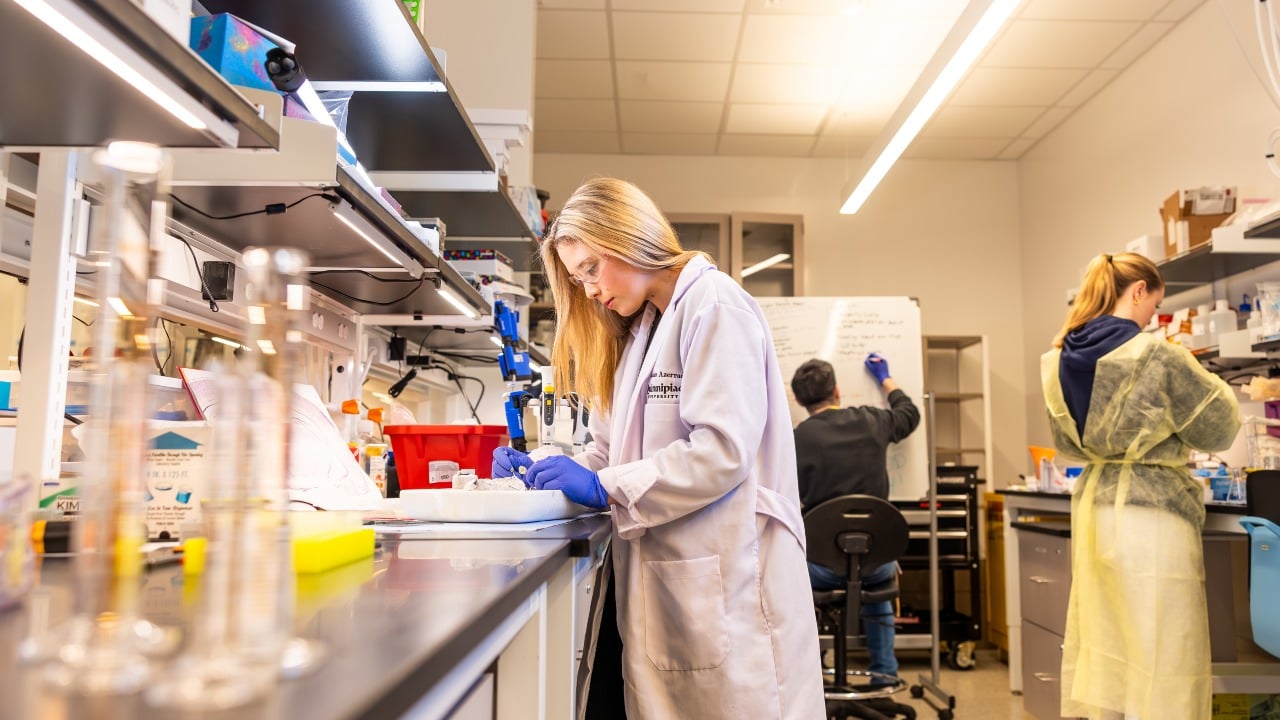
“I gained hands-on experience with key techniques, including behavioral testing, tail vein blood collection and biochemical assays, strengthening my technical skills and attention to detail,” she said.
Her research focuses on how acute stress affects both behavior and metabolic responses in an aging-related animal model.
“Specifically, I study Fischer 344 x Brown Norway F1 hybrid rats, which were developed by the National Institute on Aging (NIA) as a model that exhibits a delayed onset of age-related diseases compared to their parent strains,” Brosseau said. “This makes them an ideal model for studying healthy aging. I’m interested in characterizing how these hybrids respond to acute stress, particularly with a focus on sex differences.”
She will present her research at the Northeast Undergraduate Research Organization for Neuroscience, or NEURON conference, on Saturday, April 11.
NEURON is an open forum for undergraduate and graduate students to discuss their research and enhance collaboration among neuroscience educators.
“I’m presenting a project examining sex differences and behavioral responses to acute restraint stress in F1 hybrid rodents,” said Brosseau. “We first established baseline differences using the elevated plus maze, where we found that females displayed less anxiety-like behavior compared to males. We then exposed the animals to 30 minutes of restraint stress and immediately retested them. After stress, we observed a marked reduction in open arm exploration, consistent with increased anxiety-like behavior. We’re continuing to analyze metabolic and inflammatory markers to better understand metabolic responses.”
Brosseau’s research is a part of psychology professor Adrienne Betz’s pilot project.
“Reagen is a motivated pre-medical student who has taken on a central role in a pilot project I have started in the lab with the NIA Aged Rodent Colonies program,” said Betz, who is also director of Quinnipiac’s behavioral neuroscience program. “Reagen has been instrumental in characterizing this strain's behavior within our lab. Reagen has intellectual curiosity, attention to detail and a strong commitment to this project.”
Brosseau is grateful for Betz’s mentorship throughout her research.
“Dr. Betz has been incredibly influential in my research experience,” Brosseau said. “She has provided guidance throughout the project and created an environment where I could take initiative, learn new techniques and develop confidence in my abilities as an undergraduate researcher.”
Brosseau received funding for her work from the College of Arts and Sciences.
She said her research project was a defining part of her Quinnipiac experience.
“It has pushed me to think more critically about experimental design, data interpretation and troubleshooting real research challenges,” said Brosseau.
In this Article
Read This Next


















Stay in the Loop
Quinnipiac Today is your source for what's happening throughout #BobcatNation. Sign up for our weekly email newsletter to be among the first to know about news, events and members of our Bobcat family who are making a positive difference in our world.
Sign Up Now