



Redefining nursing education for a new era of healthcare
May 26, 2026
May 26, 2026
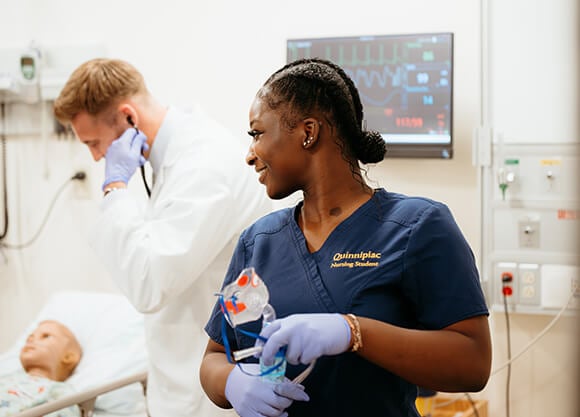
Created through a comprehensive transformation in partnership with the Minerva Project, the curriculum reflects an innovative approach to nursing education designed to prepare students for modern healthcare. Quinnipiac became the first nursing school to collaborate with the Minerva Project to incorporate its science-based learning approach into nursing education.
Rather than relying on lecture-heavy models centered on memorization and high-stakes testing, the curriculum emphasizes competency-based learning grounded in evidence-based teaching practices that build critical thinking, clinical judgment, communication, adaptability and resilience. Students entering Quinnipiac School of Nursing’s 15-month accelerated BSN program in January 2026 are the first class to experience the redesigned curriculum before it rolls out for implementation across the school’s BSN programs.
The redesign was driven in part by updated American Association of Colleges of Nursing (AACN) Essentials introduced in 2021, which shifted nursing education toward competency-based learning. As nursing programs across the country worked to align curricula with the new standards, Quinnipiac’s faculty saw an opportunity to rethink not only course structures, but also how students learn and develop professional skills.
“We took it a step further,” said Tyler Traister, director of undergraduate nursing programs. “We created a radical transformation that truly created a competency-based education with a whole new teaching and learning model that’s based on learning science.”
At the heart of the redesign is a shift in the culture of learning. Nursing classrooms now place greater emphasis on active participation, collaborative discussions, simulations, case studies and applied problem-solving activities that mirror real-world patient care scenarios.
The overhaul extended beyond course redesign, requiring faculty to adopt new approaches to competency-based education, active learning and student assessment through the Minerva Project partnership. Faculty serve as mentors and coaches, guiding students through activities that reinforce both clinical knowledge and professional skills while creating supportive, low-stakes environments where students can practice decision-making before entering clinical settings.
“It’s no longer come to class, lecture, content, test,” said Traister. “We’ve redesigned it to be a ‘pass-to-practice’ approach. Students are getting frequent formative feedback from their faculty. We still have standards, we still have rigor, but that rigor is now just attached to feedback and a growth mindset.”
The curriculum also introduces new course structures designed to support competency development. Students move through Essentials seminars, applied learning courses, clinical immersion experiences and inquiry-based projects that emphasize collaboration, leadership and hands-on problem-solving. Intercession experiences built into the semester create additional opportunities for service learning, team building and professional identity development.
Rather than separating content into isolated specialty courses, the integrated curriculum helps students connect concepts across healthcare settings and patient populations. Skills are intentionally scaffolded throughout the program, allowing students to revisit and strengthen competencies in increasingly complex situations.
Faculty leaders say the redesign responds directly to the growing gap between nursing education and modern clinical practice, where graduates are expected to navigate increasingly complex patient needs, interprofessional collaboration and fast-changing systems of care.
“We know that some graduates are going into these complex healthcare environments, and they’re just not ready for practice,” said Traister. “The industry is seeing a lot of them leave the nursing profession within their first year because they’ve focused so much on getting them to pass the NCLEX that they haven’t focused enough on building the durable, transferable skills needed to excel.”
By emphasizing durable, transferable skills such as communication, teamwork, adaptability, resilience and clinical judgment, the curriculum is designed to prepare students not only to pass licensure exams, but to thrive in healthcare environments throughout their careers.
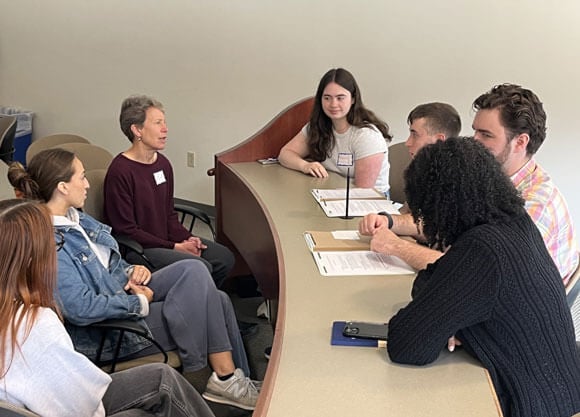
“You can’t show a competency through a test,” said Traister. “We’re seeing it through behavior, skills and actions. In our first-semester communication course, for example, students worked with physician assistants, medical students and a standardized patient, actually practicing communication. If we were focused on tests, we wouldn’t have that freedom in our curriculum.”
Through labs, simulations, seminars and clinical immersions, students regularly apply classroom knowledge in practical settings, helping bridge the gap between theory and practice while building student confidence and competence.
“There was a concern that by moving away from high-stakes testing, we would lose rigor,” said Traister. “But our students are scoring about the same, if not better, than in our old curriculum. We have objective data that shows their clinical judgment is growing, and we’re seeing their confidence change as well.”
The redesign also reflects the School of Nursing’s longstanding commitment to supporting the whole student.
“While we have a big program, it’s never been ‘you’re just a number to us,’” said Traister. “We know exactly where you are in the curriculum, how you’re doing and how we can help you succeed.”
Behind the scenes, the overhaul was extensive. Faculty, administrators and partners worked together to rebuild the curriculum from the ground up.
“We have a whole new course structure, course types and skills taxonomy,” said Traister. “We’ve redesigned the architecture of the program — our learning outcomes, pathways — everything.”
The new curriculum aligns with Quinnipiac’s broader mission to prepare graduates who are not only clinically skilled but also compassionate leaders capable of improving healthcare systems and advocating for patients and communities.
“I’m hoping that we prepare the next generation of practice-ready nurses who are equipped to both succeed and thrive in the healthcare environment,” said Traister. “And that this competency-based model reinforces Quinnipiac’s reputation for producing practice-ready nurses, while creating a student-centric experience where students come here because they know they’re going to be supported.”


























Quinnipiac Today is your source for what's happening throughout #BobcatNation. Sign up for our weekly email newsletter to be among the first to know about news, events and members of our Bobcat family who are making a positive difference in our world.
Sign Up Now