



School of Medicine students honored for research excellence at St. Vincent’s Science Symposium
May 31, 2026
May 31, 2026
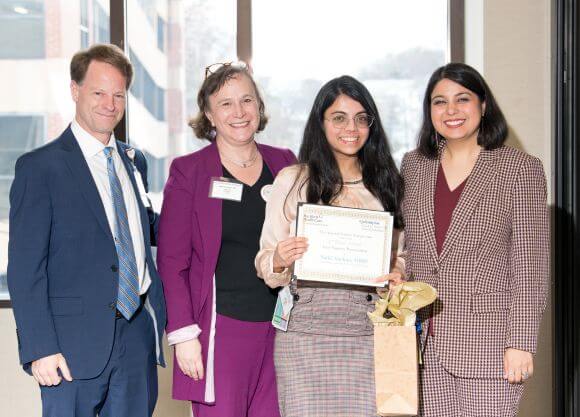
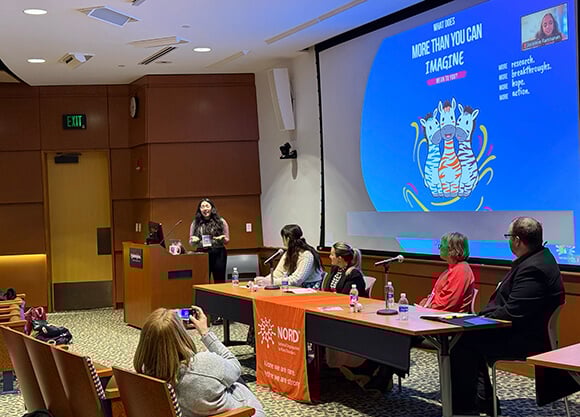
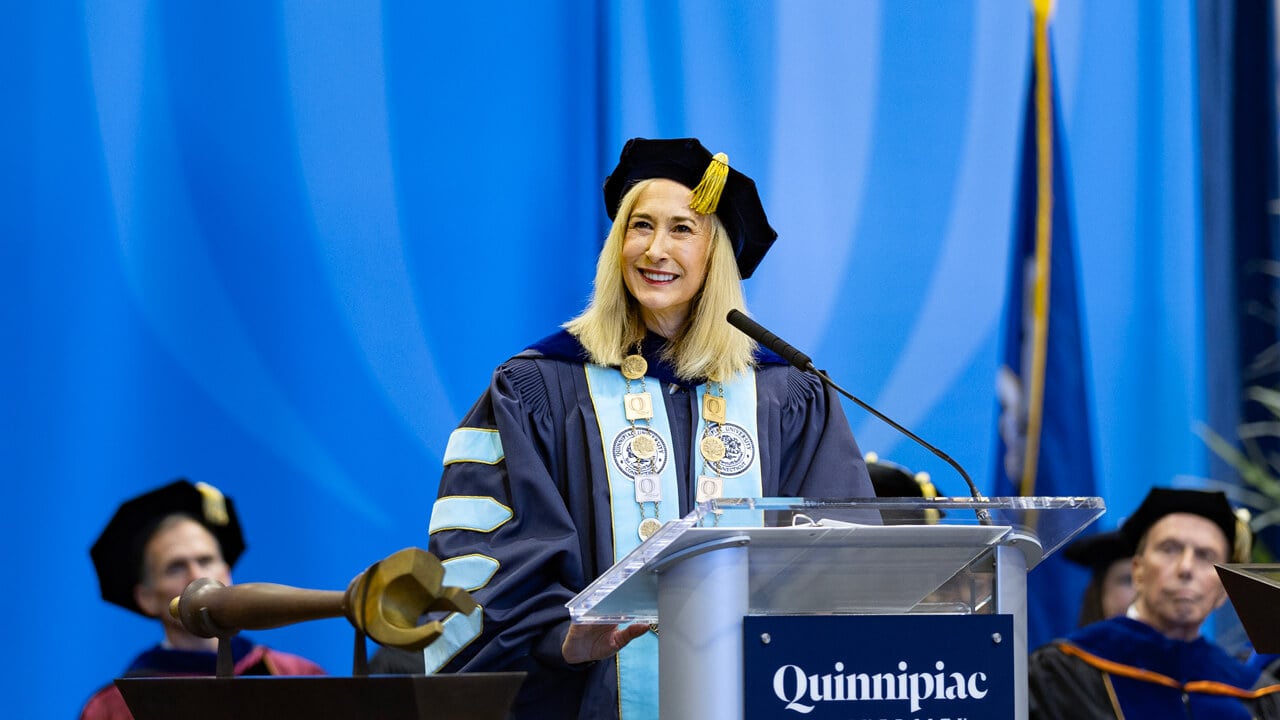
Held in April in conjunction with Netter MD School of Medicine at St. Vincent’s Hawley Conference Center in Bridgeport, Connecticut, the symposium’s adjudicated research competition featured over 60 medical students and residents presenting posters or oral plenaries. The symposium’s keynote address was given by Quinnipiac Netter School of Medicine Senior Associate Dean for Education Ellen Pearlman.
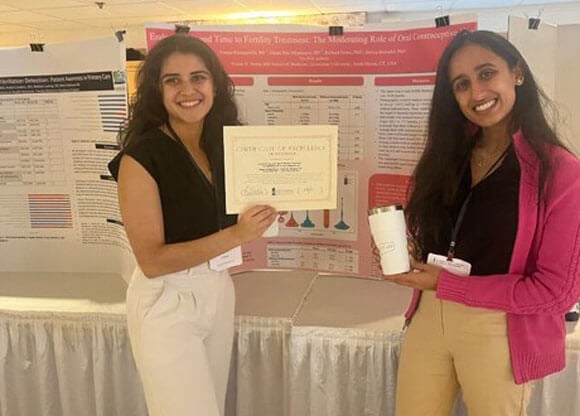
Five Netter medical students swept top research poster accolades at the symposium, including first-place winner Ekrem Ayhan, MD ’27; second place winners Elena Willow, MD ‘28 and James Concepión MD, ’28; and third-place winners Katharine Chen MD, ‘28 and Jack Crowley MD, ’28.
Pearlman said Quinnipiac’s impressive showing at the symposium reflects the impact of Netter’s four-year scholarship reflection and concentration capstone curriculum, which allows learners to personalize their curriculum and prepare for scholarly endeavors during residency and future practice.
“Students design and execute a capstone project in an area about which they are passionate. They gain both conceptual understanding and practical skills in research methods. In addition, our students are taught important communication and oral presentation skills that enable them to tell compelling stories. I believe it is these fundamental skills that make them effective stewards of scholarship,” said Pearlman.
Ayhan participated in orthopedic sports medicine research resulting in his poster, “Groin Pain Syndrome (GPS) or ‘Sports Hernia:’ An Analysis of Surgical and Nonsurgical Outcomes in Athletes and Nonathletes.” The research findings extend GPS management beyond the elite, young, male athlete by determining that under a standardized diagnostic-therapeutic algorithm, both athletes and nonathletes with GPS demonstrated significant improvement. The research also found that surgery, particularly robotic transabdominal preperitoneal mesh repair, significantly improved outcomes in nonathletes.
For their research poster “High-Value Care (HVC): A Curriculum Approach for Medical Students” Willow and Concepión assessed the impact of targeting HVC curricula across all four years of medical school, as opposed to current practices which mainly introduce HVC principles to clinical or post-graduate learners. Their longitudinal HVC project assessing first-year medical students found early, structured exposure to HVC increased student knowledge of principles and boosted their confidence toward applications in clinical practice.
Chen and Crowley’s research poster, "Anatomical Basis for Selective Blockade of the Nerve to Quadratus Femoris: A Cadaveric Study with Clinical Correlation" showed the promise of providing effective analgesia while preserving early postoperative ambulation in hip arthroscopy patients.
In her symposium keynote address, Pearlman said one of the most important skills researchers, clinicians and educators must hone is the skill of observation.
“The ability to observe without evaluating is the highest form of intelligence,” Pearlman said. “Much like the physical exam, the art of observation is slowly becoming a relic of the past, and the ability of humans to give something or someone our undivided attention is dwindling and atrophying. The greatest gift you can give is your undivided attention.”
Touching on System 1 and System 2 thinking popularized by Nobel Laureate psychologist Daniel Kahneman, Pearlman urged researchers, clinicians and educators to lean into System 2 — slow, deliberate and logical cognitive processing — and away from System 1’s fast, automatic and intuitive thinking.
“We are wired to spend most of our time in System 1, and the algorithms in our world are preying on our ability to engage in System 2,” Pearlman said.
Now, there is good data to suggest that medical students can be taught to be better observers by learning to engage in System 2 thinking, Pearlman said.
“A technique called Visual Thinking Strategies is proven to make medical students better observers. It actually helps them to engage in System 2 thinking, which reduces cognitive biases based on inferences and leads to reduced errors in clinical reasoning,” said Pearlman.
Developed by cognitive psychologist Abigail Housen and museum educator Philip Yenawine, the strategies employ structured, inquiry-based teaching methodology designed to foster critical thinking, language and communication skills.
Drawing on the profound words of Holocaust survivor and psychiatrist Viktor Frankl, “Between stimulus and response there is a space,” from his seminal work, “Man's Search for Meaning,” Pearlman emphasized the potency of pausing to deliberate.
“And it is in that pause you might make an observation that changes your thinking…you might slow down to engage System 2, to stop yourself from jumping to conclusions, to allow yourself to choose to act differently,” Pearlman said. “So I encourage all of you to embrace the pause, slow yourself down. Give yourself and your patients the gift of undivided attention.”














Quinnipiac Today is your source for what's happening throughout #BobcatNation. Sign up for our weekly email newsletter to be among the first to know about news, events and members of our Bobcat family who are making a positive difference in our world.
Sign Up Now