



'CURED' screening event shares powerful message of support for LGBTQ+ community
April 06, 2026
April 06, 2026
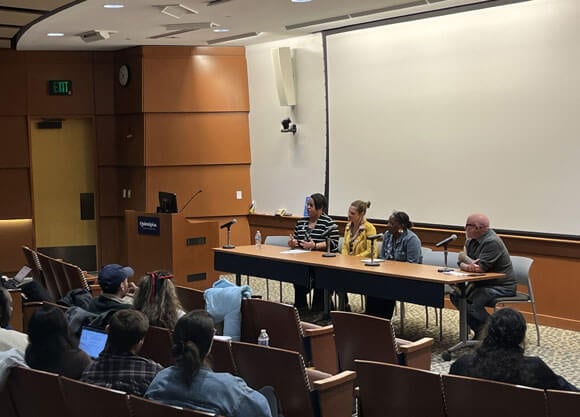
A short, customized video discussion from "CURED" co-directors Bennett Singer and Patrick Sammon set the stage for the special screening of the award-winning documentary on March 30. The event was rounded out by an insightful panel discussion immediately following the screening, as well as the participation of a variety of organizations offering supportive resources during a tabling session which opened the program.
Until 1973, doctors automatically classified every gay man and lesbian as mentally ill. "CURED" revisits forced institutionalization and other archaic medical treatments and chronicles the journey of activists who successfully challenged the American Psychiatric Association’s (APA) mental illness classification of homosexuality, helping to pave the way for LGBTQ+ acceptance.
Released in 2020, "CURED" has won multiple film festival awards as well as national recognition. The documentary premiered nationally on PBS Independent Lens on October 11, 2021, National Coming Out Day.
In a video message to the Quinnipiac audience shown on March 30, the co-directors discussed their process and passion for telling this important story which, they noted, had previously gone largely undiscussed.
“We’re really grateful for your interest in watching 'CURED' and learning about this important chapter in LGBTQ history,” Sammon said. “A big thank you to Mental Health Connecticut and Quinnipiac University for hosting this event. We’re excited that all of you are together to be able to watch this important film. While it’s a story about the past, we think the lessons are very relevant today.”
The filmmakers invested five years in the mindful construction of "CURED." Sammon said it was a humbling experience to meet the activists spotlighted in the documentary.
“The centerpiece of the film are the activists and the psychiatrists who were part of this campaign,” Singer added. “During the production process, we made the decision that the only people on-screen would be people who were first-person participants in the story. In this period, sodomy laws were pervasive and the official rubric within the psychiatric lexicon was if you were gay or lesbian, you were automatically classified as being mentally disordered and in need of a cure.”
Since filming the documentary, more than half of the interview subjects have passed away, making "CURED" a lasting testimonial to their activism, courage and bravery, Singer said. He said the film also captures the story of an important turning point in the relationship between LGBTQ+ people and the medical establishment, marking a huge paradigm shift.
“As you’ll see in the film, the APA as an institution, and really every other medical organization, has now embraced the science and data-based principle that being gay is not a pathology — that it is a natural and normal part of human behavior,” said Singer.
Netter Library Director Matthew Wilcox thanked the evening’s panelists and the “village” of colleagues from Mental Health Connecticut and Quinnipiac who contributed to organizing the event. Wilcox also recognized the event leadership of Carol R. Awasu, chair of the Social Work Department, and Julie Booth, Director of the Center for Interprofessional Healthcare. Additionally, Wilcox thanked Luis B. Pérez, president and CEO of Mental Health Connecticut, for his support and for attending the screening at Quinnipiac.
Following the screening, Jacquilyn Davis, director of Learning & Workforce Development at Mental Health Connecticut, acknowledged the documentary’s powerful effect on viewers. Davis encouraged audience members to take a moment to reflect on how seeing "CURED" had impacted them.
“It’s heavy. It’s a lot of information,” Davis said. “I think it’s beautifully done, but I’ve seen this probably four times, and every time I want to cry after — especially seeing the legacy of everyone who is no longer with us and honoring what they brought to our community and to all of us.”
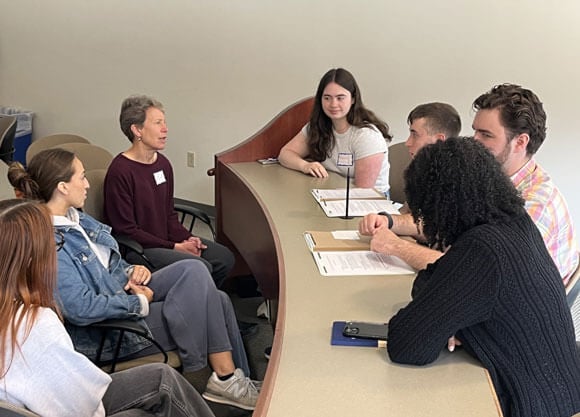
Davis was joined in the post-screening discussion by Natasha Campbell, founder, CEO and clinical director of Multicultural Clinical Services; Bliss Kern, director of support services at Q+; and Tony Ferraiolo, a life coach and founder of multiple support groups for transgender and nonbinary youth and their families.
The panel contributed insights involving their lived experiences and professional efforts to assist LGBTQ+ community members. They also discussed a parting message of "CURED," which underscores that challenges persist, including internalized stigma, the persistence of anti-queer messages and the need to protect LGBTQ+ youth from discrimination.
Kern said it’s especially important to support youth by helping to build resilience, creating and supporting queer spaces and raising awareness in society of how something as simple as appropriately recognizing a person’s sexuality, orientation or gender can be impactful.
Ferraiolo also emphasized that using a person’s correct name and pronouns is a vital way to provide affirmation, especially now, when youth are faced with barriers to necessary healthcare.
“If you’ve been doing the work as long as we have, you see a child go from hopelessness to hopefulness when you allow them to be who they are. When they have hope for a better future and can live the life that they want to live, they change, right in front of us,” Ferraiolo said.




















Quinnipiac Today is your source for what's happening throughout #BobcatNation. Sign up for our weekly email newsletter to be among the first to know about news, events and members of our Bobcat family who are making a positive difference in our world.
Sign Up Now