



Quinnipiac expands global partnerships through strategic collaboration with Óbuda University in Hungary
May 20, 2026
May 20, 2026
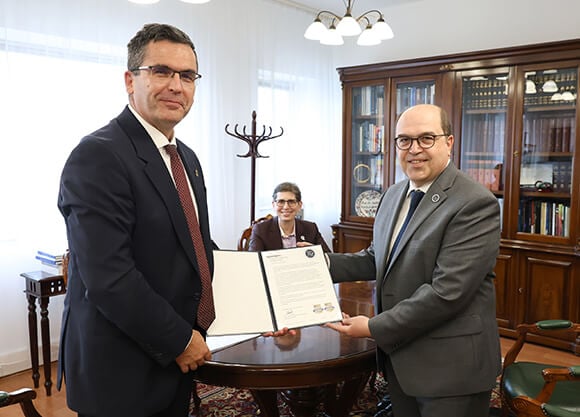
University leaders from both institutions recently gathered in Budapest to formally sign two major agreements focused on joint research collaboration and a dual-degree graduate program in computer science.
Representing Quinnipiac at the signing were Provost Debra Liebowitz, Taskin Kocak, dean of the School of Computing & Engineering, and Chris Ball, the István Széchenyi Chair in International Economics and director of the Central European Institute.
The agreements build upon a growing relationship between the two institutions. Following an initial visit to Budapest in May 2025, Quinnipiac and Óbuda University signed a general memorandum of understanding last summer.
In November 2025, a delegation led by Óbuda University Rector Levente Kovács visited Quinnipiac, where university leaders identified several initiatives to prioritize during the first phase of the partnership.
“This collaboration reflects Quinnipiac’s commitment to preparing students and faculty to thrive in a deeply interconnected world,” Liebowitz said. “By partnering with Óbuda University, we are creating meaningful opportunities for research, innovation and global learning that will benefit our students, faculty and both institutions for years to come.”
Kovács said, “International collaborations are truly valuable when they lead not only to agreements but also to the development of a shared vision and long-term professional partnerships. Thanks to mutual commitment and motivation, the collaboration between Quinnipiac and Óbuda University has flourished in a short period of time.”
One of the agreements establishes a two-year joint research collaboration program supported by a combined $100,000 investment shared equally between the two universities. Modeled after successful international collaborations Óbuda University has developed with institutions in Slovakia and Taiwan, the initiative is designed to support faculty research, strengthen professional cooperation and generate high-quality scholarly publications.
More than 20 faculty members from Quinnipiac and Óbuda University have already expressed interest in participating in the program through an initial matchmaking process.
“This agreement creates a powerful framework for faculty collaboration in emerging areas of computing, engineering and applied sciences,” said Kocak. “International research partnerships are essential for innovation today, and this initiative will help elevate the global visibility and impact of the work being done at both universities.”
Kovács said, “It is of paramount importance to us that these relationships not only be established between institutions but also build genuine professional collaborations and research communities.”
Under the second agreement, Quinnipiac and Óbuda will develop a dual-degree master of science program in computer science, pending accreditation approval from NECHE. Under the program, participating students will complete approximately half of their degree requirements at each institution and earn graduate degrees from both Quinnipiac and Óbuda University.
University leaders say the initiative is designed to expand educational access and attract international students seeking globally connected academic experiences. Budapest’s growing reputation as a safe, affordable and internationally accessible European capital also makes it an attractive destination for students pursuing advanced STEM education.
“The future of higher education is international, collaborative and experiential,” said Ball. “This partnership not only strengthens academic opportunities in computer science and research but also reinforces Quinnipiac’s broader mission to build meaningful connections across Central Europe through education, scholarship and cultural exchange.”
Ball noted that the partnership also reflects the expanding work of Quinnipiac’s Central European Institute, which was established in 2013 to strengthen the university’s academic and cultural engagement throughout the region. The institute has supported faculty collaborations, student exchanges, public programming and partnerships designed to deepen understanding of Central Europe’s economic, political and cultural significance.
“This agreement represents exactly the kind of bridge-building the Central European Institute was created to foster,” Ball said. “We are building long-term relationships that connect students and scholars across borders while creating new opportunities for innovation and discovery.”
University leaders say the agreements mark the beginning of what both institutions expect will become a long-term strategic partnership with expanding opportunities for research collaboration, student mobility and academic innovation.




















Quinnipiac Today is your source for what's happening throughout #BobcatNation. Sign up for our weekly email newsletter to be among the first to know about news, events and members of our Bobcat family who are making a positive difference in our world.
Sign Up Now