



Wise strategies sustain Quinnipiac’s Student-Managed Portfolio’s $6.1 million value
May 20, 2026
May 20, 2026
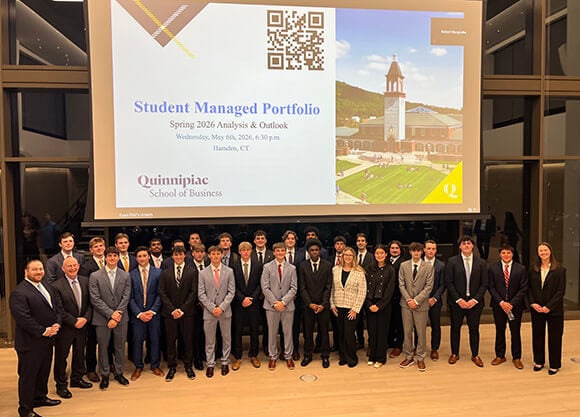
Quinnipiac School of Business finance students presented the Spring 2026 Student-Managed Portfolio Outlook and Analysis on May 6 at the School of Business. Twenty-eight smartly dressed finance students went in front of a live audience during sector reviews which discussed the status of existing holdings and defended newly-added companies based on strong fundamentals or growth potential.
As part of the Quinnipiac University Endowment Fund, the portfolio was established with a $25,000 allocation from the endowment in 2003. Each semester, undergraduate finance students in the Applied Portfolio Management course (FIN 450) work to curate and grow the portfolio. They are guided by portfolio founder Matthew O’Connor, professor of finance and finance chair, who partners with finance professor Ted Koly ‘06, MBA ’08.
O’Connor said the goal is to outperform the market with a strong return while gaining real world, supervised experience in preparation for a career in finance.
“This class is all about something that Quinnipiac is really committed to, which is hands-on, real-world, experience-based learning — and nothing does it like this class,” O’Connor said.
Fund Managers Matthew Barbella ’26; Aidan Begg ’26, MBA ’27; Mark Caruso ’26, MBA ’27; Jack Mulhall ’26, MBA ’27 and Evan Riel ’26, MBA ’27 prepared the Spring 2026 Portfolio Outlook and Analysis for President Marie Hardin, School of Business Dean Holly Raider and university trustees.
The fund managers said their strategy for the spring 2026 cycle reflects a deliberate rotation away from rate-sensitive growth and consumption names and toward quality-value, real-asset and defensive-growth exposures calibrated to a late-cycle macro environment.
During the semester, fund managers make final allocation recommendations, oversee the completion of cumulative performance reports and develop a comprehensive global macroeconomic outlook to inform future investment decisions and asset allocation choices.
The May 6 presentation drew a crowd to the School of Business auditorium, where Riel helped the fund manager team to give an overview of the portfolio.
“We have two funds that exist in the portfolio, a value fund which is longer-term, well-performing companies that generally issue dividends and aim to provide consistent returns over time. Our second is the growth fund. These are companies with growth stories and well-above average projected revenue growth in the coming years,” Riel explained.
As benchmarks, the value fund is closely mirrored by the S&P 500, and the growth fund is most comparable to the iShares Russell 1000 Growth.
Each semester, students manage real funds in roles mirroring financial sector careers as they develop investment strategies; construct, monitor and rebalance the portfolio; and report on actual portfolio performance. By conducting in-depth research and evaluating existing holdings, analysts will pitch prospective companies to add to their sector or suggest holdings that should be trimmed or dropped. All portfolio changes require a two-thirds vote of the class.
Each student can have between three to six companies to manage within their sector. Sectors include communications, consumer discretionary, healthcare, consumer staples, energy, materials, utilities, financials, real estate, industrials and information technology.
Taking current conditions into consideration, Barbella, Begg, Caruso, Mulhall and Riel developed and published a 48-page, in-depth macroeconomic outlook to construct a forward-looking investment framework for the Quinnipiac University Endowment Fund's Value and Growth mandates. Their deeply informed research synthesized analysis across global markets, domestic economic indicators, consumer behavior, monetary policy and all S&P 500 sectors.
“The value of a macro-outlook stems from how well it can answer the question: What can affect my investments,” their report notes. “This requires a knowledge that is broad enough to capture global dynamics yet has the precision to guide business level strategy. By combining macroeconomic analysis with sector-level insights, this report provides a roadmap for navigating the future. Emphasizing not only the challenges of predicting future growth and persistent geopolitical risk, but also the opportunities created by technological breakthroughs and secular growth segments. The result is a comprehensive, forward-looking framework designed to guide allocation decisions in an increasingly complex global environment.”
Further evidence of the depth of knowledge involved in supporting this extraordinary student-managed portfolio was on display May 6 during the night’s Q&A session. Student analysts and fund managers fielded several sophisticated questions from the audience, which included School of Business Advisory Board members, faculty, alumni, parents and colleagues.
Having the ability to think on their feet is critical, said O’Connor.
“You can see how hard they worked — the level of analysis, and the ability to explain themselves,” O’Connor said. “AI didn’t answer the questions — they did. It puts front and center that ability to develop your higher orders of thinking — your analytical skills, your communication skills. I think that’s the real magic of this class.”






























Quinnipiac Today is your source for what's happening throughout #BobcatNation. Sign up for our weekly email newsletter to be among the first to know about news, events and members of our Bobcat family who are making a positive difference in our world.
Sign Up Now