


MBA
The Interplay of Self-Esteem and Financial Knowledge in Financial Decision-Making

MBA
The Interplay of Self-Esteem and Financial Knowledge in Financial Decision-Making
Victor Czerneckianair ’25, MBA ’26, Mason Oak 25, MBA ’26, and Sydney Weimer ’25, MBA ’26 conducted this research as a part of MK 620: Applied Consumer Behavior.
Overview
This research project investigates how self-perception, induced through selfie-taking, influences financial decision-making, particularly in the context of financial asset name complexity. Prior research suggests that difficult-to-pronounce names can create negative biases, while selfie-taking may alter self-esteem and emotional states. Using a randomized online experiment, participants were assigned to either a selfie or control condition before evaluating their likelihood of investing in assets with easy or difficult names. The study finds that selfie-taking can shift decision-making away from analytical reasoning, weakening the positive effect of financial knowledge. These findings provide insight into how psychological factors and branding elements influence investor behavior, with implications for financial marketing and firm naming strategies.
Researchers

Victor Czerneckianair ’25, MBA ’26
Business Administration
School of Business
Mason Oak ’25, MBA ’26
Business Administration
School of Business

Sydney Weimer ’25, MBA ’26
Business Administration
School of Business
But First, Let Me Take a Selfie: The Interplay of Self-Esteem and Financial Knowledge in Financial Decision-Making
Introduction
This study examines how selfie-taking influences investment decisions, particularly for financial assets with easy vs. difficult-to-pronounce names. Consumers often depend on surface-level cues, such as ease of namepronounceability, when it comes to making decisions; is this also true for financial opportunities? Difficult-to-pronounce names cause a feeling of uncertainty and negative bias, leading to a lower willingness to choose options with more complex names(Hyunjin Song & Norbert Schwarz, 2009). Selfie taking has been shown to create a heightened level of self-awareness and emotional stimulation, having the potential to increase individuals' confidence and self-awareness when making decisions(Soojin Jeong et al., 2023). A heightened sense of self-focus may result in individuals relying more on emotionally driven judgements and developing feelings of increased social sensitivity rather than making rational decisions(Shin et al., 2017).
Key Hypothesis
H1: Selfie taking moderates the effect of financial knowledge on financial investment decisions.
Methodolgy
Variables:
IVs: Selfie-taking (primed); name complexity of financial assets (primed); individual financial knowledge (measured)
DV: Investment likelihood
- 78 individuals participated in the study via an online panel (Prolific)
- Online experiment was created via Qualtrics platform
- Informed consent from participants was provided prior to experiment
|
78 Participants (N=78) |
|
| Random Assignment | 40 Males/37 Females/1 Other | 56 Under the Age of 40 / 22 Over the Age of 40 |
⬇
|
Measure Financial Literacy |
|
|
Participants completed financial literacy questions prior to investment decisions |
⬇
|
Selfie Condition vs Control |
|
|
Take selfie before investment | No selfie before investment (Control) |
⬇
|
Evaluate Financial Assets |
|
|
Easy-to-Pronounce Names | Difficult-to-Pronounce Names |
⬇
|
Example Prime Hard/Easy Question |
|
|
Prime Hard: How likely would you be to invest in Qrzlythion Partners? Prime Easy: How likely would you be to invest in Kerziltheon Partners? |
⬇
|
Measure Investment Likelihood |
|
|
5-Point Likert Scale | Participants Rank Likelihood of Investment |
Key Findings
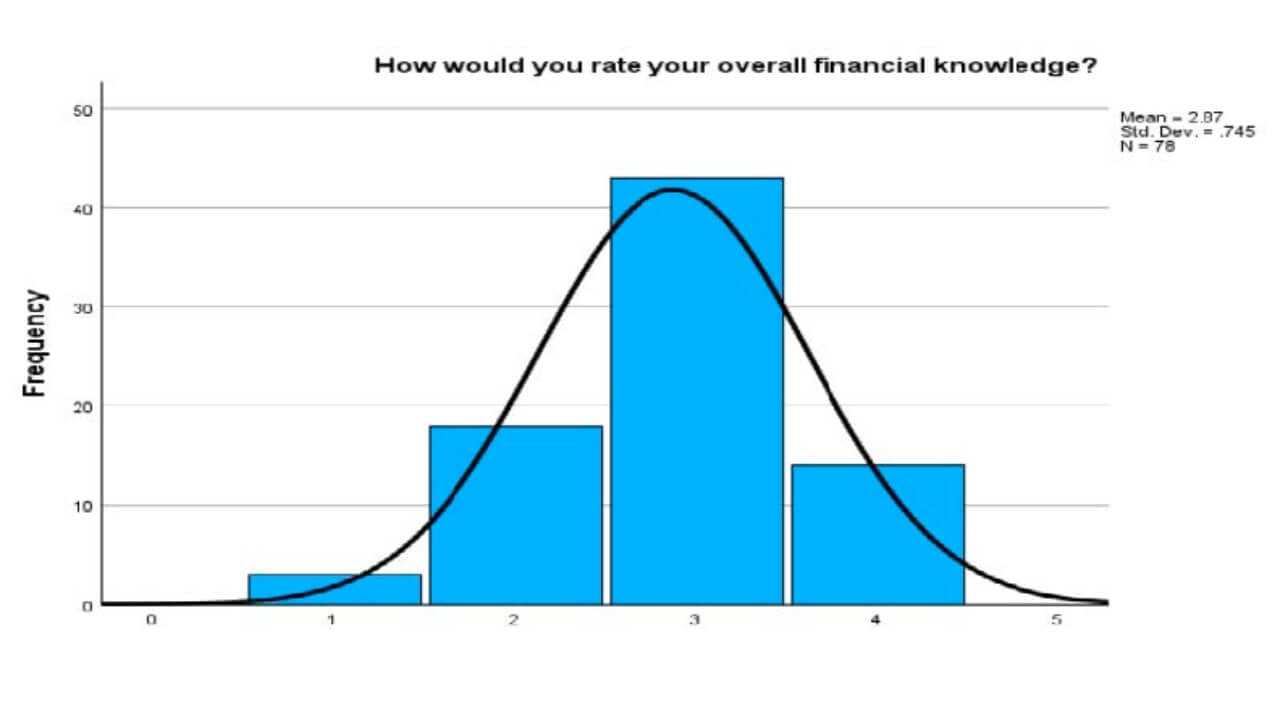
- Participants with varying levels of financial knowledge were tested
- 26 have used financial advisors, 52 have not
Financial Knowledge Score Distribution
Difficult to Pronounce Names
- For both difficult names, selfie task interacts with financial knowledge
- As expected, there is an effect of financial knowledge on financial investment decisions
|
Qrzlythion Interactions |
t | sig | |
| Financial Knowledge | -1.881 | .084 | |
| Selfie Task | -2.256 | .027 | |
| Knowledge * Selfie | 2.423 | .018 | |
|
Thryzzquor Interactions |
t | sig | |
| Financial Knowledge | -2.154 | .034 | |
| Selfie Task | -1.380 | .172 | |
| Knowledge * Selfie | 1.998 | .049 | |
Easy to Pronounce Names
- For both easy to pronounce names, selfie task interacts with financial knowledge
- As expected, there is an effect of financial knowledge on financial investment decisions
| Gamma Labs Interactions | t | sig | |
| Financial Knowledge | -2.009 | .052 | |
| Selfie Task | -2.070 | .046 | |
| Knowledge * Selfie | 2.584 | .014 | |
|
Vree-Solinth Interactions |
t | sig | |
| Financial Knowledge | -2.790 | .008 | |
| Selfie Task | -1.682 | .101 | |
| Knowledge * Selfie | 2.613 | .013 | |
Focus on Selfie vs. No Selfie
- Financial knowledge has a significant effect in the no selfie (control) condition
- Financial knowledge effect disappears in the case of selfie-taking condition
| Vree-Solinth (Easy Name) | t | sig |
| Financial Knowledge (No Selfie) | -3.510 | .003 |
| Financial Knowledge (Selfie) | .478 | .638 |
| Thryzzquor (Difficult Name) | t | sig |
| Financial Knowledge (No Selfie) | -2.322 | .026 |
| Financial Knowledge (Selfie) | .571 | .571 |
- The selfie task cancels out the benefit of financial knowledge when making investment decisions
- No effect of name type; note hypothetical names used
Conclusions
- Individuals with higher levels of financial knowledge tend to be more cautious with investment decisions, seeking more information prior to deciding if they choose to invest.
- Through interpreting the role of financial literacy plays in these decisions, companies may need to re-evaluate their strategies to provide more transparent, up-front information about their assets to reduce potential investor hesitation.
- This said, it was found that the presence of selfie-taking inhibits this cautious behavior, alterting natural decisions making processes among those with high financial literacy, distracting them, leading to an increased willingness to invest.
- The significant interaction between financial knowledge and selfie-taking suggests that psychological states can influence the financial decision-making process.
- To the best of our knowledge, this is the first study ever to examine the proposed combined effect.
- Looking ahead, understanding the role self-perception has in decision-making can aid firms in predicting and responding to consumer behavior in financial contexts.
For Further Discussion
This serves as an overview of the project and does not include the complete work. To further discuss this project, please email Sydney Weimer.
Course Overview
MK 620: Applied Consumer Behavior Research provides a basic understanding of the major concepts and theories in consumer decision-making and behavior and how these can be used as the basis for empirical research on the way consumers process information, form preferences and make buying choices. This is a course in which theories from psychology, sociology and economics are applied to the study of consumer behavior.
Explore Our Areas of Interest
We've sorted each of our undergraduate, graduate and doctoral programs into unique Areas of Interest. Explore these categories to discover which programs and delivery methods best align with your educational and career goals.