


Physical Therapy
Scrubbing in for Success: Understanding the Impact of Interprofessional Healthcare Education on Student Outcomes
Physical Therapy
Scrubbing in for Success: Understanding the Impact of Interprofessional Healthcare Education on Student Outcomes
Eve Behrens ’27, DPT ’30 completed this project for the Center for Interprofessional Healthcare Education under the mentorship of Julie Booth, director of the Center for Interprofessional Healthcare Education and clinical associate professor of physical therapy.
Overview
This purpose of this research project was to understand the importance and impact of the Center for Interprofessional Healthcare Education (CIHE) at Quinnipiac University. Students of various healthcare-related majors were surveyed on their abilities and perceived outcomes using the Interprofessional Competencies Attainment Survey (ICCAS) and National Association of Colleges and Employers (NACE) competencies.
Student Researcher

Eve Behrens ’27, DPT ’30
Physical Therapy, Doctorate (Entry-Level Program)
School of Health Sciences
Scrubbing in for Success: Understanding the Impact of Interprofessional Healthcare Education on Student Outcomes
Abstract
Purpose: to understand the importance and impacts of the Center for Interprofessional Healthcare Education (CIHE) at Quinnipiac University
Methods: Students were surveyed on their abilities and perceived outcomes. Students of various healthcare-related majors, at both the undergraduate and graduate level, were surveyed using the Interprofessional Competencies Attainment Survey (ICCAS) and National Association of Colleges and Employers (NACE) competencies.
Results: Positive correlations between
-
The number of CIHE events attended and the perceived abilities of the students can help professionals and educators to understand the impact of the interprofessional education.
-
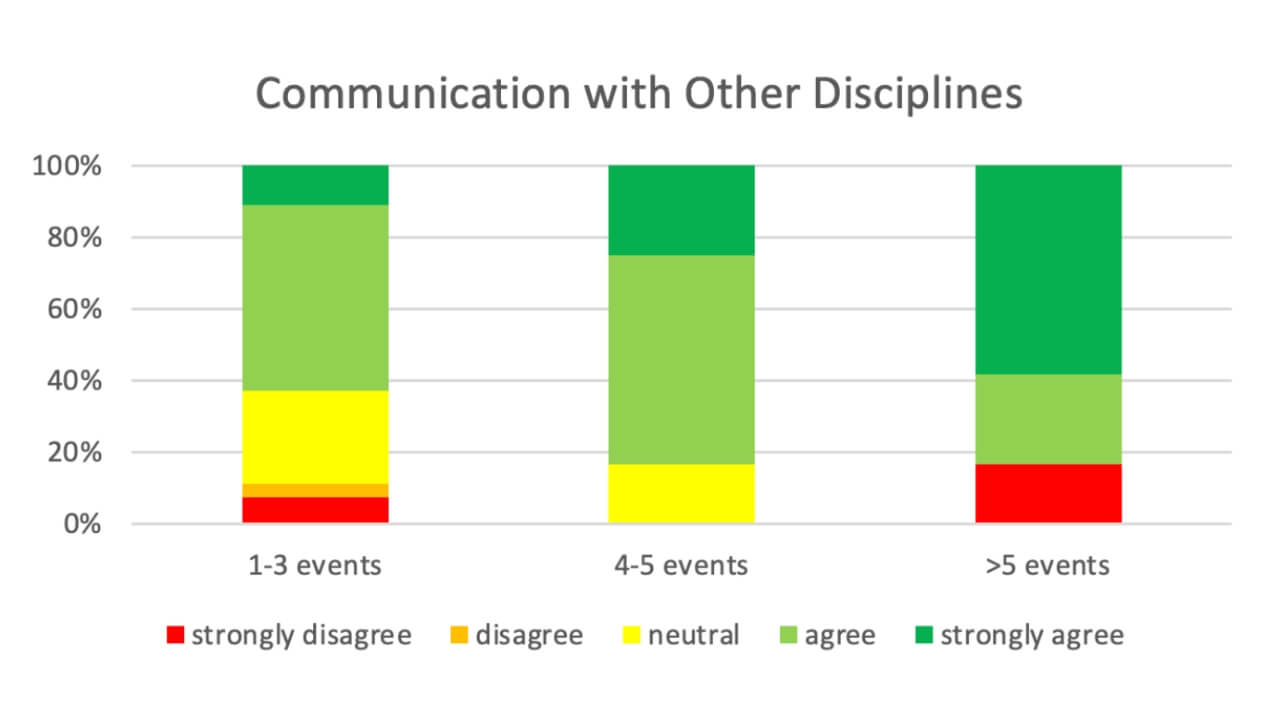
The number of events attended and the perceived ability in communicating with other disciplines, but decreased perceptions in preparedness for real-world clinical situations.
-
CIHE event and increased confidence in oral and written communication compared to those who did not attend CIHE events.
-
The perceived abilities in data analysis and problem solving and facilitation of group dynamics was similar between students who did not attend CIHE events and students that attended 4-5 CIHE events.
Introduction
Interprofessional education (IPE) is the occasion where learners of two or more professions learn with, from and about each other to improve collaboration and the quality of care and services. At Quinnipiac University, the Center for Interprofessional Health Education (CIHE), teaches and empowers future healthcare professionals through transformative interprofessional learning experiences and promotes collaboration, person-centered care and application of the core competencies established by the Interprofessional Education Collaborative.
Collaboration, whether in healthcare or other professions, can provide new opportunities for learning, access to new resources, success in tackling complex problems and better health services for the populations that are served. 1
In an era where healthcare services are becoming increasingly fragmented and specialized, the need for interdisciplinary and interprofessional teams within healthcare is crucial for patient care outcomes.2 Therefore, there is a growing need within higher education to ensure graduates are prepared to navigate interprofessional relationships and networks.
Materials and Methods
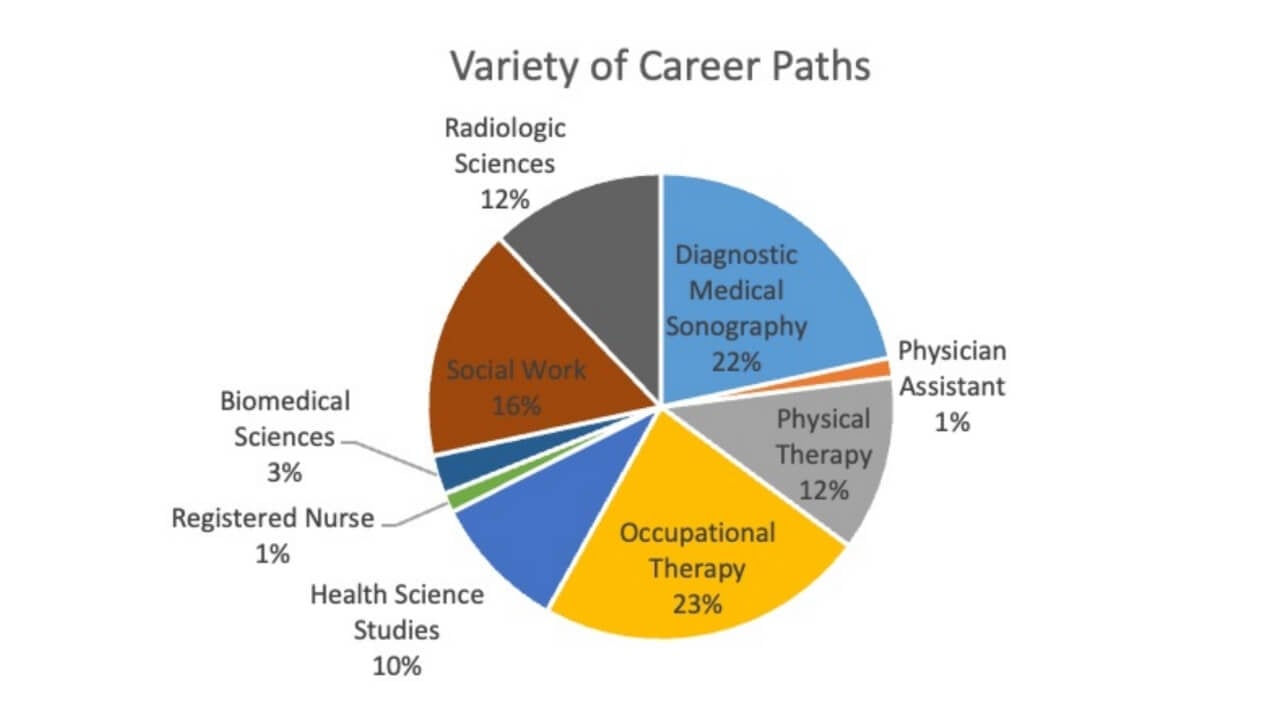
Students of various healthcare-related majors and programs of study, at both the undergraduate and graduate level, were surveyed based on the number of CIHE events they have attended and their perceived abilities and outcomes. 75 student responses were collected, with 51 undergraduate students and 24 graduate students. The majors and programs surveyed included occupational therapy (n=17), diagnostic medical sonography (n=16), social work (n=12), physical therapy (n=9), radiologic sciences (n=9), health science studies (n=7), biomedical sciences (n=2), physician assistant (n=1) and registered nurse (n=1).
Students were separated into groups based on the range of CIHE events they had attended: 0 events (n=24), 1-3 events (n=27), 4-5 events (n=12) and more than 5 events (n=12).
Results
Summary
*The ratings were translated to numerical values for data analysis: Strongly agree = 5, agree = 4, neutral = 3, disagree = 2 and strongly disagree = 1.
- Competencies in Interprofessional Care
- For perceived communication with students from other disciplines, there is a positive correlation between number of events attended and mean ratings(1-3 events: u=3.56, 4-5 events: u=4.08, more than 5 events: u=4.08). Slope = 0.260 (mean rating vs number of events attended)
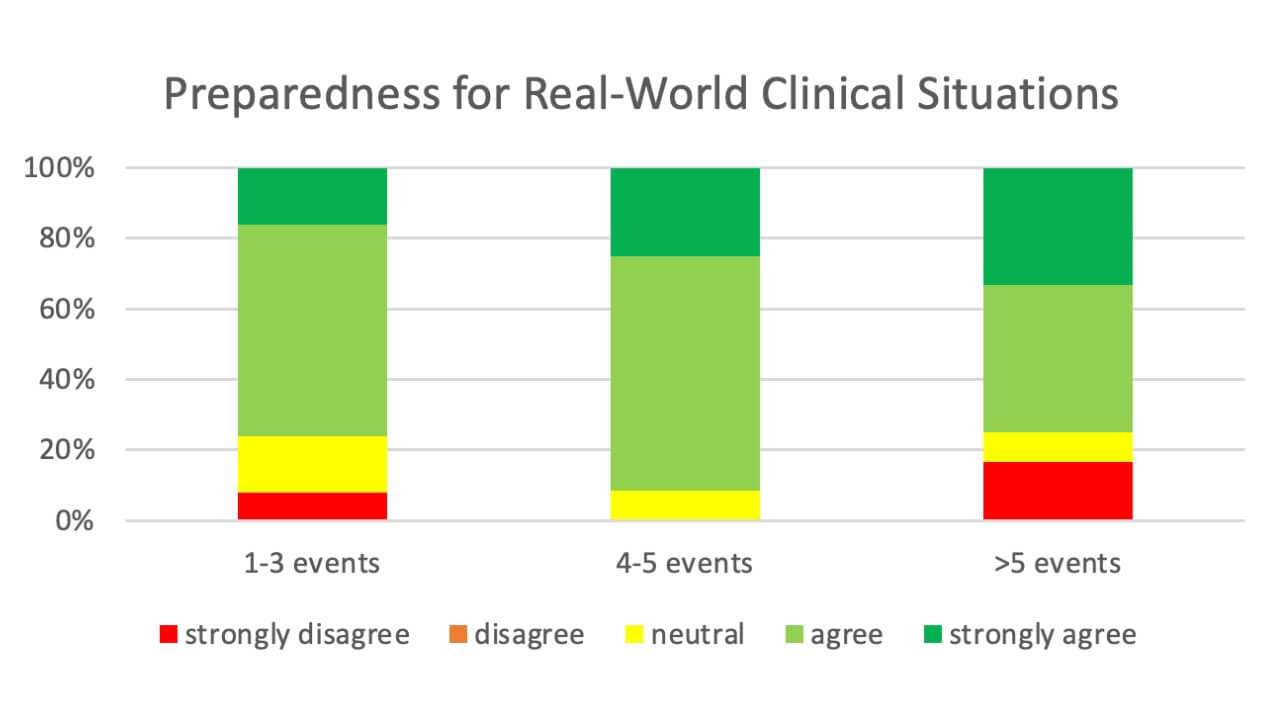
- For perceived preparedness for real-world clinical situations, there is a negative correlation between number of events attended and mean ratings(1-3 events: u=3.78, 4-5 events: u=4.17, more than 5 events: u=3.75). Slope = -0.015 (mean rating vs number of events attended)
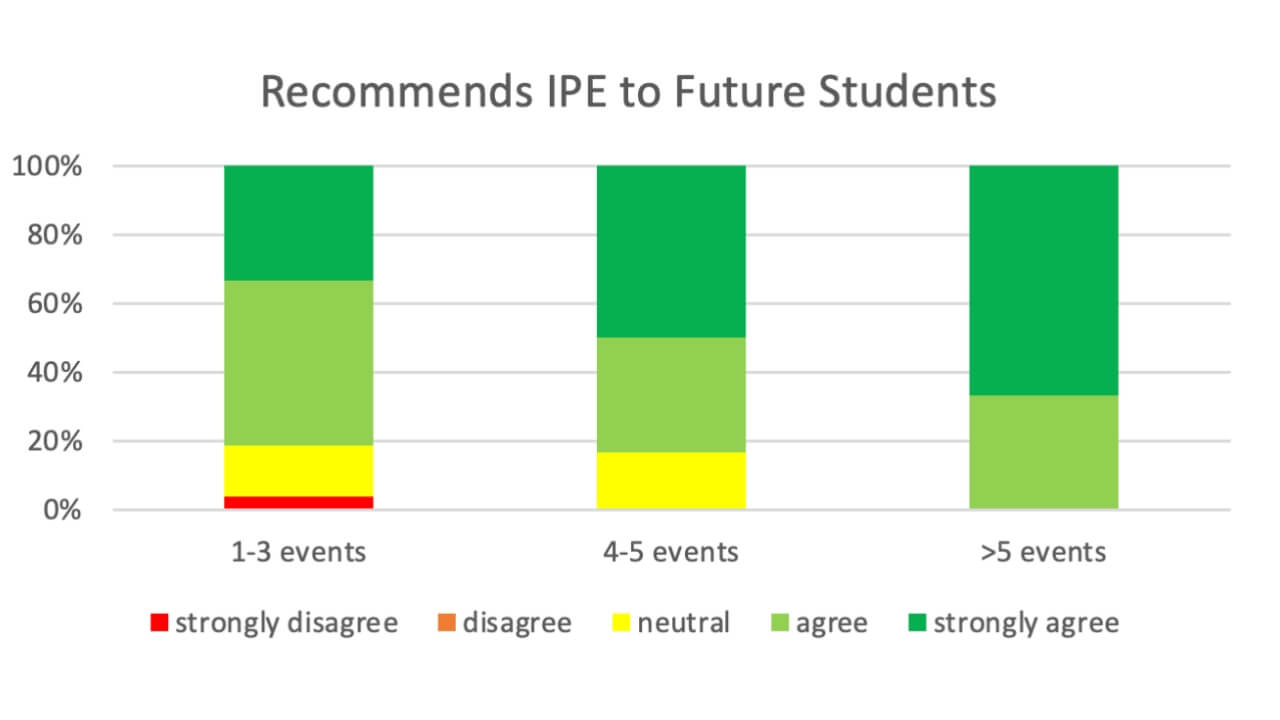
- When asked if they would recommend the CIHE events to other students, there is a positive correlation between number of events attended and mean ratings(1-3 events: u=4.07, 4-5 events: u=4.33, more than 5 events: u=4.67). Slope = 0.300 (mean rating vs number of events attended)
- NACE Competencies
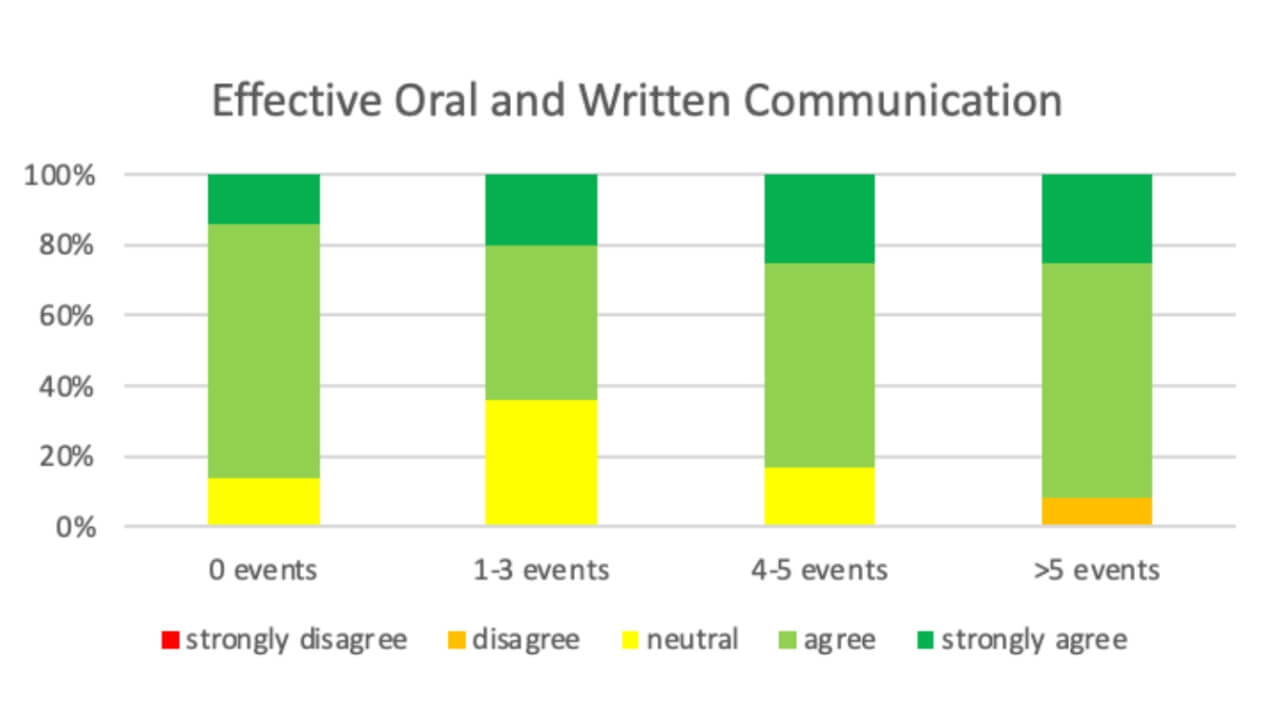
- For perceived oral and written communication skills, there is a positive correlation between number of events attended and mean ratings, (0 events: u=4.00, 1-3 events: u=3.84, 4-5 events: u=4.08, more than 5 events: u=4.08). Slope = 0.048 (mean rating vs number of events attended)
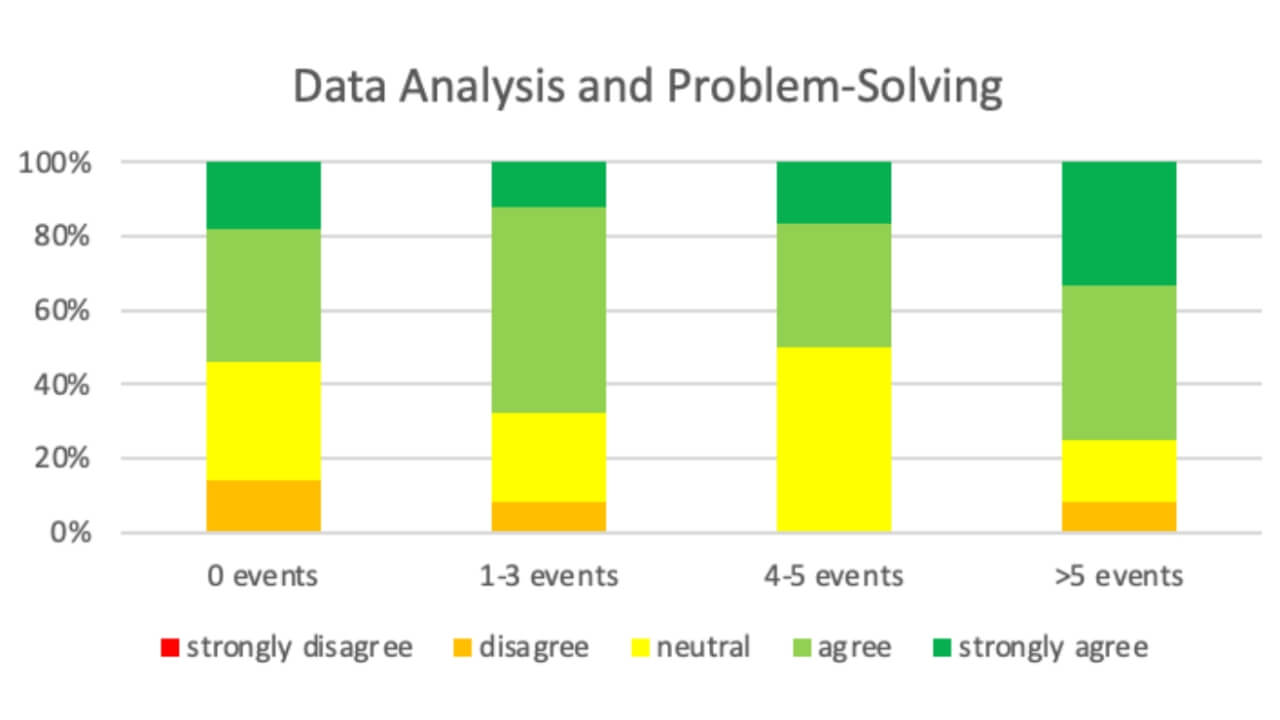
- For perceived data analysis and problem-solving skills, (0 events: u=3.59, 1-3 events: u=3.72, 4-5 events: u=3.67, more than 5 events: u=4.00). Slope = 0.118 (mean rating vs number of events attended)
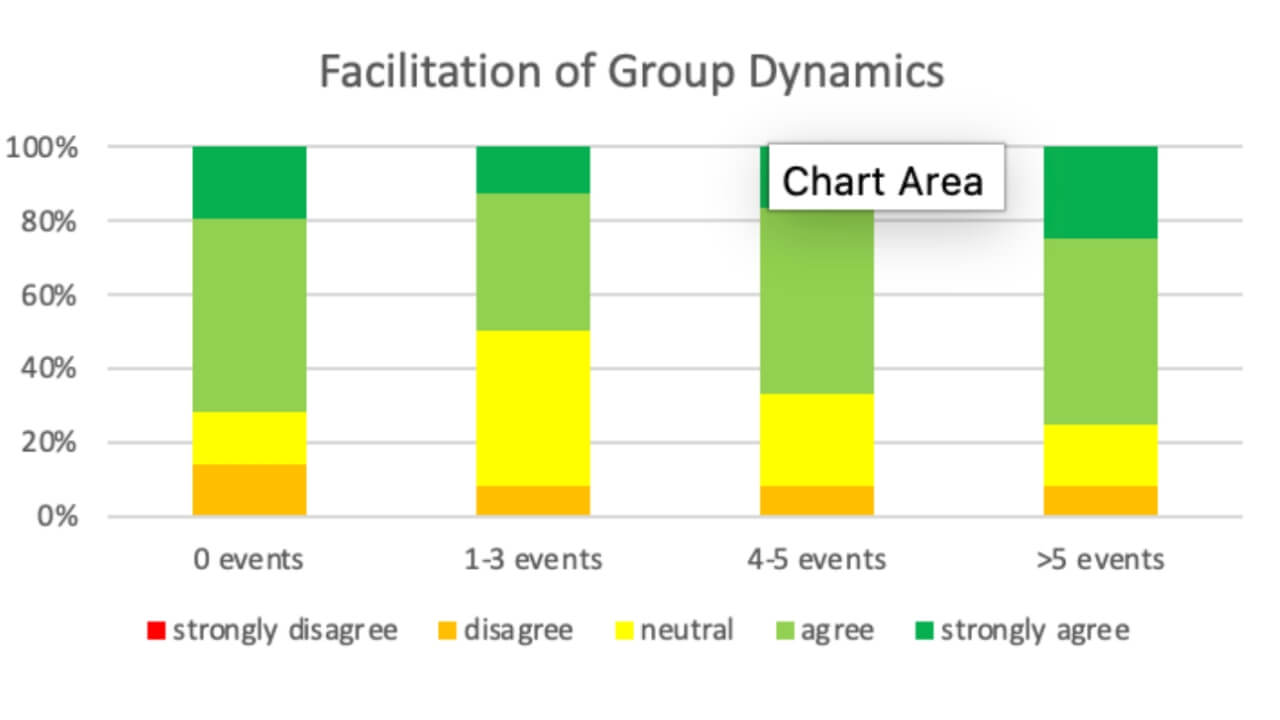
- For perceived facilitation of group dynamics (0 events: u=3.76, 1-3 events: u=3.52, 4-5 events: u=3.75, more than 5 events: u=3.92). Slope = 0.071 (mean rating vs number of events attended)
- For both perceived communication skills and perceived facilitation of group dynamics, the ratings of those who attended zero events are higher than the trend suggests. This is possibly due to lack of understanding of weakness and skills to work on when not exposed to environments that demonstrate these skills.
Conclusions
- The data supports that Quinnipiac University students who participate in IPE events have an increased confidence in their abilities to communication with students from other disciplines, oral and written communication skills, data analysis and problem-solving skills and ability to facilitate group dynamics.
- The data suggests that students who attended more events don’t necessarily feel more confident in their preparedness for real-world situations.
- The data also suggests that perceived abilities vary more between students participating in varying levels of CIHE events than between students who don’t participate in the events compared to those who do participate.
- Follow up research can be conducted to understand if these results are due to gaps in the event curricula or students’ recent awareness of complexities in healthcare or interprofessional collaboration.
Limitations
- Data collected is only a self-reported perception of an individual’s abilities, not a standardized assessment
- Some students may have selected incorrect answers or misread survey questions
- Confounding variables, including clinical experiences, healthcare employment. participation in the IPE micro-credential, GPA, etc., were not controlled for
Looking Forward
- Analyze post-graduate outcomes in a longitudinal study to assess direct outcomes
- Analyze for confounding variables, including clinical experiences, healthcare employment. participation in the IPE micro-credential, GPA, etc.
Resources
1Green, B. N. and (2015). Interprofessional collaboration in research, education, and clinical practice: working together for a better future. The Journal of Chiropractic Education, Vol. 29 (1).
2Hill, E. (2019). 12 tips for developing inter-professional education (IPE) in healthcare. National Library of Medicine, Vol. 8 (69).
Faculty Mentor
Julie Booth
Director of the Center for Interprofessional Healthcare Edu
Clinical Associate Professor of Physical Therapy
Physical Therapy
Professional Application
"There are two main ways that this project helped my career preparation. First, it gave me direct insight into the importance of interprofessional collaboration within healthcare, something that will take me far in my work. Second, it has helped me understand the importance of the Center for Interprofessional Healthcare Education and the importance of implementing interprofessional programs in higher education." - Eve Behrens ’27, DPT ’30
For Further Discussion
This serves as an overview of the project and does not include the complete work. To further discuss this project, please email Eve Behrens.
Center Overview
The Center for Interprofessional Healthcare Education supports innovative, collaborative learning to develop healthcare professionals who can provide evidence-based, coordinated, person- and client-centered healthcare. The center enables faculty, students and community partners to learn together, identify effective and efficient delivery options and engage in team practice that meets the challenges of 21st-century healthcare.
Learn more about the Center for Interprofessional Healthcare Education
Explore Our Areas of Interest
We've sorted each of our undergraduate, graduate and doctoral programs into unique Areas of Interest. Explore these categories to discover which programs and delivery methods best align with your educational and career goals.