


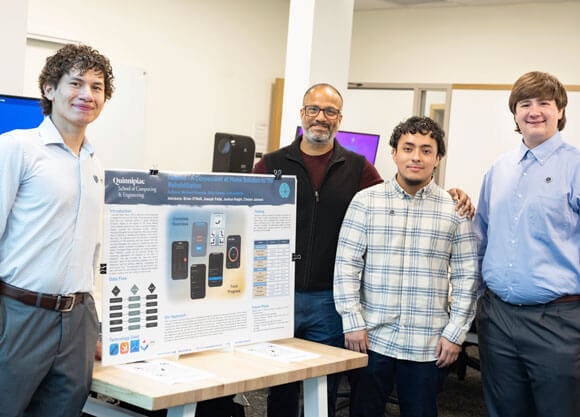
Joshua Lewis Haight
Associate Professor of Psychology
Joshua Haight joined Quinnipiac University in 2019 as an Assistant Professor in the Department of Psychology. He received his B.A. in Psychology from Connecticut College in 2009, and then went to work as a research assistant for two years in the Dyslexia Research Lab at Beth Israel Deaconess Medical Center/Harvard Medical School. He received his Ph.D. in Neuroscience from the University of Michigan in 2016, where he worked in the lab of Dr. Shelly Flagel studying the neural mechanisms underlying individual differences in Pavlovian conditioning, and received funding from a National Institute of Drug Abuse NRSA award. After graduate school, he completed his postdoctoral training in the lab of Dr. Nii Addy at Yale University, studying the neural circuitry of depression-related behaviors. Dr. Haight teaches courses in the psychology and behavioral neuroscience majors, including Introduction to Psychology, Physiological Psychology, and Drugs, Brain & Behavior. Dr. Haight also supervises research students and runs a research program on campus studying the neural mechanisms of motivation in healthy and diseased states.
Education
- MS, University of Michigan
- PHD, University of Michigan
Areas of Expertise
- Behavioral Neuroscience
- Motivation
- Depression
Organization
- Psychology
Office Location
- The Site 176
Mail Drop
- SI-TE1
Quinnipiac Today
Experience
Quinnipiac University
Associate Professor of Psychology
Hamden, CT
2026 - Present
Quinnipiac University
Assistant Professor of Psychology
Hamden, CT
2019 - 2026
Yale University
Postdoctoral Associate in Psychiatry
New Haven, CT
2016 - 2019
University of Michigan
Graduate Student, Neuroscience Graduate Program
Ann Arbor, MI
2011 - 2016
Selected Publications
Peer Reviewed Journal
Ventral tegmental area M5 muscarinic receptors mediate effort-choice responding and nucleus accumbens dopamine in a sex specific manner
Nunes, E., Kebede, N., Haight, J., Foster, D., Lindsley, C., Conn, P., Addy, N.
385 The Journal of Pharmacology and Experimental Therapeutics 146-156 May (2023)