
Quinnipiac University

BS in Construction Management Curriculum

Our curriculum builds industry-specific knowledge and skills while giving you the flexibility to customize your schedule based on your needs. Below are the course requirements for the Construction Management program, and an example of what your academic experience might look like.

Build the skills to lead complex construction projects

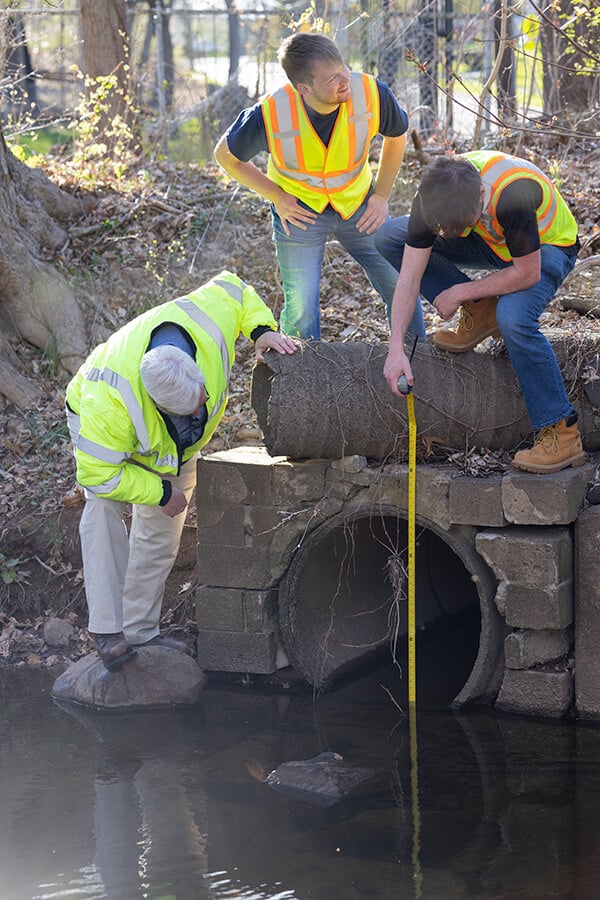
Three people wearing high-visibility safety gear inspect and measure a concrete culvert carrying water beneath an embankment, with one person standing on a rock in the stream while others take measurements from above in a wooded area.

Our curriculum combines courses in mathematics, science, business and engineering to provide a comprehensive foundation in construction management, spanning safety planning, quality assurance and sustainable construction practices. You'll gain the technical knowledge, leadership skills and practical expertise needed to manage complex projects from concept to completion.

You'll also explore:

  • Construction technology: the digital tools used to manage today's projects

  • Estimating and cost control: pricing projects accurately and managing budgets through completion

  • Planning and scheduling: building realistic schedules and keeping work on track

  • Construction methods and materials: how projects are built and the equipment used to build them

  • Site design and surveying: construction layout, site control and visualization

  • Building systems and structures: structural behavior and HVAC, electrical and plumbing systems

  • Project delivery and law: contracts, regulations and the roles of owners, designers and builders

Learning Outcomes

Upon graduation from an ACCE (American Council for Construction Education)–accredited bachelor’s degree program, all graduates will be able to: 

  1. Create written communications appropriate to the construction discipline.
  2. Create oral presentations appropriate to the construction discipline.
  3. Create a construction project safety plan.
  4. Create construction project cost estimates.
  5. Create construction project schedules.
  6. Analyze professional decisions based on ethical principles.
  7. Analyze methods, materials, and equipment used to construct projects.
  8. Apply electronic-based technology to manage the construction process.
  9. Apply basic surveying techniques for construction layout and control.
  10. Understand different methods of project delivery and the roles and responsibilities of all constituencies involved in the design and construction process.
  11. Understand construction accounting and cost control.
  12. Understand construction quality assurance and control.
  13. Understand construction project control processes.
  14. Understand the legal implications of contract, common, and regulatory law to manage a construction project.
  15. Understand the basic principles of sustainable construction.
  16. Understand the basic principles of structural behavior.
  17. Understand the basic principles of HVAC, electrical and plumbing systems.