Quinnipiac University

Chemistry

Construction and Deployment of a Portable, Low-Cost Sensor Unit for Measurement of CO2 Fluctuations

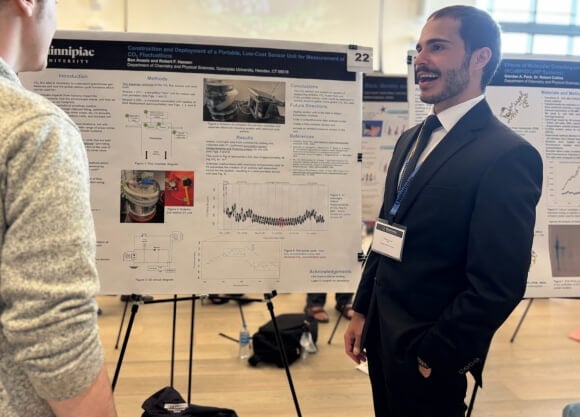
Benjamin Anasis standing in front of poster

Chemistry

Construction and Deployment of a Portable, Low-Cost Sensor Unit for Measurement of CO2 Fluctuations

Benjamin Anasis ’26 completed this project as a part of CHE 491: Chemistry Research II under the mentorship of Dr. Robert Hansen, assistant professor of chemistry. 

Overview

This project develops and tests a low-cost portable chamber system for measuring small-scale soil CO₂ fluxes, providing an accessible tool for studying carbon cycling and greenhouse gas emissions.
Researcher

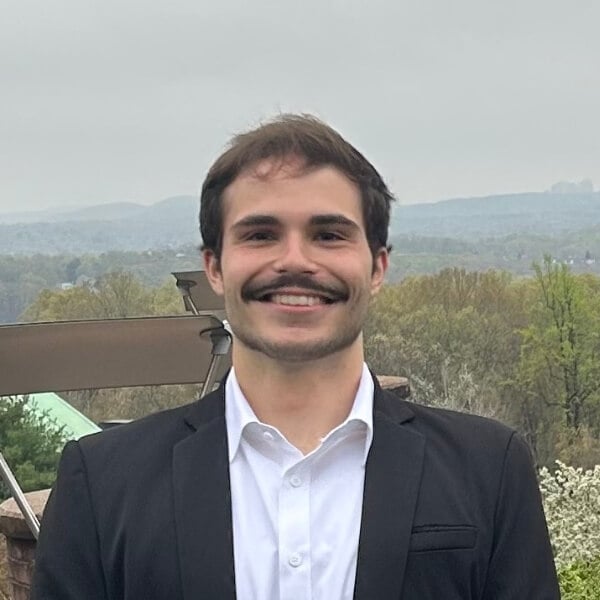
Headshot of Benjamin Anasis

Benjamin Anasis ’26

Chemistry, Environmental Science

College of Arts & Sciences

Construction and Deployment of a Portable, Low-Cost Sensor Unit for Measurement of CO2 Fluctuations


Introduction

  • CO2 flux data is necessary to understand greenhouse gas balances and how the global carbon cycle functions which can be used for:
    • Climate impacts (how humans impact the environment, how the environment reacts, and how we can reduce our footprint)

    • Optimizing agricultural practices (carbon sequestration through reduced tilling, optimizing fertilizer use, planting cover crops, etc.) to annually maximize efficiency, reduce costs, and increase soil resilience

  • CO2 flux data is gathered in various locations, but with more long-term datasets from a wider range of areas comes a greater global understanding of climate systems
  • Current methods primarily use sensor units that are both permanent and cost-prohibitive installations (providing high quality data with little interference but at the cost of having a larger network of sensor units to cover more ground)
  • This research investigates an alternative method which solves the problem of both cost and permanence by making a portable and inexpensive sensor unit 
  • CO2 flux is defined as the direction and rate of flow between two CO2 sinks4 and can be calculated using
    • F = (dC/dt)((Pamb x V)/(Rgas x T x A))
  • Variables:
    • F = Calculated flux (μmol m−2 hr−1)
    • dC/dt = Concentration change of CO2 over time (ppm hr-1)
    • Pamb = Ambient pressure (Pa)
    • V = Chamber volume (m3)
    • Rgas = Ideal gas constant (8.314 m3 Pa K−1 mol−1)
    • T = Temperature (K)
    • A = Chamber surface area (m2)
  • To calculate fluctuations, the change in concentration of CO2 over time can be measured using a sensor unit

Project Objectives

  • Construct a low-cost, portable carbon dioxide flux sensor unit able to repeatedly measure soil fluctuations
  • Deploy in the field and gather ambient data
  • Code a functional program to run the system
  • Code a functional data analysis method

Methods

  • Two separate versions of the CO2 flux sensor unit were built
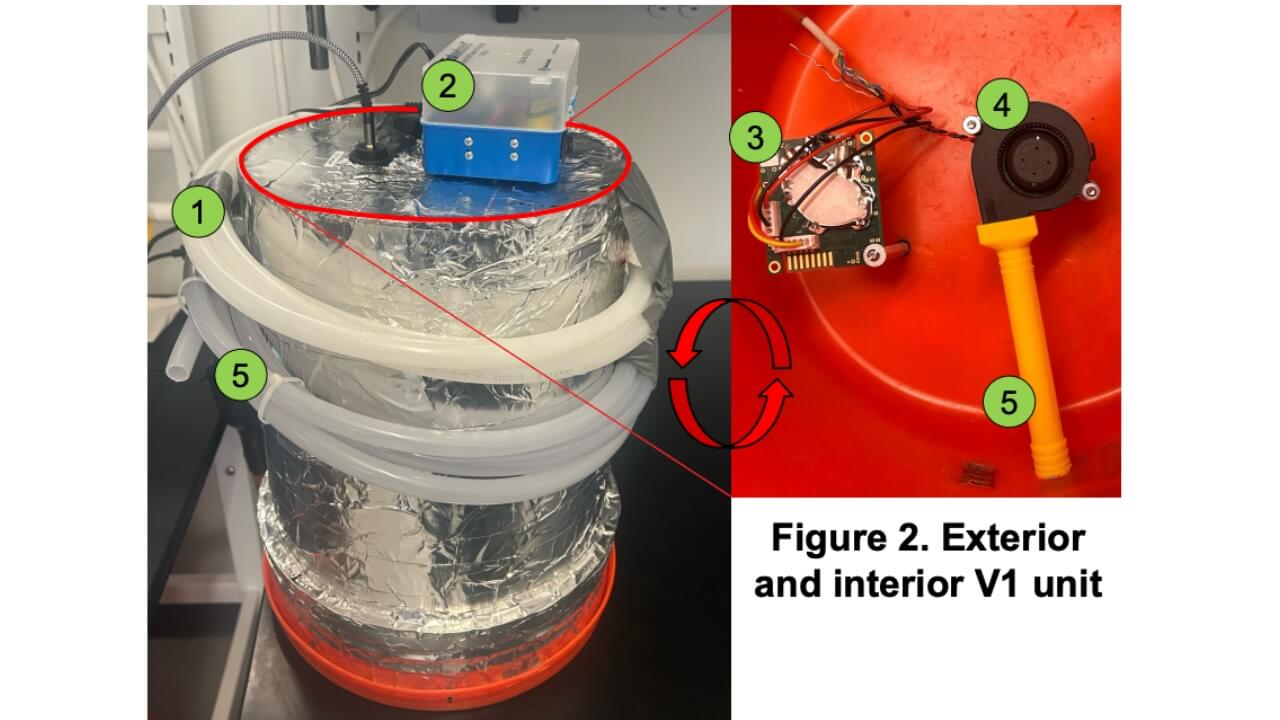
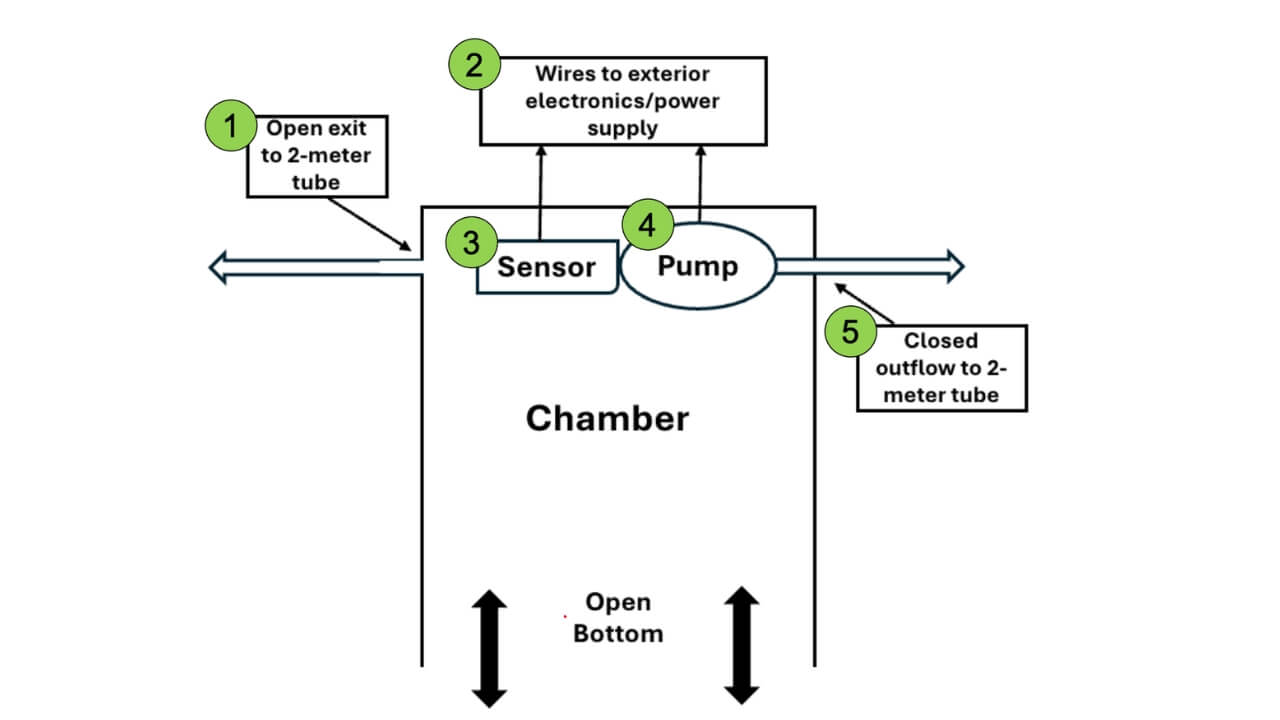
  • Version 1 (V1) – a simplified “test” unit for indoor use (not portable) (see Figs. 1 and 2)
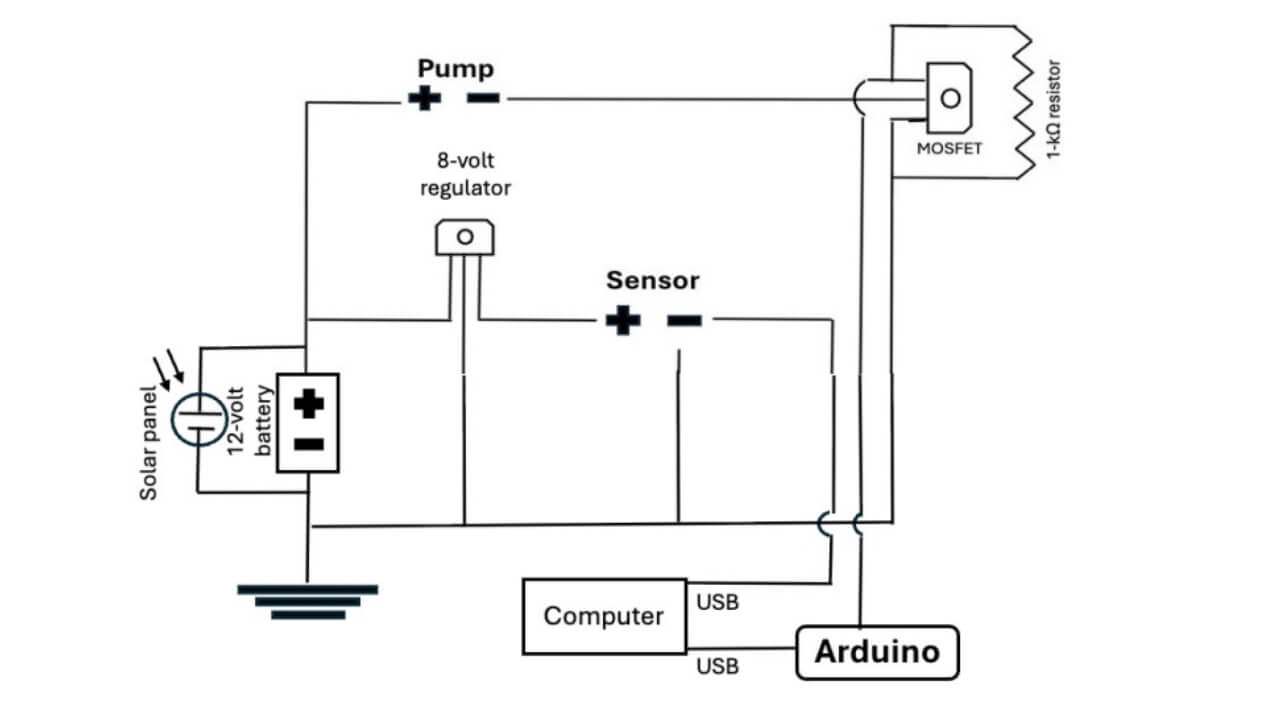
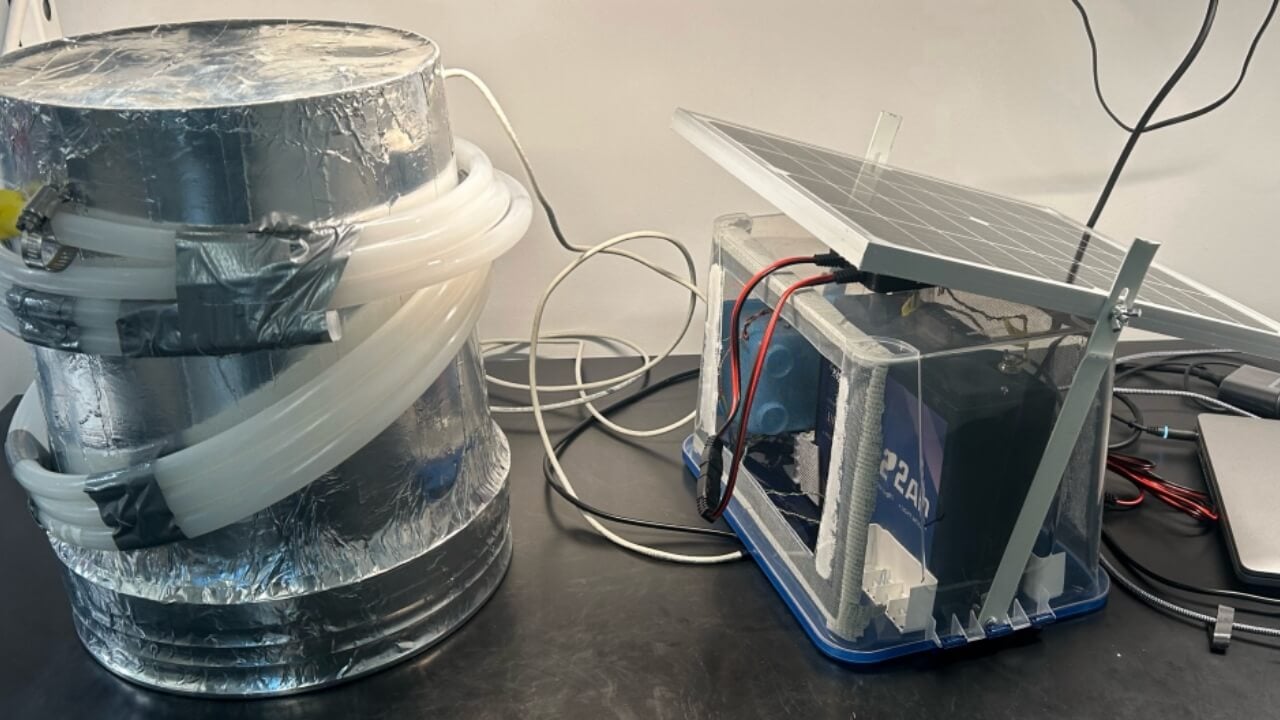
  • Version 2 (V2) – a complete automated unit capable of field deployment (semi-portable) (see Figs. 1, 3, and 4)

Results

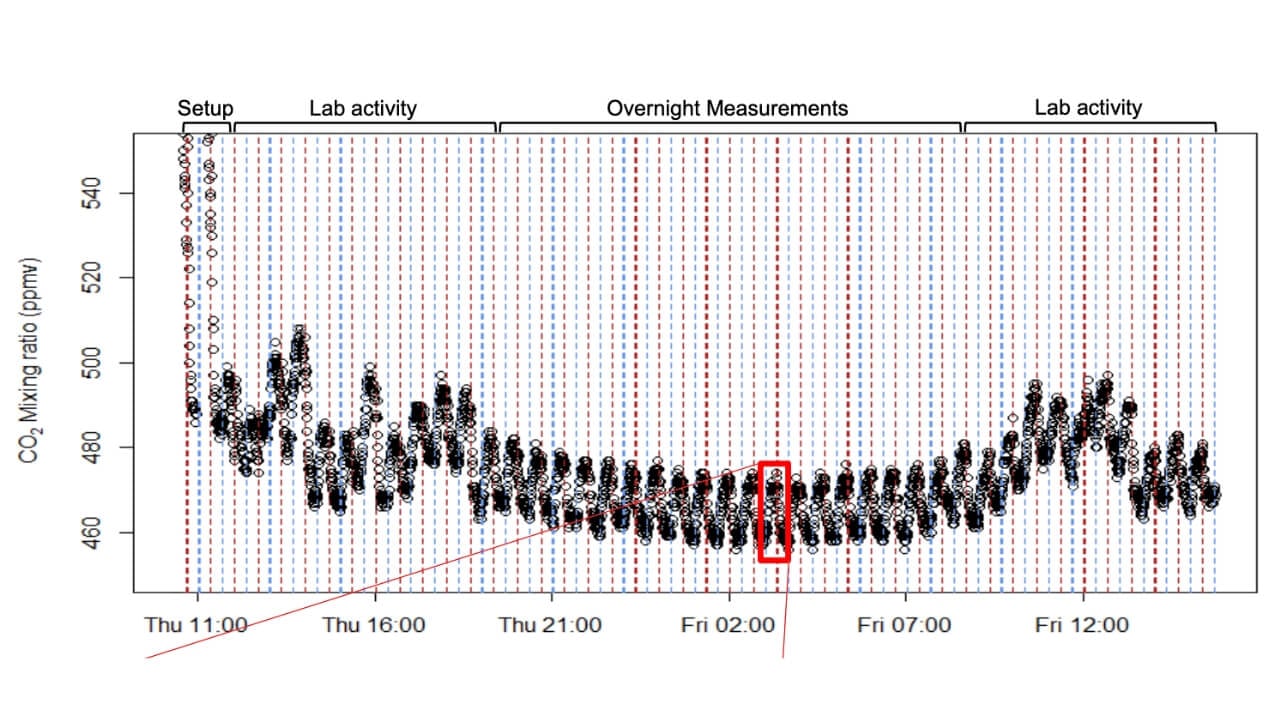
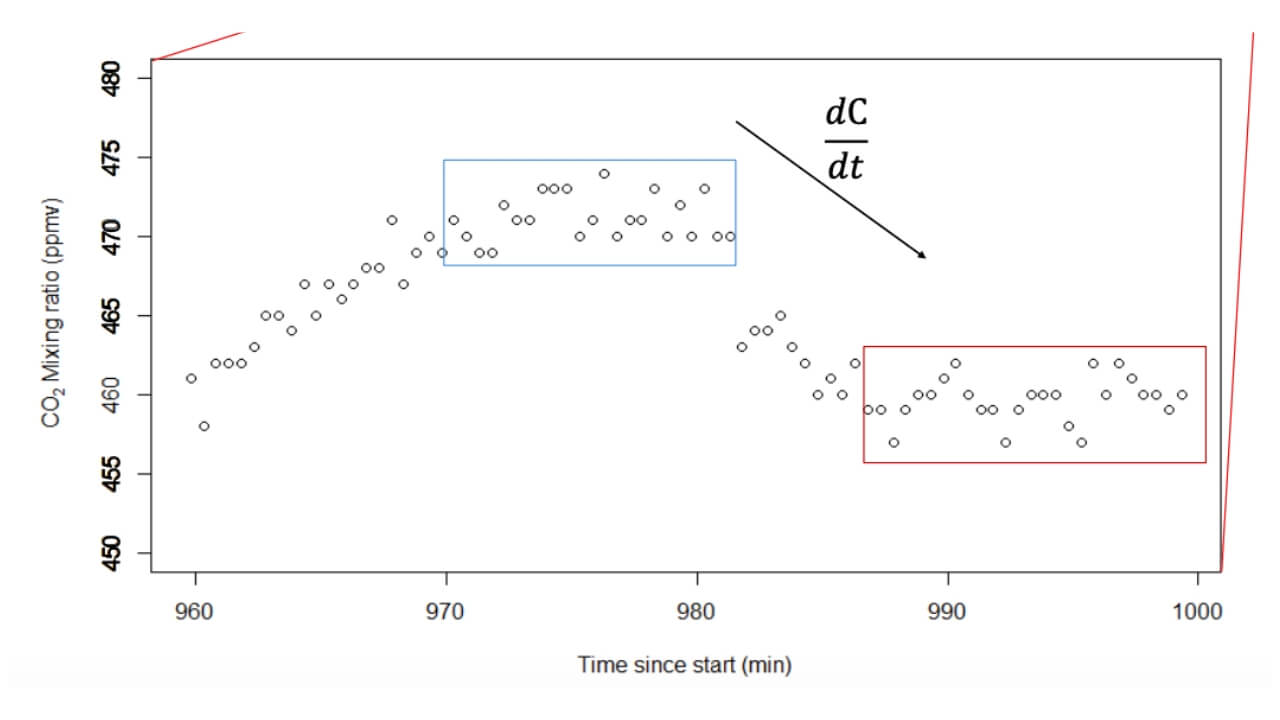
  • Indoor, overnight data from commercial potting mix collected with V1 confirmed successful sensor measurements and flushing system for the unit (see Figs. 5 and 6)
  • The cycle in Fig. 6 represents a CO2 flux of approximately 38 mg CO2 hr-1 m-2
  • Unknown malfunctions with electronic components used for V2 prevented the creation of an entirely self-dependent circuit for the system, resulting in a semi-portable sensor unit (see Fig. 3)

Conclusions

  • The CO2 sensor unit system is capable of measuring ambient CO2 fluxes from soil. 
  • Fully portable sensor units could be deployed in remote areas to gather more global CO2 flux data

Future Directions

  • Deploy sensor unit in the field at Albert Schweitzer Institute
  • Code a comprehensive data analysis script
  • Create a fully portable sensor unit
  • Include an ambient pressure sensor in the unit


References 

Ameriflux. About Data. https://ameriflux.lbl.gov/data/aboutdata/. [accessed 19 Mar. 2026]

Bastviken, D., Sundgren, I., Natchimuthu, S., Reyier, H., & Gålfalk, M. Cost-efficient approaches to measure carbon dioxide (CO2) fluxes and concentrations in 2 terrestrial and aquatic environments using mini loggers 3. Biogeosciences 12, 3849-3859, 2015.

Sø, J. S., Sand-Jensen, K., & Kragh, T. Self-made equipment for automatic methane diffusion and ebullition measurements from aquatic environments. Journal of Geophysical Research: Biogeosciences, 129(6), e2024JG008035, 2024.

Earth Science Data Systems, NASA. 30 Sept. 2024. Carbon Flux. www.earthdata.nasa.gov/topics/climate-indicators/carbon-flux. [accessed Mar. 24, 2026]

Faculty Mentor

For Further Discussion

This serves as an overview of the project and does not include the complete work. To further discuss this project, please email Robert Hansen.

Course Overview

In CHE 491: Chemistry Research II, students continue their work on a chemistry research project, which they began in CHE 490. A minimum of 100 lab hours or equivalent is required. 

Explore Our Areas of Interest

We've sorted each of our undergraduate, graduate and doctoral programs into unique Areas of Interest. Explore these categories to discover which programs and delivery methods best align with your educational and career goals.

Explore Physical/Life Sciences at Quinnipiac

Explore Health and Medicine at Quinnipiac

Explore Education at Quinnipiac

Explore STEM at Quinnipiac

Explore Enviroment and Sustainability at Quinnipiac