

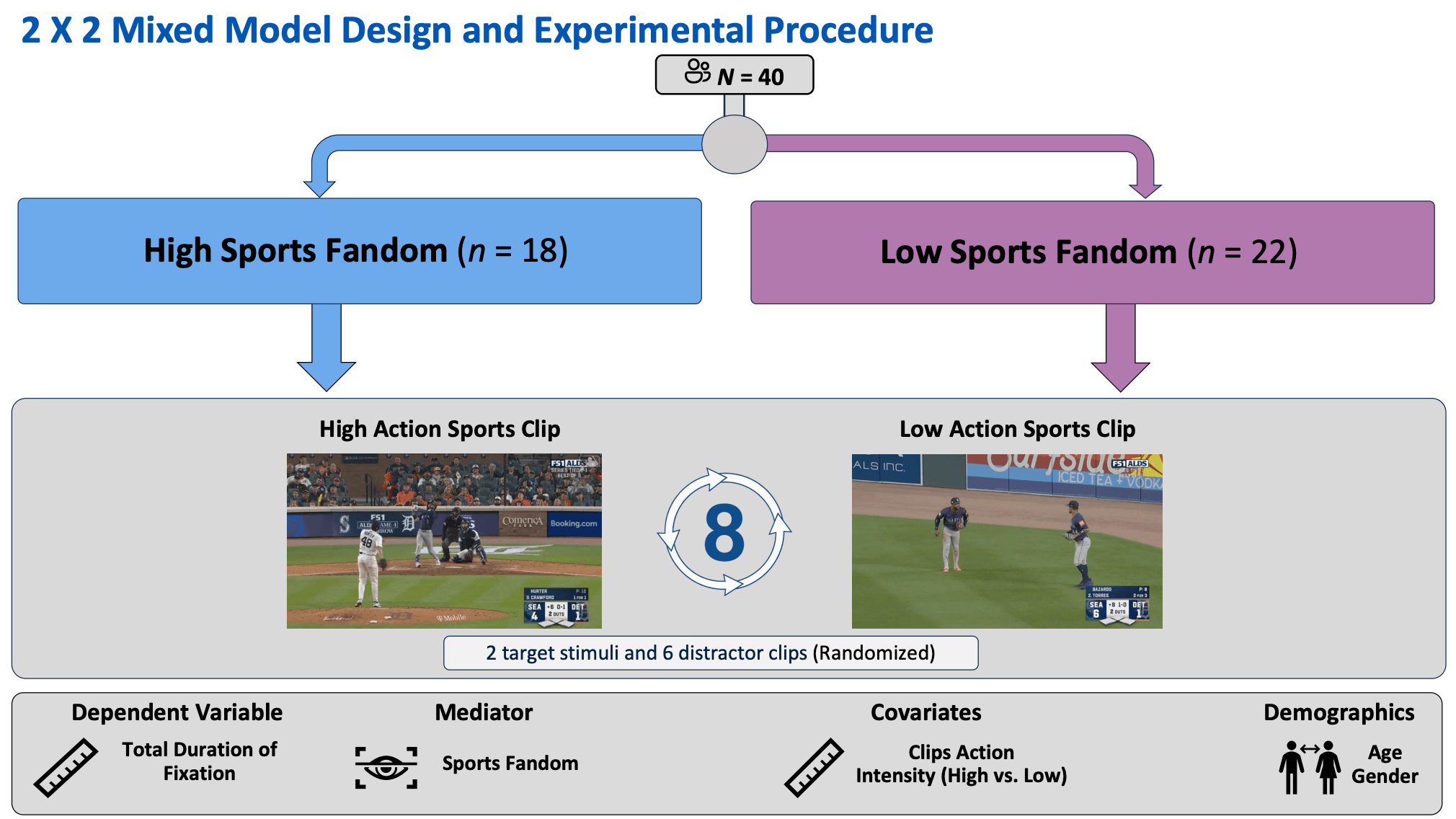
With 40 participants, 18 were High Sports Fandom and 22 were Low Sports Fandom. Both groups were shown a High Action sports clip and a Low Action sports clip randomized with 6 distractor clips. Total duration of fixation was measured.

Marketing
Marketing
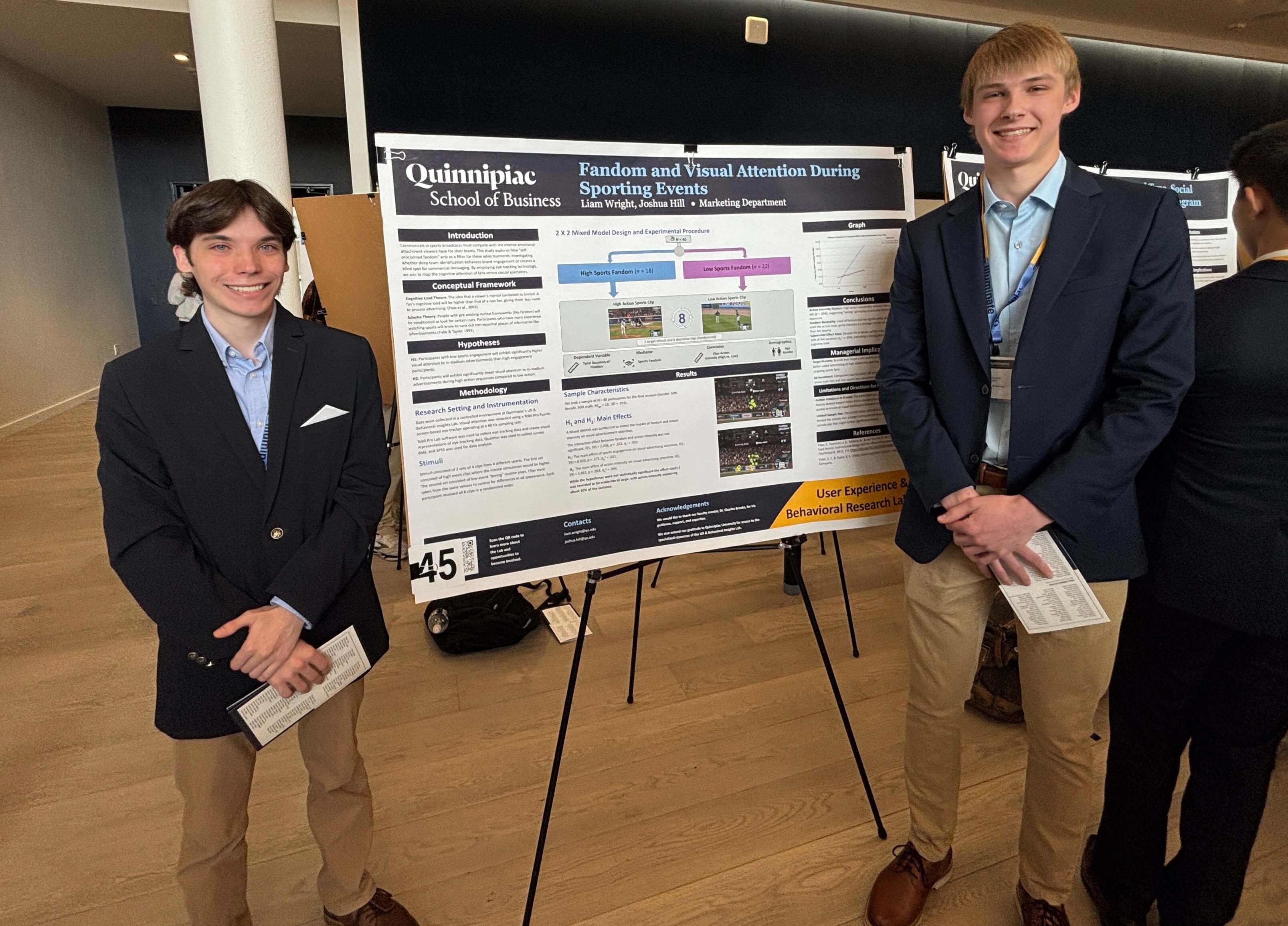
Liam Wright '27, MBA '28 and Josh Hill '27, MS '28 conducted this research for the course MK 328: Behavioral Research Fellowship.
This research project examined how sports fandom and game action intensity influence attention to in-game advertisements. Using eye-tracking technology, we analyzed visual fixation patterns across high- and low-action sports clips among participants with varying levels of sports engagement, uncovering how viewing context impacts advertising effectiveness and informing more strategic ad placement decisions.

Marketing, BS/MBA (3+1)
School of Business

Marketing, BS/MS in Applied AI and Business Analytics (3+1)
School of Business
Commercials in sports broadcasts must compete with the intense emotional attachment viewers have for their teams. This study explores how "self-proclaimed fandom" acts as a filter for these advertisements, investigating whether deep team identification enhances brand engagement or creates a blind spot for commercial messaging. By employing eye-tracking technology, we aim to map the cognitive attention of fans versus casual spectators.
The idea that a viewer's mental bandwidth is limited. A fan's cognitive load will be higher than that of a non-fan, giving them less room to process advertising (Paas et al., 2003).
People with pre-existing mental frameworks (like fandom) will be conditioned to look for certain cues. Participants who have more experience watching sports will know to tune out non-essential pieces of information like advertisements (Fiske & Taylor, 1991).
H1: Participants with low sports engagement will exhibit significantly higher visual attention to in-stadium advertisements than high-engagement participants.
H2: Participants will exhibit significantly lower visual attention to in-stadium advertisements during high-action sequences compared to low action.
Data were collected in a controlled environment at Quinnipiac’s UX & Behavioral Insights Lab. Visual attention was recorded using a Tobii Pro Fusion screen-based eye tracker operating at a 60 Hz sampling rate. Tobii Pro Lab software was used to collect eye-tracking data and create visual representations of eye-tracking data, Qualtrics was used to collect survey data and SPSS was used for data analysis.
Stimuli consisted of 2 sets of 4 clips from 4 different sports. The first set consisted of high event clips where the mental stimulation would be higher. The second set consisted of low-event "boring" routine plays. Clips were taken from the same venues to control for differences in ad appearance. Each participant received all 8 clips in a randomized order.
2 X 2 Mixed Model Design and Experiment
With 40 participants, 18 were High Sports Fandom and 22 were Low Sports Fandom. Both groups were shown a High Action sports clip and a Low Action sports clip randomized with 6 distractor clips. Total duration of fixation was measured.
We took a sample of N = 40 participants for the final analysis (Gender: 50% female, 50% male; Mage = 19, SD = .918).
A Mixed ANOVA was conducted to assess the impact of fandom and action intensity on visual advertisement attention.
The interaction effect between fandom and action intensity was not significant, F(1, 39) = 2.036, p = .162, ηp2 = .051
H1: The main effect of sports engagement on visual advertising attention, F(1,39) = 0.820, p = .371, ηp2 = .021.
H2: The main effect of action intensity on visual advertising attention, F(1,39) = 3.963, p = .054, ηp2 = .094.
While the hypotheses were not statistically significant, the effect size(ηp2) was revealed to be moderate to large, with action intensity explaining about 10% of the variance.
High-action sequences reduce visual attention to ads (p = .054), suggesting "boring" gameplay is actually better for brand exposure.
Level of fandom did not significantly affect ad attention until the action rose; game intensity is a stronger driver of gaze behavior than fan loyalty.
Despite the p-values, action intensity explained 10% of the variance (ηp2 = .094), indicating a strong practical impact on cognitive load.
Brands that target a non-sports-centered audience would be better suited advertising at high viewership sporting events than Brands targeting sports fans.
Companies may be better off advertising in low event sports where both fans and non sports fans demonstrate similar ad awareness.
The participant group identifying as fans was heavily skewed toward males; future studies should implement recruitment quotas to ensure an equal distribution between male and female subjects.
The current study utilized a brief testing window that limited the sample size; a longer testing period would allow for a greater sample size that might further reduce significance levels.
Paas, F., Tuovinen, J. E., Tabbers, H., & Van Gerven, P. W. (2003). Cognitive load theory: Instructional design and the effects of complexity. Educational Psychologist, 38(1), 1-4. https://doi.org/10.1207/S15326985EP3801_1
Fiske, S. T., & Taylor, S. E. (1991). Social cognition (2nd ed.). Mcgraw-Hill Book
Company.
"This project strengthened my skills in experimental design, data analysis (SPSS & Qualtrics) and translating behavioral insights into actionable marketing strategies. I’m especially interested in continuing to apply data-driven research like this within sports marketing and analytics roles." - Liam Wright '27, MBA '28
This serves as an overview of the project and does not include the complete work. To further discuss this project, please email Josh Hill or Liam Wright.
In MK 328: Behavioral Research Fellowship, each Research Fellow designs and carries out an independent research study in conjunction with a faculty member. The course covers advanced research techniques using state-of-the-art technologies. Students gain valuable hands-on experience by administering a variety of studies in the Marketing Insights and Behavioral Research Lab.
As a part of the Innovation Hub, the mission of Quinnipiac’s User Experience and Behavioral Insights Lab is to foster a dynamic and collaborative research environment dedicated to advancing knowledge, innovation and societal impact.
We've sorted each of our undergraduate, graduate and doctoral programs into unique Areas of Interest. Explore these categories to discover which programs and delivery methods best align with your educational and career goals.