


Marketing
From Fixation to Preference: How Sustainability Cues Drive Attention Across Diverse Product Categories
Marketing
From Fixation to Preference: How Sustainability Cues Drive Attention Across Diverse Product Categories
Elisabeth Duffelmeyer ’27 and Madeline Fournier ’26, MBA ’27 completed this study as a part of MK 328: Behavioral Research Fellowship.
Overview
This study investigates how sustainability and organic labels capture consumer visual attention across different product types using eye-tracking technology to measure exactly where and how long people look at packaging. Conducted at Quinnipiac University's Behavioral Insights Lab, the experiment had 64 participants evaluate mockup product packaging while a Tobii Pro eye-tracker recorded their gaze patterns in real time.
Student Researchers

Elisabeth Duffelmeyer ’27
Marketing
School of Business
Madeline Fournier ’26, MBA ’27
Marketing
School of Business
From Fixation to Preference: How Sustainability Cues Drive Attention Across Diverse Product Categories
Introduction
Sustainability is now a mainstream expectation, and labels like “organic” influence consumer perceptions and purchase decisions. This study uses eye-tracking to examine how sustainability labels capture attention for hedonic versus utilitarian products and explores both bottom-up and top-down visual processing.
Conceptual Framework
Hedonic Goods (“Wants”): Driven by pleasure and emotion. Sustainability cues can reduce guilt and enhance appeal.
Utilitarian Goods (“Needs”): Focus on function and efficiency. Sustainability signals quality and long-term value but is secondary to performance.
Attention Processing: Sustainability labels capture early attention (bottom-up), while goals guide focus (top-down). Hedonic emphasizes moral justification, utilitarian emphasizes function.
Hypotheses
H1: The Attention Magnet: Sustainable products will have a lower Time to First Fixation than generic products across both categories.
H2: The Guilt-Justification Effect: Total Fixation Duration on sustainability claims will be higher for hedonic products than for utilitarian products.
H3: Environmental Concern as a Moderator: Consumers with high environmental concern will show greater fixation on sustainability cues across all categories.
Methodology
Research Setting & Instrumentation
Data were collected in Quinnipiac’s Behavioral Insights Lab using a Tobii Pro Fusion eye tracker. Tobii Pro recorded eye-tracking data, Qualtrics collected survey responses, and SPSS was used for analysis.
Stimuli
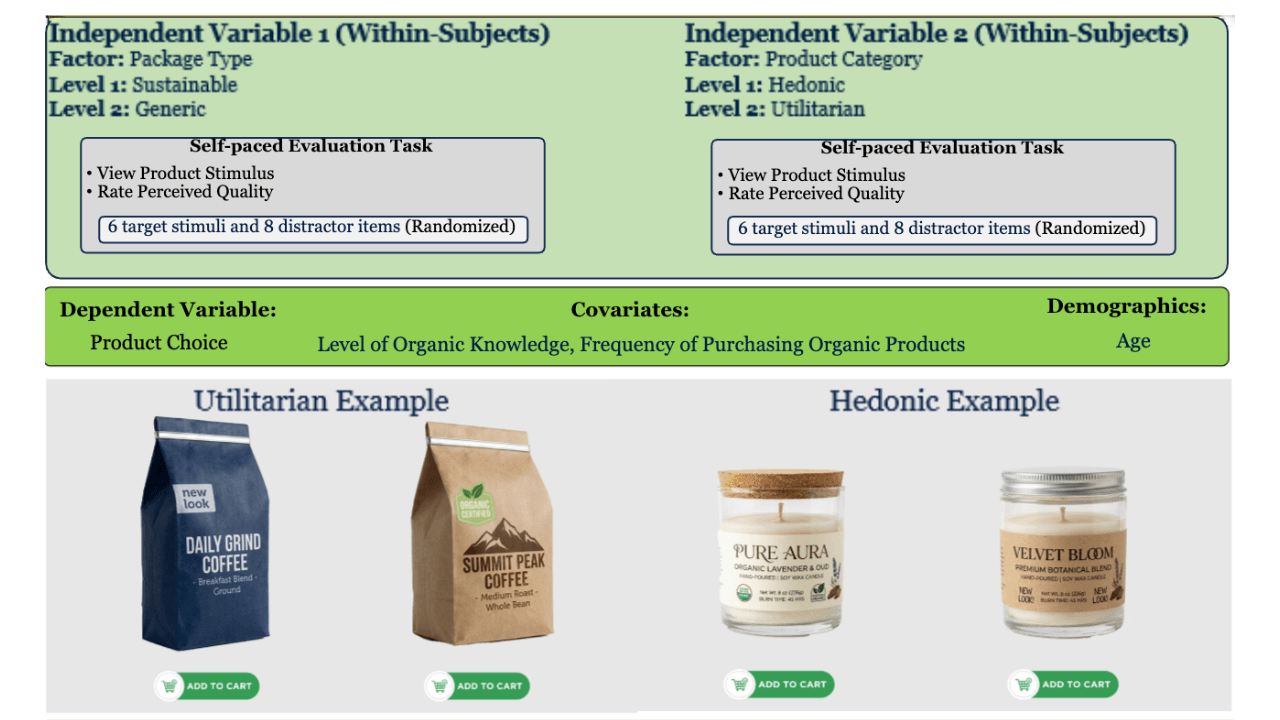
High-resolution mockups of fictitious brands were used to control for brand bias. Hedonic and utilitarian products were shown with sustainable (eco/organic labels) and generic packaging conditions.
Data Collection Method
Eye-tracking measured Time to First Fixation (TTFF) and Total Fixation Duration (TFD). Areas of Interest (AOIs) included sustainability labels, functional claims, and key packaging elements.
Research Design and Sample
A 2x2 within-subjects experimental design was used. Price was held constant to isolate visual and cognitive effects. Overall, our study included 65 participants, 56.9% were female, while 43.1% were male. The average age was 19 years old, with the minimum and maximum lying at 18 and 22, respectively.
2x2 Repeated Measures Experimental Design and Procedure
Statistical Tests
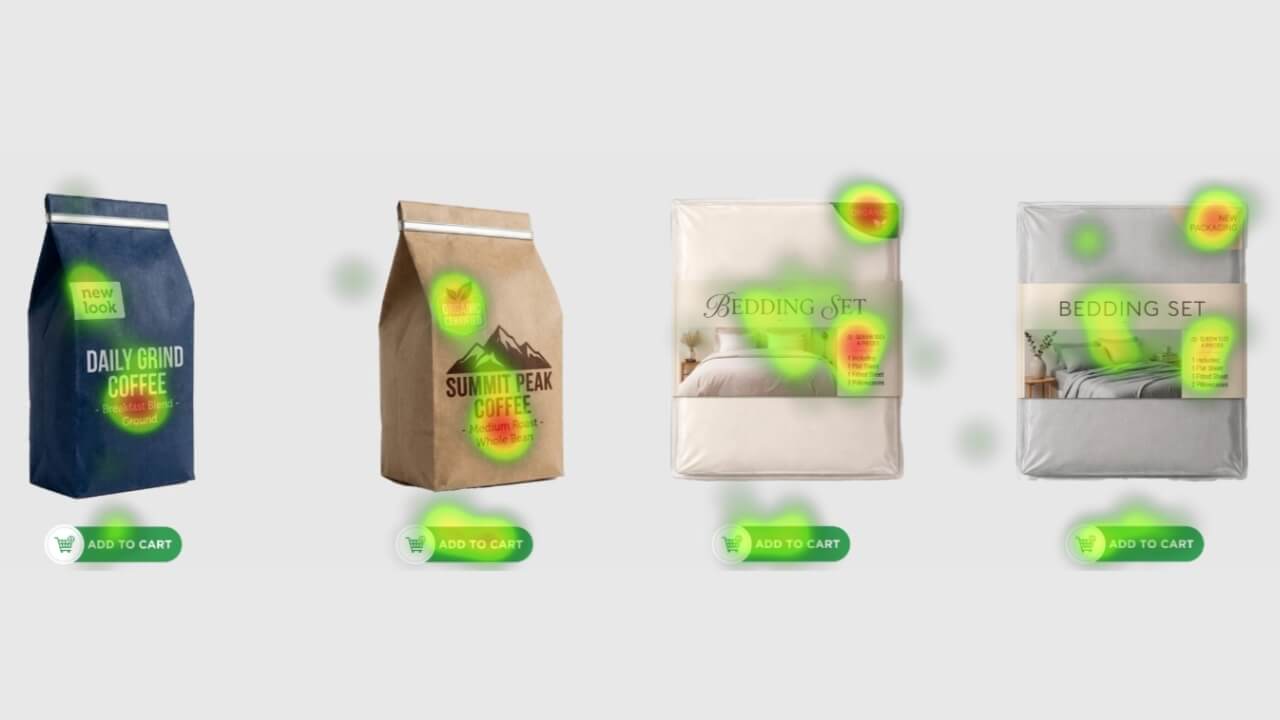
For H1: Time to First Fixation (TTFF) was lower for organic products; however, the difference was not significant (t=.820, p=.208)
For H2: Total Fixation Duration on organic labels was significantly higher than on generic labels (t=.820, p<.001).
For H3: Consumers with high environmental concern had a mean. Total Fixation Duration on organic labels of 2.1 seconds and a mean. Total Fixation Duration on generic labels of 2.7 seconds (p = .159). The results were not significantly different.
Results
Conclusions
The Justification Mechanism: Data confirms that sustainability acts as a moral tie-breaker. It doesn't always grab attention faster (H1), it holds attention longer (H2) when the product is tied to pleasure and emotional reward.
The "Value Gap" in Attention (H3): High environmental concern did not translate into significantly higher fixation on organic labels compared to generic ones. This suggests that even for environmentally conscious consumers, visual attention is driven more by the product category (hedonic vs. utilitarian) than by personal ideological values.
Managerial Implications
Prioritize Hedonic Categories: Because sustainability claims effectively reduce "purchase guilt," they are most influential on products like snacks, luxury items, or treats.
Beyond the "Green Segment": Since environmental concern didn't change how long people looked at lables, brands should design ego-packaging that appeals to the consumer's need for justification, rather than assuming "green" consumers will stare at the lables longer.
Limitations and Directions for Future Research
H1 & H3 Non-Significance: H1: Sustainability labels were notmagnets, suggesting that green-colored badges may now be so commonthey no longer trigger automatic visual capture. H3: The ANOVA forenvironmental concern showed no significant difference, whichsuggests a potential gap where personal concern does not result inincreased scrutiny of labels during the decision process.
Demographic Constraints: The study focused on a Gen Z sample. Future research should investigate if older demographics show the same lack of "hyper-fixation" found in H3.
References
Lim, W. M., et al. (2020). Consumer behavior in the context of sustainability: A review and research agenda. Journal of Cleaner Production, 277, 123925. https://doi.org/10.1016/j.jclepro.2020
Orquin, J. L., & Mueller Loose, S. (2013). Attention and choice: A review on eye movements in decision making. Acta Psychologica, 144(1), 190–206. https://doi.org/10.1016/j.actpsy.2013
Shi, R., et al. (2025). An eye-tracking study on the impact of green consumption behavior on consumer attention. Sustainability. https://doi.org/
Google. (2024). Gemini (March 2024 version) [Large language model]. https://gemini.google.com
For Further Discussion
This serves as an overview of the project and does not include the complete work. To dicuss this project further, please email Elisabeth Duffelmeyer and Madeline Fournier.
Course Overview
In MK 328: Behavioral Research Fellowship, each Research Fellow designs and carries out an independent research study in conjunction with a faculty member. The course covers advanced research techniques using state-of-the-art technologies. Students gain valuable hands-on experience by administering a variety of studies in the Marketing Insights and Behavioral Research Lab. Enrollment requires that instructor's approval.
Explore Our Areas of Interest
We've sorted each of our undergraduate, graduate and doctoral programs into unique Areas of Interest. Explore these categories to discover which programs and delivery methods best align with your educational and career goals.