


Nursing
Implementing Nurse-Led Interdisciplinary Rounds in the Adult ICU to Decrease Length of Stay
Nursing
Implementing Nurse-Led Interdisciplinary Rounds in the Adult ICU to Decrease Length of Stay
A. Sebastian Morales Barreto, RN, BSN, CCRN, DNP ’26 completed this project as part of NUR: 811PBL PBL DNP Project Continuation under the mentorship of Nicole Casbarro, assistant professor of nursing.
Overview
This project involves implementing a nurse-led, structured interdisciplinary rounds (IDR) checklist as a quality improvement (QI) initiative in an adult Intensive Care Unit (ICU) sought to reduce ICU length of stay (LOS) by strengthening interprofessional communication and discharge planning. The problem addressed was fragmented, non-standardized rounding that contributed to delayed discharge planning, prolonged ICU LOS, and inconsistent documentation of daily goals.
Researcher

A. Sebastian Morales Barreto, RN, BSN, CCRN, DNP ’26
Nursing Practice
School of Nursing
Implementing Nurse-Led Interdisciplinary Rounds in the Adult ICU to Decrease Length of Stay
Abstract
- Adult intensive care units (ICUs) are high-risk environments where fragmented communication and inconsistent interdisciplinary rounds contribute to errors, prolonged length of stay (LOS), and reduced patient satisfaction. In a large academic ICU, baseline assessment revealed variable rounding practices, inconsistent team participation, and incomplete documentation of daily goals and discharge criteria. This quality improvement project implemented standardized, nurse-led interdisciplinary team (IDT) rounds using a structured checklist and Plan-Do-Study-Act cycles, guided by Kotter’s 8-Step Change Model. Over five months, checklist utilization reached 80%, nurse participation increased by 30%, and documentation of daily goals improved by 25%. ICU LOS decreased by approximately 20%, demonstrating meaningful clinical and operational impact. This nurse-led, checklist-driven rounding model is a feasible, lowcost strategy that enhances communication, supports team-based care, and aligns with the IHI Quadruple Aim.
Introduction
- Adult ICUs are high-stakes environments where fragmented communication and non-standardized rounds contribute to preventable errors, prolonged LOS, and lower patient and family satisfaction.
- Evidence from multiple studies links structured interprofessional rounding to reduced LOS, fewer medical errors, improved satisfaction, and lower mortality.
- At a large academic adult ICU, baseline assessment showed variable rounding practices, inconsistent team participation, incomplete documentation of daily goals and discharge criteria, and suboptimal HCAHPS communication scores.
Problem and Aim
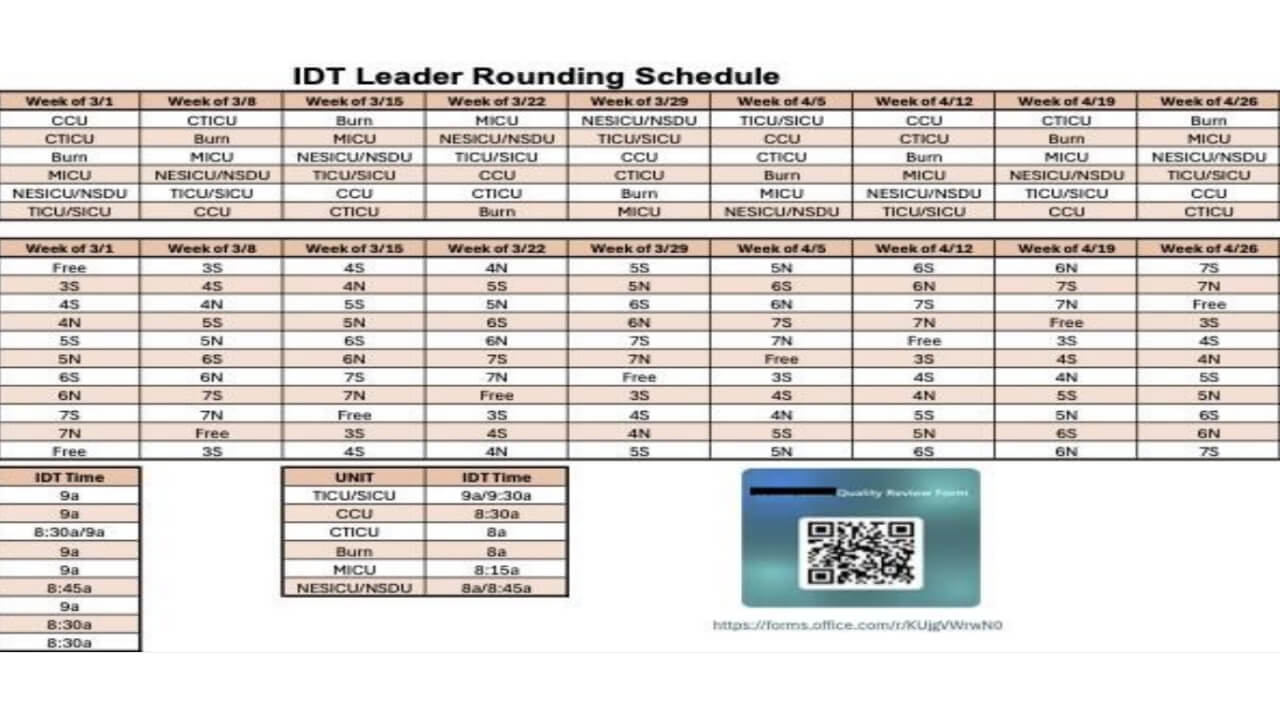
- Problem: Lack of standardized interdisciplinary team (IDT) rounds led to inconsistent communication, delayed discharge planning, prolonged ICU LOS, and decreased satisfaction among patients, families, and staff.
- Aim: Implement a standardized, nurse-led IDT rounding checklist using Plan-Do-Study-Act (PDSA) cycles to improve communication and reduce ICU LOS.
- Objectives: Increase nurse participation in rounds by 30%, improve documentation of daily goals by 25%, and reduce ICU LOS by 20% compared with baseline.
Materials and Methods
- Design: Quality improvement project using iterative PDSA cycles.
- Change framework: Kotter’s 8-Step Change Model to build urgency, engage a guiding coalition, communicate the vision, generate short-term wins, and anchor nurse-led IDT rounds in ICU practice.
- Setting: Adult ICU in a tertiary academic medical center staffed by intensivists, bedside ICU nurses, pharmacists, respiratory therapists, case managers, dietitians, therapists, social workers, and trainees.
- Daily nurse-led IDT rounds at a standardized time, with the bedside nurse initiating each patient presentation.
- Interdisciplinary Rounds Checklist included: patient identifiers; diagnosis/status; overnight events; Generalized Medical Length of Stay (GMLOS); pertinent background; recent procedures /complications; goals for the day; current barriers to downgrade/discharge; explicit ICU discharge criteria; and patient/family questions and education.
- Assistant nurse managers served as project champions, delivering brief 30-minute education sessions with demonstrations and role clarification across shifts.
Measures and Data Collection
- Process measures: checklist completion rate (target ≈80% of eligible encounters), education attendance, and interdisciplinary participation in rounds (especially nurse presence and verbal contribution).
- Outcome measures: ICU LOS, completeness of documentation of daily goals and discharge criteria, and available communication-related patient/family experience indicators.
- Data were de-identified, entered into secure spreadsheets, and audited periodically for accuracy and completeness. Descriptive statistics were used to compare pre- and post-implementation metrics.
Summary
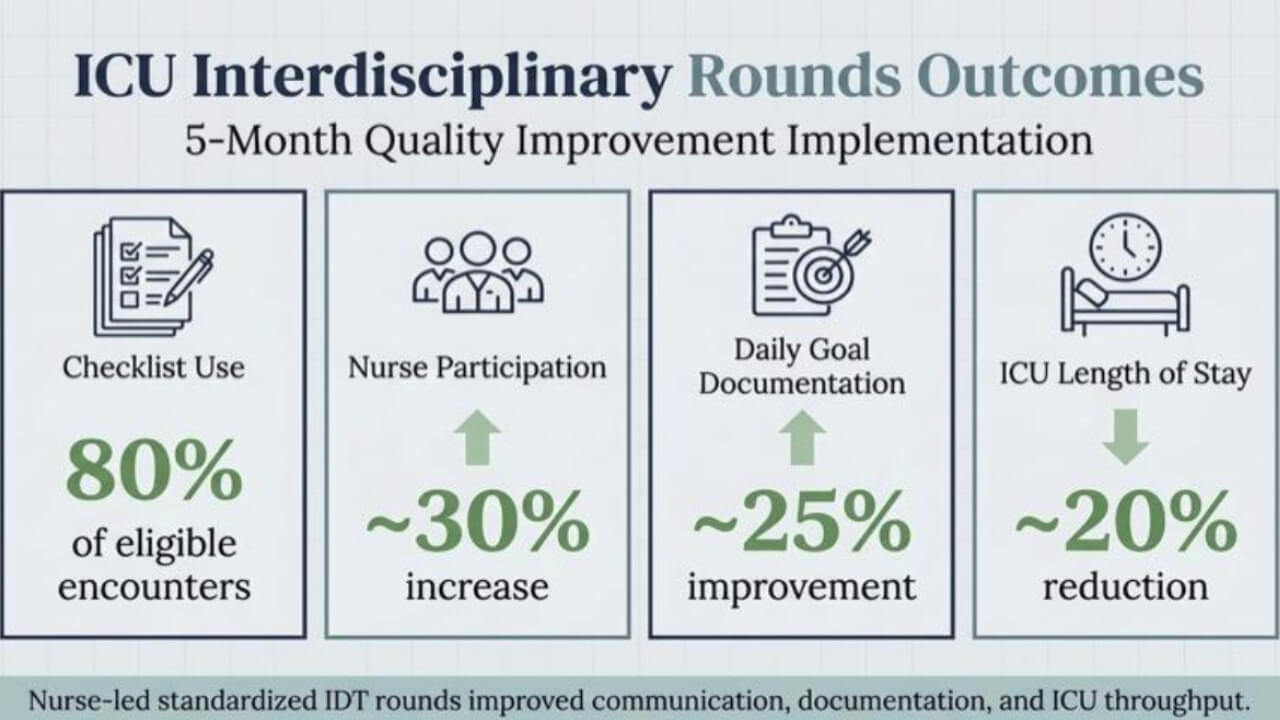
- Over a five-month implementation period, checklist use reached approximately 80% of eligible rounding encounters.
- Nurse participation in rounds increased by about 30% compared with baseline, and documentation of daily goals improved by rougly 25%.
- ICU length of stay decreased by approximately 20%, suggesting meaningful improvements in throughput and potential reduction in excess LOS-related costs.
Conclusion
- Implementing standardized, nurse-led IDT rounds using a PDSA quality improvement approach was feasible in a high-acuity academic ICU and associated with improved communication processes, clearer daily goals, and reduced ICU LOS.
- This low-cost, scalable intervention aligns with the IHI Quadruple Aim by enhancing patient experience, improving population health, reducing costs through shorter stays, and supporting care team function.
- Sustain adherence through ongoing education, feedback, and monitoring of process measures.
- Explore electronic integration of the IDT checklist into the EMR, expand deliberate patient/family participation during rounds, and evaluate longer-term outcomes such as adverse events, readmissions, and staff well-being.
Faculty Mentor
Professional Application
"This project has prepared me for my career by strengthening both my clinical and leadership capacities in advanced practice nursing. Designing and implementing a nurse-led, structured interdisciplinary rounds checklist required me to translate evidence into a practical intervention, navigate real-world barriers, and use quality improvement methods to evaluate impact. That experience mirrors exactly what is expected of a DNP-prepared nurse in complex health systems. Leading the work in a busy ICU also sharpened my skills in interprofessional communication, stakeholder engagement, and change management. I had to collaborate with physicians, assistant nurse managers, case management, and bedside nurses; clarify roles; and negotiate competing priorities while keeping patient outcomes at the center. Working with Kotter’s 8-Step Change Model and iterative PDSA cycles gave me hands-on experience in guiding sustainable practice change rather than one-time projects. Finally, collecting and interpreting run-chart data on ICU length of stay, nurse participation, and daily goal documentation helped me become more confident in using data to drive decisions and advocate for system-level improvements. The combination of evidence appraisal, project planning, frontline implementation, and outcome evaluation has equipped me to step into roles that demand both clinical expertise and the ability to lead meaningful, measurable change in patient care." - Sebastian Morales Barreto, RN, BSN, CCRN, DNP ’26
For Further Discussion
This serves as an overview of the project and does not include the complete work. To further discuss this project, please email A. Sebastian Morales Barreto.
Course Overview
NUR: 811 PBL PBL DNP Project Continuation is a project-based (PBL) learning course is intended for Doctor of Nursing Practice (DNP) students who have not yet completed the required work of either NUR 810PBL, NUR 812PBL, or NUR 814PBL. This continuation course allows students to finish the requirements of the related DNP project course, including writing of chapters and clinical practice hours. Students will collaborate with course faculty to establish specific goals and a timeline for completion of the required work.
Explore Our Areas of Interest
We've sorted each of our undergraduate, graduate and doctoral programs into unique Areas of Interest. Explore these categories to discover which programs and delivery methods best align with your educational and career goals.