


QUIP-RS
Towards Accountability of AI Agents: Distributed Ledger-Based Logging Mechanisms
QUIP-RS
Towards Accountability of AI Agents: Distributed Ledger-Based Logging Mechanisms
Ava Poletski ’28, MBA ’29 completed this project as part of the Interdisciplinary Program for Research and Scholarship.
Overview
Through a PRISMA-aligned systematic review with a Python-based simulation, this research project investigates how AI agent accountability can be achieved through tamper-evident logging, since most autonomous agents in warehouses and logistics still have their records generated and stored by the same operator running them.
Student Researcher

Ava Poletski ’28, MBA ’29
Finance
School of Business
Towards Accountability of AI Agents: Distributed Ledger-Based Logging Mechanisms
Background
Autonomous AI agents are increasingly deployed in logistics systems, warehouses, and smart infrastructure, where they make independent decisions that influence efficiency, safety, and coordination. Despite their growing use, many existing logging mechanisms remain centralized and mutable, making it difficult to ensure accountability or conduct reliable audits.
This project is guided by the question: “How can a logging framework be designed to ensure verifiable accountability in multi-agent AI systems?” It is hypothesized that a hybrid framework combining cryptographic hashing, Merkle tree structures, and blockchain anchoring can reliably detect tampering.
Recent work in blockchain-based logging demonstrates that distributed ledgers can provide secure, tamper-resistant storage for critical records, and adaptive Merkle tree structures show strong efficiency for high-frequency logging environments — but a gap remains between these theoretical models and lightweight implementations that can actually be tested.
Goal
The goal of this project is to design a tamper-resistant logging architecture for AI agent decisions, prototype it within a simulated multi-agent environment, and evaluate whether cryptographic hashing and blockchain anchoring can reliably detect log tampering — contributing a practical, scalable approach to AI accountability grounded in cryptographic verification.
Approach
This project combines a PRISMA-aligned systematic review with a Python-based simulation. Structured search strings targeting AI agent and logging/accountability terminology (2023–2026) narrowed over 1,370 candidate papers down to 23 for synthesis. In parallel, a simulated warehouse environment logs agent actions such as movement, item handling, and task coordination: each event is hashed with SHA-256, hashes are organized into a Merkle tree, and the resulting root hash is optionally anchored to the Solana Devnet. Honest and adversarial scenarios test whether post-hoc tampering is reliably detected.
Figures & Tables
Graphics summarizing the literature landscape and the tamper-evident logging pipeline developed for this project.
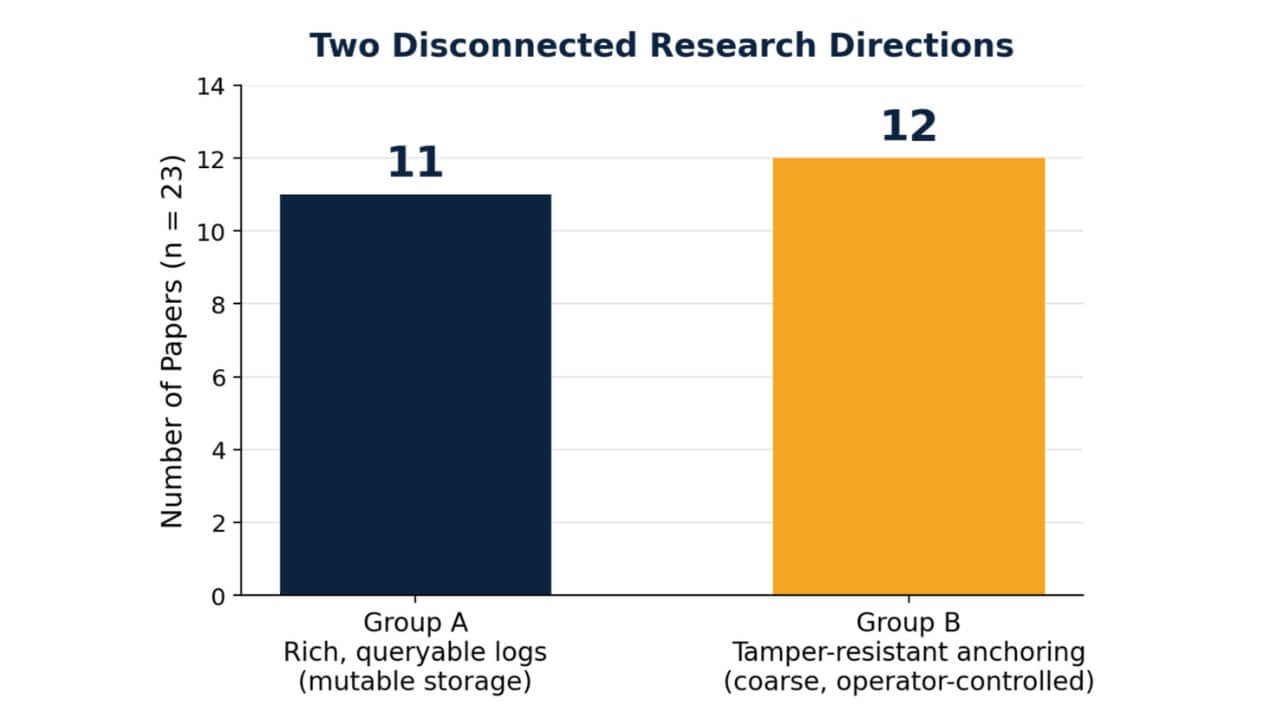
Figure 1. The literature splits almost evenly between rich, queryable logging systems (Group A) and tamper-resistant anchoring systems (Group B) — but no paper connects the two.
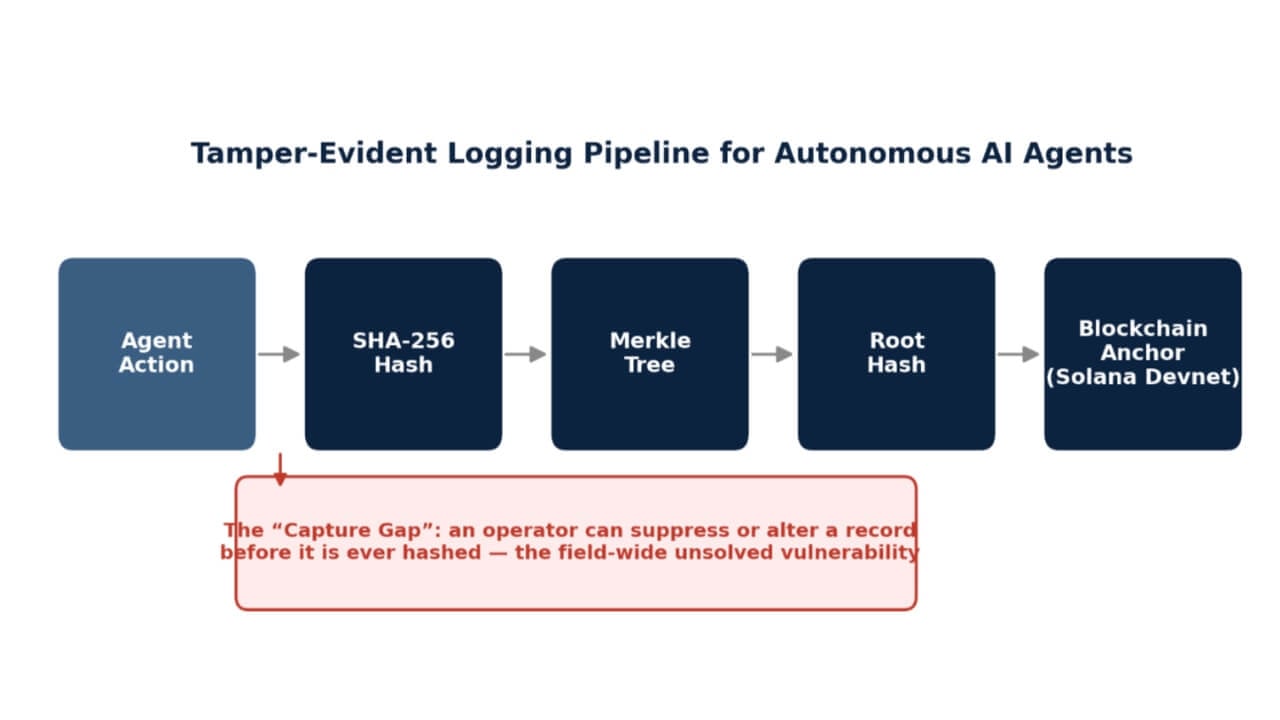
Figure 2. The proposed pipeline hashes each agent action, aggregates hashes into a Merkle tree, and anchors the root hash on-chain. The “capture gap” before hashing remains the field’s core unsolved vulnerability.
Findings & Discussion
Across the 23 reviewed papers, Group A systems provide rich, human-interpretable audit logs but store them in mutable, operator-controlled storage with no cryptographic integrity guarantee. Group B systems reliably protect records once submitted, but that submission is decided by a single privileged actor, and captured logs tend to be coarse. The systems that performed best committed to a narrow, bounded problem rather than a fully verifiable, operator-independent audit trail. No existing architecture solves the capture gap: the moment between when an agent acts and when that action is actually written to a tamper-evident log.
Future Direction
Future work should focus on closing the capture gap, potentially through agent-side attestation or multi-party witnessing at the moment of action rather than after the fact. The prototype should be extended to test adversarial Byzantine agents, high-frequency event loads, and real network latency, and should incorporate privacy-preserving techniques such as zero-knowledge proofs. Longer term, this supports regulatory-grade audit standards for autonomous AI in finance, logistics, and cybersecurity.
References
Phiri (2025). Auditable Agentic AI Systems
Hmimou et al. (2026). AgentSec Dataset
Van der Maden et al. (2026). HEAL Workshop
Su et al. (2026). AuditAgent
Souza et al. (2025). Workflow Provenance
Faculty Mentor
Professional Application
"This project has prepared me for my career in several ways that go beyond the technical content itself. Starting with a question I genuinely did not know the answer to and having to work through 23 academic papers, identify patterns across them, and turn that into an original argument taught me how to think rigorously about a problem rather than just finding information and reporting it back. The research process required me to communicate complex technical ideas to different audiences, whether that was breaking down cryptographic hashing and blockchain anchoring for a general audience in the poster and presentation, or tailoring the same core ideas for industry professionals with different backgrounds when preparing for interviews. That ability to adjust how I explain something depending on who I am talking to is something I expect to use constantly in a professional setting. Working through the cross-case analysis also taught me how to identify what is actually missing in a field rather than just summarizing what exists, which is a skill that translates directly to strategic thinking in any role. Recognizing that no existing system had mapped whether agent records could be verified by an outsider was the insight that made the project original, and that kind of gap analysis is exactly what employers are looking for in people they want making decisions. On a practical level, managing a project with a defined timeline, limited resources, and a real deliverable at the end gave me experience in scoping work realistically and executing under constraints, which is something no classroom assignment fully replicates." - Ava Poletski ’28, MBA ’29
For Further Discussion
This serves as an overview of the project and does not include the complete work. To further discuss this project, please email Tan Gürpinar.
Quinnipiac University Interdisciplinary Program for Research and Scholarship
Open to students of all majors, QUIP-RS provides up to $5,000 in funding for undergraduate students to conduct research or complete creative projects alongside faculty mentors. This intensive 8-week program enables students to develop scholarly skills while encouraging discussion about successes and shortcomings with fellows and mentors.
Explore Our Areas of Interest
We've sorted each of our undergraduate, graduate and doctoral programs into unique Areas of Interest. Explore these categories to discover which programs and delivery methods best align with your educational and career goals.