Quinnipiac University

Political Science

Tracking Social Capital Before and After the COVID-19 Pandemic

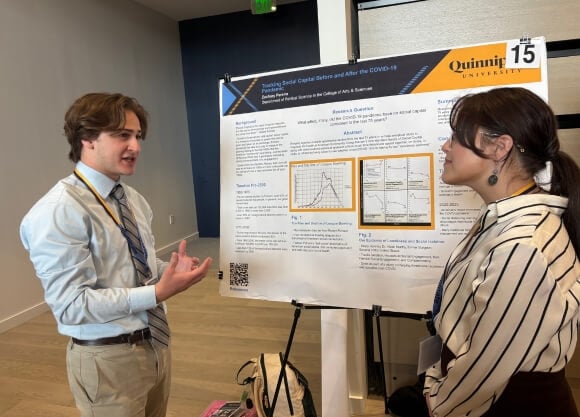
A photo of Zachary Pereira standing in front of poster and speaking to a female listener

Political Science

Tracking Social Capital Before and After the COVID-19 Pandemic

Zachary Pereira ’26 completed this research project as part of PO 408: Senior Seminar.

Overview

This project is a meta-analytical study that pulls together research from the last 75 years of social capital theory, as well as psychological research on the effect of the COVID-19 on American community.

Researcher

Headshot of Zachary Pereira

Zachary Pereira ’26

Political Science

College of Arts & Sciences

Tracking Social Capital Before and After the COVID-19 Pandemic


Research Question

What effect, if any, did the COVID-19 pandemic have on social capital compared to the last 75 years?

Abstract

Bringing together multiple quantitative studies from the last 75 years in a meta-analytical study to diagnose the health of American Community. Using Putnam’s now-standard theory of Social Capital, along with individualized statistical analyses of how much time Americans spend together, on dates, in clubs, or otherwise being social to see whether or not COVID-19 is to blame for our “loneliness epidemic”. 

Background

  • “[Social Capital] is the value of social networks and the norms of reciprocity and trustworthiness that arise from them” - Robert Putnam
  • Similar to financial and real capital, social capital is a measure of success or power that can be given and taken as an exchange. Putnam pioneered this idea as a way to measure the growing feeling in the mid-1900s that the American “community” was fading, and the death of the post World War II generation defined by strong communal and civic engagement.
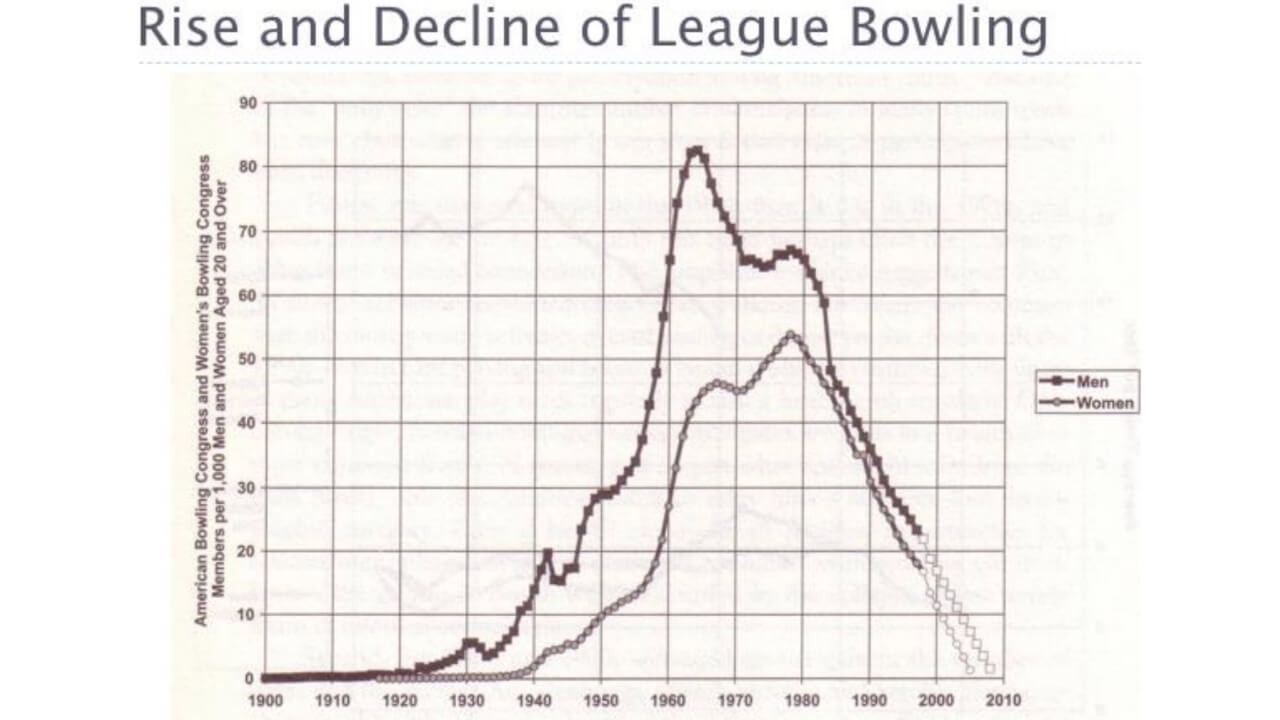
  • Social clubs like the Elks, Moose, and Lions all saw an increase of 100% or more in the post-war era but would see a near complete fall off post 1960s.

Timeline Pre-2000

1950-1975
  • The era closest studied by Putnam, over 50% of people believed that people, in general, live good honest lives
  • Total crime rate per 100,000 rose from less than 2,000 in 1960 to more than 5,000
  • Over 30% of nonagricultural laborers were in a union in 1950
1975-2000
  • By the beginning of this era, the answer to the same question barely surpassed 30%
  • From 1980-2000, the totale crime rate fell from 6,000 per 100,000 to 5,000 per 100,000
  • Less than 15% of nonagricultural laborers were unionized by 2000


Timeline Post-2000

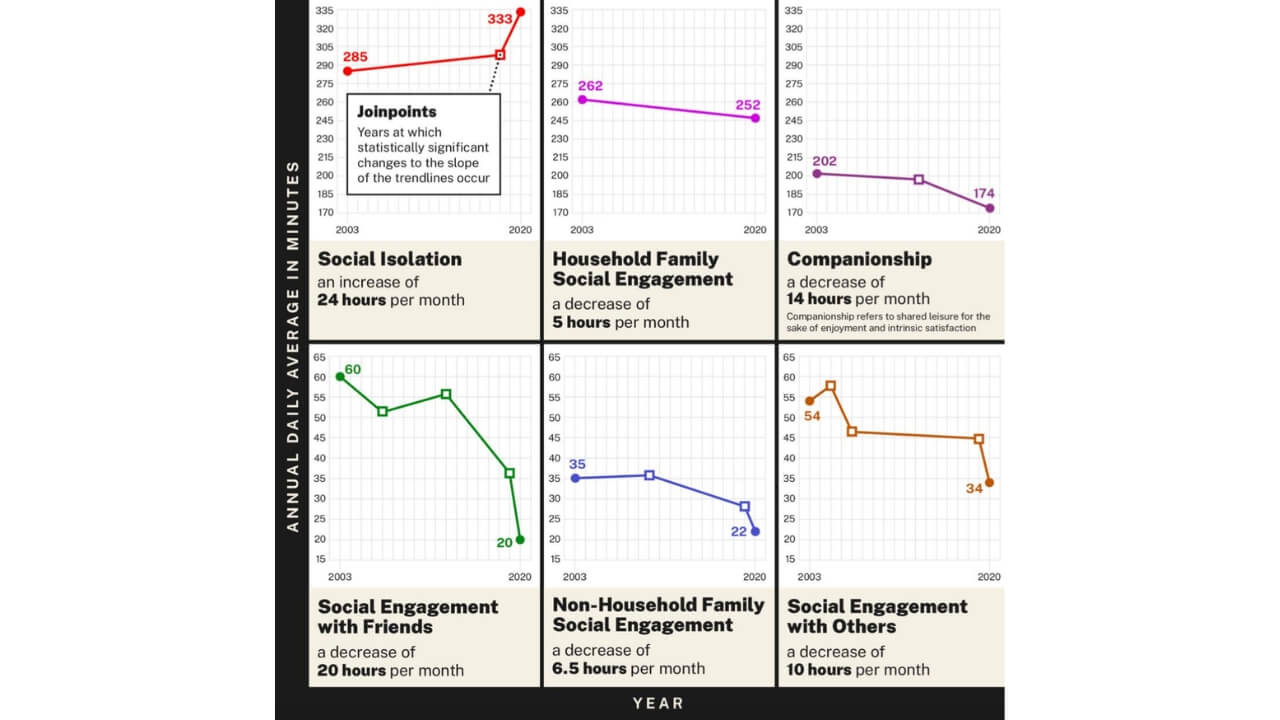
2000-2020
  • Social Engagement with others falls by 10 hours on average a month
  • Social Engagement with Friends falls 20 hours on average a month
2020-2025
  • Americans report en masse feeling lonelier than before the COVID pandemic
  • Social distancing and digital communication discourages Americans from going outside, meeting others
  • Many traditional forms of communication and social engagement are replaced with digital surrogates

Summary

Measuring American Social Capital throughout the last 75 years shows us that the 1950s-60s was an anomalously good time for social health. Since then, American’s have been growing more and more distant, and unlikely to trust one another. 

Conclusions

  • While it cannot be yet ascertained that COVID-19 had a direct impact on Social Capital, it is clear that Americans are more disconnected than ever
  • Social Capital has been falling drastically since the 1980s


For Further Discussion

This serves as an overview of the project and does not include the complete work. To further discuss this project, please email Zachary Pereira. 

Course Overview

PO 408: Senior Seminar is a capstone course for senior political science majors. Students integrate prior learning with a seminar topic announced each year, and prepare and present original research to their peers in the form of a senior thesis, related to a common seminar theme announced each year. The seminar allows students to apply the knowledge and methodology they have learned in previous courses to a particular project.

Explore Our Areas of Interest

We've sorted each of our undergraduate, graduate and doctoral programs into unique Areas of Interest. Explore these categories to discover which programs and delivery methods best align with your educational and career goals.

Social Sciences at Quinnipiac

Law & Public Policy at Quinnipiac