


Psychology
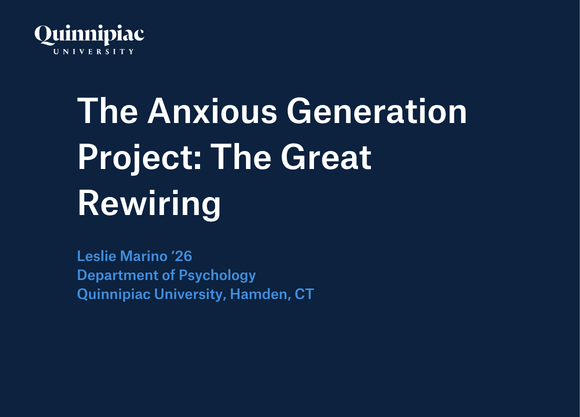
The Anxious Generation Project: The Great Rewiring
Psychology
The Anxious Generation Project: The Great Rewiring
Leslie Marino ’26 completed this project as part of PS 372: Child Psychopathology.
Overview
This project examines how increased smartphone and social media use is linked to rising rates of anxiety, depression and social disconnection in adolescents. It draws on ideas from "The Anxious Generation" and focuses on the shift from play-based childhood experiences to screen-based environments and how that change affects development. Key factors explored include reduced face-to-face interaction, sleep disruption and constant online exposure. Through research and a video presentation, the project raises awareness of how these patterns affect mental health and highlights the importance of more intentional technology use during critical developmental years.
Researcher

Leslie Marino '26
Professional Studies
College of Arts & Sciences
Note: This presentation was delivered virtually. The italicized text beneath each slide's key bullet points is a transcript of the spoken remarks for that section.
The Anxious Generation Project: The Great Rewiring
This presentation looks at how childhood has shifted from being play-based to much more phone-based and what that shift means for mental health.
When researchers talk about "The Great Rewiring," they're basically describing how constant access to phones and social media is changing the way young people connect with each other and how their brains develop.
Roadmap
-
Effects of social media on mental health
-
Why social media affects youth and emerging adults
-
Evidence-based guidance for youth and parents
To keep things organized, I'm going to focus on three main questions.
First, what effect does social media actually have on mental health?
Second, why does social media have such a strong impact on youth and emerging adults?
And finally, based on the research, what advice makes sense for parents and students?
Effects: Depression & Mattering
-
Heavy media use linked to depression and anxiety
-
Mattering = feeling significant to others
-
Low mattering linked to higher distress
-
High mattering acts as a protective factor
So first, let's talk about the effects.
A lot of research shows that heavy social media use is linked to higher levels of depression and anxiety. One study found that an important part of this relationship has to do with something called mattering.
Mattering isn't just self-esteem. It's more about whether someone feels important and valued by other people, like whether they feel they would actually be missed if they weren't around.
In this study, mattering explained about 12.8% of the differences in anxiety and depression levels among adolescents, which is actually a pretty meaningful amount. The problem is that lower feelings of mattering are linked to higher social media addiction. So, when students don't feel valued in real life, they may turn to social media to try to get validation through likes, comments or attention.
Researchers called this mood modulation, basically using social media to try to feel better emotionally. The issue is that this can turn into a cycle. The more someone relies on social media to feel important, the more stress they may actually experience over time.
On the positive side, feeling like you matter to parents and peers can act as a protective factor and reduce the likelihood of developing problematic social media use.
Screen Time vs. Problematic Use
-
Total screen hours alone do not predict outcomes
-
Addictive quality drives distress
-
Withdrawal: feeling upset or disconnected
Before talking about the more serious outcomes, I want to take a moment and clear something up. There's an important difference between screen time and problematic use. They're not the same thing.
One study found that just adding up how many hours teens spent on screens didn't predict suicidal thoughts or behaviors. In other words, the total time alone wasn't the issue. What mattered was whether their use was becoming addictive.
Another 2025 study looked at youth in clinical care in Texas and focused on what they called problematic use. They didn't define it by the time spent online, but by how kids reacted when they couldn't be online, things like feeling really upset or emotionally disconnected from others.
What they found was pretty interesting. Youth who spent a lot of time on their phones but weren't addicted actually had better mental health than youth whose use was more compulsive.
This really stood out to me when I thought about my own experience working full-time and also going to school. I don't always spend a huge amount of time on my phone, especially when I'm busy with work or assignments. But when I'm really stressed or exhausted, I've noticed that I'm much more likely to reach for my phone as a way to mentally escape or decompress.
On days when I can't check it or step away the way I usually do, I do feel more irritable and a little bit more overwhelmed. Not because of the amount of screen time, but because of how much I rely on it emotionally.
That fits really closely with how researchers define problematic use. It's not about hours. It's about how much the app starts to regulate mood and stress.
So, the takeaway here is that this isn't just about screen time. It's about whether social media starts to play too big of a role in how someone feels emotionally.
Effects: Addiction & Suicidality
-
Addictive use trajectories increase risk
-
2-3x higher risk of suicidal thoughts/behaviors
-
More severe symptoms in clinical youth
Because problematic social media use is so closely tied to emotions, it can lead to some very serious outcomes. In a 2025 study, they found that youth whose social media use followed an addictive pattern, meaning that it stayed high or kept increasing over time, were about two to three times more likely to experience suicidal thoughts or behaviors compared to youth with low or nonaddictive use.
The Canard study from 2025 found similar patterns in clinical settings. Among youth who were likely receiving treatment for depression or suicidality, problematic social media use was strongly linked to more severe symptoms.
These youth reported higher anxiety, worse depression and lower psychological resilience than those whose social media use wasn't addictive.
So, when social media use crosses the line into addiction, it doesn't just add stress. It can make it much harder for students to cope and significantly increase the risk for a serious mental health crisis.
Why? Displacement Theory & Sleep
-
Phone time displaces sleep
-
1 hour limit increases sleep
-
Sleep loss worsens mental health
If social media is related to all of these outcomes, the next question is why is this happening?
One explanation is something called displacement theory. The basic idea is that time is limited. If more time is spent on the phone, that time has to come from somewhere else.
This makes sense to me personally because I've had nights where I planned to scroll for just a few minutes before bed, and then it turned into staying up way later than I meant to. The next day, I'm more tired and less focused, which is exactly what displacement theory is describing.
According to research from Davis and Goldfield, one of the biggest things being displaced by social media use is sleep. In their study, adolescents who limited social media use to just one hour per day slept about 30 minutes more per night.
That's crazy.
That increase in sleep was linked to lower stress and lower levels of depression. Haidt also points out that sleep is especially important during puberty, when the brain is undergoing major developmental changes. Without enough sleep, the process doesn't happen as effectively.
Why? Hooked Design & Brain Drain
-
Apps use variable-ratio reinforcement
-
Dopamine hooks developing brains
-
Phone presence drains attention
Another reason social media affects mental health has to do with the way these apps are designed. Social media platforms use what's called a variable-ratio reinforcement schedule, which is the exact system that's used in slot machines.
Basically, you never know when you're going to get that reward, like a comment or a notification, so your brain keeps wanting to check.
To understand why this is so damaging, we really have to look at what's going on in the brain during puberty.
Haidt explains that the frontal cortex, which is the part of the brain that handles executive functioning, self-control, and your ability to say no to distractions, isn't fully mature until after age 20. At the exact same time, the reward centers of the brain are highly active.
So, when app designers use these variable-ratio rewards, they're basically injecting dopamine into a brain that doesn't yet have the biological hardware to hit the brakes and stop scrolling.
This makes social media especially hard to step away from.
There's also the idea of brain drain. Research shows that even when people aren't actively using their phones, just having them nearby can reduce attention and working memory.
In one study, students performed best when their phones were in another room and worse when the phone was sitting on their desk.
For me, the key takeaway here is that phones can drain attention even when people are trying to ignore them.
Why? Social Comparison
-
Exposure to highlight reels
-
Leads to envy and lower self-worth
-
Especially harmful for vulnerable youth
Another factor that plays a role is social comparison. Social media constantly exposes people to highlight reels of other people's lives. For youth who already feel insecure or anxious, comparing themselves to these carefully edited and filtered images can lead to envy and lower self-worth, which can make existing mental health concerns worse.
Advice for Parents & Students
-
Limit social media to 1 hour/day
-
Keep phones out of bedrooms
-
Encourage phone-free school environments
What's important is that the advice coming from this research is both evidence-based and realistic.
One recommendation is limiting social media use to about one hour per day. You might actually think that telling a teenager to cut their social media use down to just one hour a day would cause intense anxiety and make them feel totally left out. I know my teen would.
But Davis and Goldfield actually found the exact opposite. Youth in their intervention group who cut their screen time saw a significant decrease in their fear of missing out, otherwise known as FOMO.
Because they were sleeping an extra 30 minutes a night and probably interacting more in the real world, the anxiety of missing out online actually faded away instead of getting worse.
Surprisingly, another piece of advice is keeping phones out of the bedroom, especially at night. That's pretty much to protect the vital sleep that's needed.
Finally, encouraging phone-free environments at school can help students focus and create more opportunities for real face-to-face interactions.
Summary & Conclusion
-
Social media can function like an addiction for some youth
-
Mechanisms include sleep loss and attention drain
-
Boundaries and real-world connect are protective
So, to sum everything up, social media can function like an addiction for some youth and is linked to several mental health concerns, including depression, anxiety and suicidality. Factors like sleep loss, brain drain and social comparison help explain why these effects occur.
The research doesn't suggest that we need to completely ban phones. That's not what's being told or said. Instead, it shows that setting boundaries, prioritizing sleep, and encouraging real-world connections can make a meaningful difference.
Professional Application
"Through the psychology department at QU, I have been able to explore my interest in mental health more deeply. Working on this project also helped connect those ideas to real-world settings, especially in how behavior and environment impact people over time.
I was also introduced to organizational psychology, which showed me how to apply psychology within the workplace, particularly in leadership and team development. That led me to continue my education beyond Quinnipiac University by pursuing a dual Master's in Organizational Psychology and an MBA." - Leslie Marino ’26
For Further Discussion
This serves as an overview of the project and does not include the complete work. To further discuss this project, please email Leslie Marino.
Course Overview
PS 372: Child Psychopathology provides students with an understanding of child and adolescent problems within the framework of developmental and child clinical psychology. Theoretical and methodological issues are addressed early in the course. Thereafter, the nature, etiology and treatment of a wide range of psychological disorders affecting children from infancy through adolescence is examined.
Explore Our Areas of Interest
We've sorted each of our undergraduate, graduate and doctoral programs into unique Areas of Interest. Explore these categories to discover which programs and delivery methods best align with your educational and career goals.
Explore Social Sciences at Quinnipiac
Explore Education at Quinnipiac