You can turn personalized recommendations back on at any time.
Turn on personalized recommendations?
Get personalized recommendations based on your interests and activity.
Research at Quinnipiac
Faculty Research Initiatives
Research at Quinnipiac
Faculty Research Initiatives
Quinnipiac faculty are deeply committed to active scholarship. Many of our esteemed faculty members work diligently to publish research, drive discovery and expand the boundaries of knowledge in their fields, individually, with one another and with students. With support from the entire Quinnipiac community, our faculty enjoy access to state-of-the-art facilities and ample funding opportunities to power their critical contributions.
Library exhibit highlights the rise of faculty scholarship
The Arnold Bernhard Library's recent showcase of faculty scholarship and publications is more than a celebration of individual achievements — it reflects a broader university trend: the notable rise in faculty-authored work across disciplines.
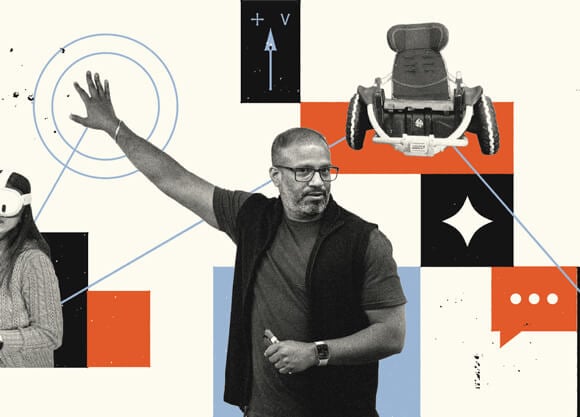
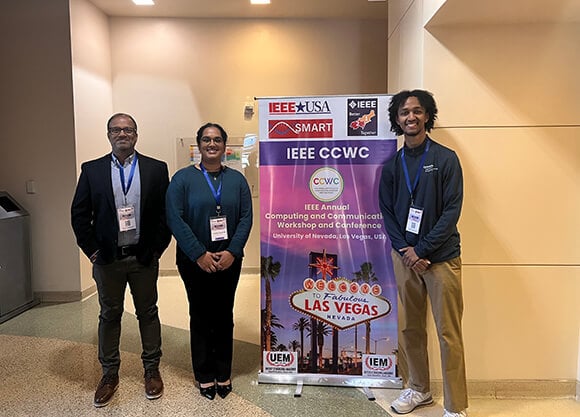
At Quinnipiac University, innovation in artificial intelligence doesn’t start with a code. It starts with a question: Who will this benefit?
For computer science professor Chetan Jaiswal, PhD, and his students, AI advancements aren't measured by novelty, but by their power to restore agency, break down barriers and foster greater independence.
That philosophy came into focus during an occupational therapy event when Jaiswal noticed a young boy struggling to steer his wheelchair while trying to talk to his mother. His independence was compromised by the very tools meant to empower him.
“It was a moment where I thought, ‘We can do better,’” said Jaiswal. “To me, meaningful development means solutions that improve lives. Not just inventing for innovation’s sake.”
That experience sparked the creation of AccessiMove™, a hands-free mobility tool powered by facial gestures and artificial intelligence.
It also marked a milestone as the university’s first technology approved for a U.S. patent.
Quinnipiac faculty have been exploring artificial intelligence for more than a decade, with the first AI-related research publications appearing in 2008. While scholarship on AI has steadily evolved over time, research activity has grown rapidly since 2022, reflecting the technology’s expanding influence across disciplines. Today, AI-focused publications come from a wide range of subject areas and academic departments, highlighting Quinnipiac’s interdisciplinary approach to innovation and discovery.
Faculty in the College of Arts & Sciences are devoted educators who are passionate about teaching and mentoring. Passionate and driven scientists, authors, economists and historians, they epitomize the Quinnipiac mission of turning passion into action.
Pat Boily: Comparative and integrative physiology; Energetics, metabolism, and thermoregulation; Individual physiological variability
Scott Davies: Environmental physiology; Reproduction; Animal behavior; Urbanization
Alexandre de Lencastre: Aging; Diseases of Aging (Alzheimer's Disease, Parkinson's Disease); RNA; Biology; Model organisms; Neurodegenerative diseases
Caitlin Hanlon: Tissue migration in embryonic development; Genetic architecture of the tick salivary gland; Genetics pedagogy
Lisa Kaplan: Environmental Toxicology - The role of plasticizers and plastics in disruption of key animal behaviors and physiological processes
Sarah Lawson: Native pollinator health, nutrition and diversity; Social insects; Evolution of social behavior
Craig Magie: Developmental Biology - Cell movements and shape changes in the early embryo and how these mechanisms have evolved in animals
Courtney McGinnis: Molecular mechanisms of environmental toxins - Endocrine disrupting chemicals, PFAS, and environmental obesogens
Nils Pilotte: Molecular diagnostics and repetitive DNA within the context of neglected tropical disease and parasitic disease
Lise Thomas: Cell signaling - Proteins that interact with Mitogen-Activated Protein (MAP) kinases, either as substrates or by activating them
Trevor Tivey: Beneficial host/microbe interactions, molecular and cellular mechanisms that govern symbioses such as cnidarian-algal and plant root-mycorrhizal fungal symbiosis
Donn Johnson: Valuation of Outdoor Recreation; Sports Economics
Jesse Kalinowski: Disparities in policing; Information Economics; Urban and Labor Economics
Patricia Comitini: Eighteenth-Century Philanthropy and Women's Writing; History of Novel; How to Read Fiction; Wordsworth's "Beggar" Poems; Archival Research & Recovery
Ruth Kaplan: Renaissance English literature - The history of education, history of reading, affect studies, poetry and poetics, and gender and sexuality.
Marissa McKinley: Feminist rhetorics; Medical rhetorics; Writing Across the Curriculum/Writing in the Disciplines; Writing Program Administration
Glenda Pritchett: Medieval literature; Popular culture, including films of Clint Eastwood and TV series Breaking Bad
Nicholas Robinette: Working-class literature; Literature and the environment; Comics
Valerie Smith: American Literature; Travel Writing (fiction and nonfiction)
Kim O'Neill: Reproductive justice; Intersectional analysis of literature and film
Christina Dickerson: Late 19th and Early 20th Century African American and Native American History
Jill Fehleison: Reformation Europe; Catholic/Protestant Relations; Caregiving in EMEurope; Religious Propaganda; Teaching the Reformation
Christine Kinealy: Irish Famine; Abolition; Frederick Douglass; Green and Black Atlantic
Nita Prasad: British colonial India (intersection of gender and medicine/gender and law); History of Indian cinema (Bollywood); Nationalism in 19th-century Hindi-language fiction; Teaching India
David Valone: The history of 19th and 20th century science, technology, and medicine; Popular culture (especially music) in America history
Alan Bruce: Media effects upon crime perception, criminological history and theory
Sam Edwards: Environmental law; International environmental space law; Compensation for lands taken from indigenous groups; Valuation of cultural property; Law and technology
Ashley Marshall: Energy law and utility regulation; Energy affordability and vulnerable populations; Energy insecurity
Kimberly Przeszlowski: Evidence-based policing; Police technology; Public perceptions of police practices
Lori Sudderth: Policies/practices addressing violence against women; Survey research
Louis Deaett: Matrix theory and linear algebra - The intersection with discrete math and combinatorics
Mous-Abou Hamadou: Estimation and asymptotic theory for dependent data; Stochastic processes; Copula models; Markov chains
Lisa Hollman: Teaching and Learning in Foundational Math Courses
Stanley Rothman: The study of baseball data using statistics
Jill Shahverdian: Mathematics Education Research; Scholarship of Teaching and Learning
James Soda, Jr.: Disease modeling; Geometric morphometrics; Statistical applications to ecology, evolution and medicine
Luis Arata: Literary and cultural studies of Latin America and Spain; Interdisciplinary studies in humanities and sciences
Aileen Dever: Rosalia de Castro; Jose Asuncion Silva; Ana Maria Matute; Language pedagogy; Translation
Filippo Naitana: Poetry and Literary Translation; Dante Studies; The Renaissance in a Mediterranean Context
Mary Paddock: Germanic philology, poetics, poetic linguistics; Medieval German literature and culture; German cabaret; Early 20thc German drama - Frank Wedekind; Lyric performance; Visual culture; German film and television; Pedagogy
Fodei Batty: Africa; Sierra Leone; Political Behavior; Political Violence; Human Rights; International Agreements; Development and Modernization
Genevieve Quinn: Partisan polarization in American politics; The politics of gun control
Jennifer Sacco: Women and American politics; Theories of representation
Candice Travis: Critical theory; American political thought; Nationalism; Race/ethnicity; Political violence; Extremism and radicalization; Conspiracy theories; Social/political movements
Scott McLean: American political thought; U.S. generational change in voting behavior; Public opinion; Role of swing states in U.S. presidential elections
Adam Roth: History and philosophy of rhetoric and medicine; Scholarship of teaching and learning; Future of higher education
Adrienne Betz: Neurobiology of Stress, Inflammation, and Affective Disorders
Carrie Bulger: Occupational health psychology, employee stress & well-being; Managing boundaries around work and personal life; Perceived time
Anne Eisbach: Diaper need and period poverty in local community
Gary Giumetti: The impact of workplace stressors on employee health and performance
Joshua Haight: Neural mechanisms of motivation in healthy and diseased states
William Jellison: Contemporary Forms of Prejudice; LGBTQ+ Studies
Penny Leisring: Intimate Partner Violence; Digital Wellness; Problematic Smartphone Use and Mental Health
Jeff Saerys-Foy: How people understand stories; Antiracist pedagogies
Michael Sheehan: Aggressive behavior; Belongingness among college students; Competitive and cooperative behavior; Adolescents' and young adults' interactions with parents and peers
Clorinda Velez: Family mental health; Diaper need, period poverty, and related social determinants of health; Stress and coping; Rumination; Perinatal depression
Angela Walker: Preventing unintentional plagiarism in undergraduate writing in psychology; The efficacy of peer review in research methods courses in psychology; Stereotypes and prejudice regarding those who share suicidal thoughts and those who attempt suicide
Xi Chen: Demography; Social Inequality/Stratification; Spatial Analysis; Quantitative Research Methods; Chinese Ethnic Studies; Applications of Remote Sensing Data
Julia Giblin: Neolithic, Copper, & Bronze Age Europe; Mortuary & Isotope Analysis; Archaeology of the Quinnipiac River Valley; Community Based Archaeology
Hillary Haldane: Oceania; Applied Medical Anthropology; Indigeneity and GBV; Higher Education; Football
Keith Kerr: Social Theory; Justice Studies; Financial Empowerment; Prison Education; China Studies
Lauren Sardi: Human rights and genital cutting; Critical feminist methodology; Scholarship of teaching and learning; Bodies/embodiment; Masculinities; Sexualities
Faculty in the School of Communications are devoted educators who set a precedent for the students they teach and mentor. Passionate and driven researchers, authors, writers, directors and producers, they epitomize the Quinnipiac mission of turning passion into action. Our professors have published numerous books, regularly contribute their scholarship, criticism and reviews to academic journals and news outlets, and bring creative visions to life in films, shorts and documentaries.
Wasim Ahmad: #MeToo in the Newsroom: Image Repair and Allegations of Sexual Misconduct in Journalism Practice (2022)
Katie Place: Toward a framework for listening with consideration for intersectionality: Insights from public relations professionals in borderland spaces in Journal of Public Relations Research (2022)
Katie Place and Alexander Laskin: Framing the strategic R&D paradigm shift in big pharma: A content analysis of pharmaceutical annual reports in Journal of Communication Management (2022)
Alexander Laskin: Investor Relations and Financial Communication (2022)
Lisa Burns: Political Branding and Messaging Strategies in the 2020 Post-Election Campaign in The 2020 Post-Election Campaign: A Communication Perspective (2021)
Lisa Burns: How Media (and Media History) Shape Students’ Individual and Collective Memories of 9/11 in Journalism History (2021)
Wasim Ahmad: Not at Risk? News, Gatekeeping, and Missing Teens in Journalism Practice (2020)
Lisa Burns: Media Relations and the Modern First Lady: From Jacqueline Kennedy to Melania Trump (2020)
Ben Bogardus: An MMJ's Day - An Interactive Timeline - Journal of Media Education in Journal of Media Education (2019)
Katie Place and Hilary Fussell Sisco: A Longitudinal Analysis of the Gender Income Gap in Public Relations From 1979 to 2014 in Media Report to Women (2019)
Alexander Laskin: Social, Mobile, and Emerging Media Around the World (2018)
John Powers: Case Study: Mobile Communication in the Bateyes of the Dominican Republic in Social, Mobile, and Emerging Media Around the World (2018)
When they aren’t shaping young engineers in the classroom, our professors are active in their field and engaged in their own important research. Our faculty are practicing engineers who regularly showcase their work at conferences, sit on panels and publish in a variety of research journals.
Engineering faculty are mentors who lead by example. They advise, guide and encourage students to pursue meaningful undergraduate research and independent study that leads to reports, presentations and even publications of their own.
Applied Ergonomics
Computers & Operations Research
The Heroku Cookbook (Packt Publishing)
IEEE Transactions on Software Engineering
The Joint Commission Journal on Quality and Patient Safety
Journal of Bridge Engineering
Journal of Hydrologic Engineering
Journal of Supercomputing
Materials and Structures
Methods of Information in Medicine
Sustainability
Applying geotechnical engineering towards the conservation of archaeological sites
Applying thermal and electrical technologies to biomedical applications
Artificial intelligence (general)
AI and the role it can play in supporting creativity
Faculty in the School of Education are devoted educators who set a precedent for the students they teach and mentor. Passionate innovators in their field, our faculty regularly showcase their work and research, and publish in a variety of research journals.
Recent Journals
Association of Mexican American Educators Journal
Journal of Science Education and Technology
Journal of Computers in Mathematics and Science Teaching
Faculty in the School of Health Sciences are devoted educators who set a precedent for the students they teach and mentor. Our faculty are practicing researchers and clinicians who regularly showcase their work at conferences, sit on panels and publish in a variety of research journals. They advise, guide and encourage students to pursue meaningful research and independent study that leads to reports, presentations and even publications of their own.
Advances in Social Work
American Journal of Lifestyle Medicine
American Journal of Occupational Therapy
Assistive Technology: The Official Journal of RESNA
Human Molecular Genetics
International Journal of Multiple Sclerosis Care
The Internet Journal of Allied Health Sciences and Practice
JAAPA: Journal of the American Academy of PAs
Journal of Allied Health
Journal of Cardiopulmonary Physical Therapy
Journal of Experimental Orthopaedics
Journal of Human Behavior in the Social Environment
The Journal of Physical Medicine and Rehabilitation
Journal of the Academy of Nutrition and Dietetics
Molecular Psychiatry
OMEGA - Journal of Death and Dying
Proceedings of the National Academy of the Sciences
Translational Psychiatry
American Physical Association Annual Pediatric Conference
American Society for Microbiology Conference for Undergraduate Educators
American Society For Rickettsiology
American Society of Radiologic Technologists
AOTA National Conference
APTA Pediatrics Annual Conference
ASAHP Conference
Eastern Athletic Trainers' Association Symposium
National Athletic Trainers’ Association Annual Meeting and Clinical Symposium
National Center on Forensics Conference
Thomas Jefferson Center for Interprofessional Practice and Education Conference
Our faculty members are practicing nurses with a wealth of clinical experience. They love what they do and also love inspiring that same kind of passion in future generations of nurses, encouraging their students through example to make their own contributions to the field.
Faculty in the Quinnipiac School of Nursing don’t just remain current on innovative nursing practices and procedures — they have a hand in their creation. Professors regularly participate in grant-funded research, publish in numerous trade journals and periodicals, contribute their work to medical and nursing textbooks, and present their many insights at conferences and summits nationwide.
Journal of Clinical Simulation
Journal of Holistic Nursing
Journal of Nursing Administration
Gerontology & Geriatrics Education
Journal of Nursing Education and Practice
Advances in Nursing Science
Clinical Simulation in Nursing
International Journal for Human Caring
Journal of Hospice and Palliative Nursing
American Holistic Nurses Core Curriculum (2nd ed.) Sudbury, Mass.: Jones & Bartlett.
Simulation Scenarios for Nurse Educators: Making it Real. New York: Springer
Holistic Nursing: A Handbook for Practice (6th ed.) Sudbury, Mass.: Jones & Bartlett.
Gerontological Nursing: Competencies for Care (3rd ed.) (pp. 50-73). Sudbury, Mass.: Jones & Bartlett
Robert Wood Johnson Foundation New Careers in Nursing Summit
American Association of Colleges of Nursing
International Technology Conference
American Holistic Nurses Association Annual Conference
National League for Nursing Education Summit
Connecticut Sigma Theta Tau Collaborative Research Day
The faculty at Quinnipiac University School of Law have consistently made significant contributions to the legal field — both within academia and beyond. Our faculty continue to produce impactful publications, including single-author journal articles, book chapters, and notable legal filings, among other works. As a result, their research has earned praise from scholars, practitioners, judges and legislators alike.
Recent Faculty Scholarship
Kevin Barry Professor of Law and Associate Dean for Student Success
Jordan A. Jefferson Director of the Lynne J. Pantalena Law Library and Associate Professor of Law
Considering Trauma-Informed Reference Services in an Academic Law Library, in Exploring Equity, Diversity, and Inclusion in Academic Law Librarianship: Historical Reflections, Present Challenges, and Future Opportunities in Legal Education (Jessica de Perio Wittman & Raquel J. Gabriel eds., forthcoming 2025).
Our faculty are award-winning physicians with decades of practice experience in multiple specialties, as well as passionate educators who have taught in numerous universities, hospitals and other institutions. They have received prestigious fellowships, served as chaired members in international societies and even host nationally syndicated radio shows.
Both clinicians and scholars, our professors contribute to the advancement of medicine through groundbreaking medical research and regularly publish their work in trade journals and magazines.
Our faculty members contribute to the advancement of medicine through groundbreaking research in subjects as diverse as renal disease, veterans’ health issues, public health community program planning and cannabis pharmacology.
Associate Professor Carolyn Macica's research on metabolic bone disorders, namely the most common form of familial childhood rickets — X-linked hypophosphatemia (XLH) — led to the creation of Quinnipiac’s XLH Day program, a patient advocacy event and symposium held at the Frank H. Netter MD School of Medicine.
Advances in Physiology Education
Connecticut Medicine
Clinical Science
American Journal of Physiology
The Physiologist
Academic Medicine
Journal of Molecular Signaling
British Journal of Pharmacology
Journal of Pharmacology and Experimental Therapeutics
From engaging with distinguished scholars and thought leaders to collaborating with scientific researchers and global organizations, our work and research empowers students with the skills, opportunities and confidence to do meaningful work that redefines industries.